
How many days do you need in St Kitts and Nevis? We spent six days exploring both islands: Basseterre and Brimstone Hill Fortress on St Kitts, a rainforest jeep safari, and a ferry day trip to quiet Nevis. We visited in 2013 and have updated the practical details — entry requirements, the new eTA, and driving rules — for 2026.
Travel Month – April
A Caribbean escape to two of the Lesser Antilles’ most underrated islands — where sugarcane plantations meet British colonial forts, rainforest trails dissolve into turquoise bays, and a short ferry ride takes you to a quieter island that feels like time forgot.
A note before we begin: We visited St. Kitts and Nevis about twelve years ago, and these islands have stayed with us ever since. The itinerary and stories below are entirely our own — the places we explored, the roads we drove, the food we ate, the inn we fell in love with. We haven’t been back since. But because we want this to be genuinely useful to anyone planning a trip today, we’ve researched and added current 2026 updates throughout — entry requirements, what’s changed on the ground, and importantly, one beloved place we stayed that has since closed its doors. Our experience is from 2013; the practical facts have been verified for 2026. We think that’s the most honest way to tell it.
Table of Contents
- Why St. Kitts & Nevis?
- Getting There & Getting Around
- Where We Stayed: Ottley’s Plantation Inn
- Day 1 — Basseterre & the Berkeley Memorial Clock
- Day 2 — Romney Manor, Caribelle Batik & the Rum Distillery Ruins
- Day 3 — Brimstone Hill Fortress: The Gibraltar of the Caribbean
- Day 4 — Rainforest Jeep Safari with Greg’s Safaris
- Day 5 — The Southeast Peninsula: Where Two Oceans Meet
- Day 6 — Island Hopping: A Day Trip to Nevis
- What We Missed — And You Shouldn’t
- Practical Tips for St. Kitts & Nevis
2026 Travel Update — What’s Changed Since We Visited
We haven’t returned to St. Kitts and Nevis since our 2013 trip, but we’ve researched current conditions thoroughly so you don’t have to. Here are the three most important practical changes for anyone travelling in 2026:
1. Electronic Travel Authorization (eTA) is now mandatory All passengers arriving by air or sea must complete the eTA before travelling, at www.knatravelform.kn or via the eBorder – St. Kitts & Nevis app (iOS and Android). The fee is US $17 and approval typically comes within 24 hours. Do this before you fly — airlines may deny boarding without it.
2. New digital customs & immigration form (KNA Travel Form) The Online Customs and Immigration Form must be completed within 24 hours of your departure. Travelers with their QR codes ready can use automated kiosks at Robert L. Bradshaw International Airport on arrival. Print a backup copy in case of poor airport Wi-Fi.
3. New sustainability fee A small sustainability fee is now integrated into the entry process, earmarked for protecting the islands’ coral reefs and maintaining the UNESCO-listed Brimstone Hill Fortress.
Safety advisory: The U.S. State Department currently advises travellers to exercise normal precautions — the lowest advisory level, meaning the islands are considered safe to visit.
Why St. Kitts & Nevis?
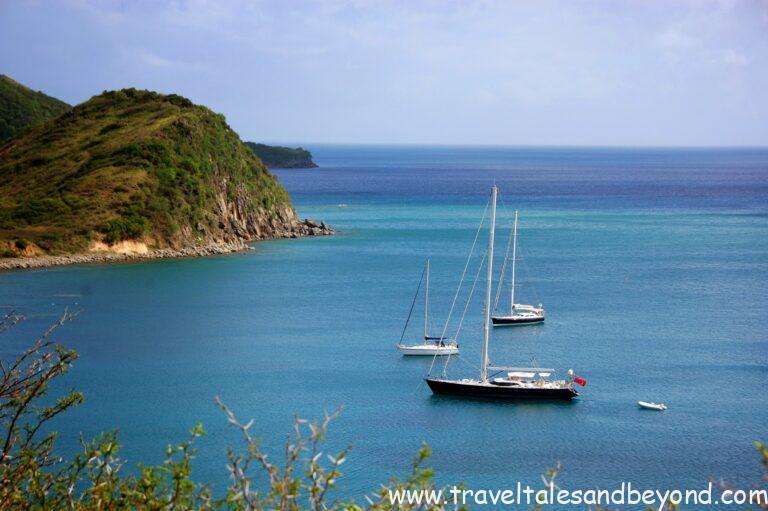
In a Caribbean crowded with resort-heavy islands and cruise-ship towns, St. Kitts and Nevis quietly offer something different. These two small islands — a two-island federation at the northern end of the Lesser Antilles — feel genuinely unhurried. There are no mega-resorts dominating the coastline, no neon strip of souvenir shops. What you get instead is lush volcanic scenery, some of the best-preserved British colonial architecture in the region, a fascinating plantation history, and a warmth from locals that makes you feel less like a tourist and more like a welcome guest.
We visited about twelve years ago, and the islands have stayed with us ever since. St. Kitts — the larger of the two — is anchored by its charming capital Basseterre and dominated by the green cone of Mount Liamuiga. Nevis, just a short ferry ride across The Narrows, is even more tranquil, with a single volcanic peak rising from the sea and a pace of life that borders on meditation. Together, they made for one of the most memorable Caribbean trips we’ve taken — and from everything we’ve read and researched since, the soul of both islands remains very much intact.
Getting There & Getting Around
Getting to St. Kitts: Most international travellers fly into Robert L. Bradshaw International Airport (SKB) in Basseterre, with connections through American, JetBlue, or regional carriers via Antigua or San Juan.
Renting a Car: We hired a rental car for most of our time on St. Kitts — highly recommended for exploring the island at your own pace. One important thing to know: you’ll need a local driver’s permit, which costs around US $24 for three months. Your rental company can usually arrange this for you. Also note that in St. Kitts, driving is on the left.
Getting to Nevis: There are two main ways to cross The Narrows between St. Kitts and Nevis:
- Passenger ferry from Basseterre Port to Charlestown Pier — the most common option for foot passengers, taking about 25–45 minutes. Multiple sailings daily.
- Car ferry (Sea Bridge or iConnect) — departs from Major’s Bay on St. Kitts’ Southeast Peninsula and can carry your rental vehicle across to Nevis. This is how you’d take a car, though note that many rental companies have restrictions on cross-island travel, so always check with your provider first. If they won’t allow it, car rental is available on Nevis independently.
Where We Stayed: Ottley’s Plantation Inn
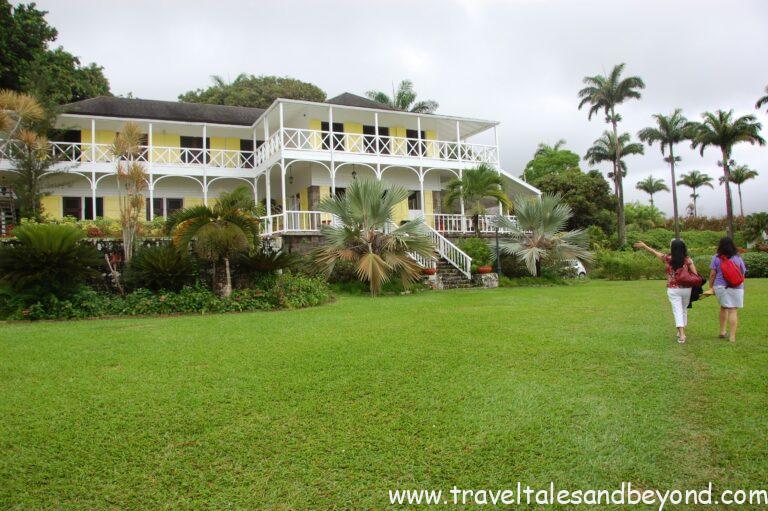
One of the absolute highlights of our trip was where we stayed: Ottley’s Plantation Inn, and it deserves far more than a passing mention. Sitting 500 feet above sea level on the lower slopes of Mount Liamuiga, the inn is built on a sugar plantation originally established by Englishman Drewry Ottley in the early 1700s. It remained in the same family for over 200 years before being transformed into a boutique inn in 1988 — and the family warmth never left with the conversion.
The centrepiece is the Great House — a graceful two-storey plantation building with wraparound verandas, sweeping views over the Atlantic coastline, and interiors full of hardwood floors, antique furnishings, and the kind of unhurried elegance that large hotels simply cannot manufacture. Accommodation spreads across the Great House and a series of stone plantation cottages dotted through the lush gardens, with the more indulgent “Supreme” cottages featuring private plunge pools and whirlpool tubs.
The grounds are extraordinary. A spring-fed 65-foot pool is nestled within the old sugar mill stone ruins — one of the most atmospheric places to take a swim anywhere in the Caribbean. Beyond that, there are manicured ornamental gardens, a palm forest, a meditation garden overlooking the rainforest canopy, and trails leading directly into the rainforest itself. The Royal Palm Restaurant, set within the plantation’s old boiling house walls, serves daily-changing Caribbean fusion menus that draw locals and guests alike.
What sets Ottley’s apart from any resort, though, is the hospitality. The family owners made rounds at dinner each evening, stopping at every table. There was a weekly rum punch party in the Great House. The staff greeted you by name. It’s the kind of place that makes you feel like a houseguest rather than a paying customer — and that is increasingly rare.
⚠️ Important update for 2026 readers: Ottley’s Plantation Inn is currently closed and for sale. The property was sold in 2017 and has been locked down since, with the grounds currently unoccupied. It remains one of the most beautiful plantation estates in the Caribbean and there is hope it will reopen under new ownership — but if you’re planning a trip now, you’ll need to look at alternatives. For a similar plantation experience on St. Kitts, ask locally about current boutique inn options, or consider Montpelier Plantation & Beach or Golden Rock Inn on Nevis for that same intimate, historic character.
Day 1 — Basseterre & the Berkeley Memorial Clock
We arrived into Basseterre in the late afternoon and headed straight into town. The capital of St. Kitts is compact, walkable, and full of character — a blend of British colonial architecture, Caribbean colour, and everyday local life that feels refreshingly authentic compared to more tourist-polished Caribbean destinations.
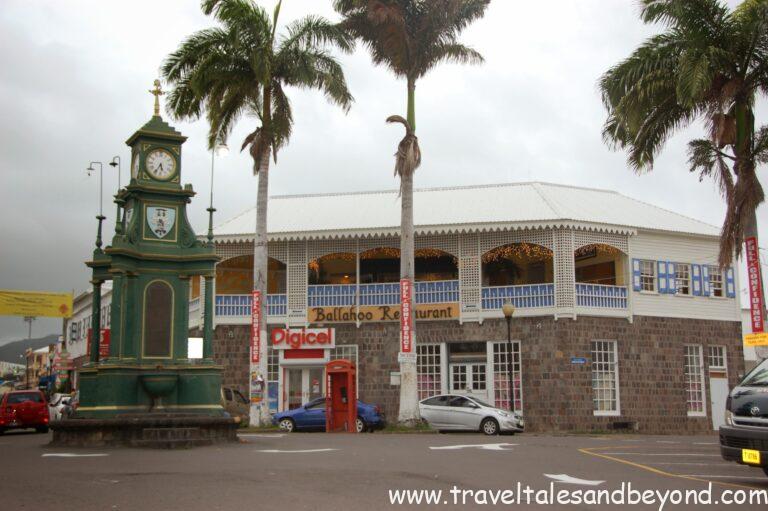
The heart of the city is The Circus — a roundabout styled after Piccadilly Circus in London, centred on the elegant Berkeley Memorial Clock Tower, a green cast-iron Victorian clock tower erected in 1894 in memory of a former government official. It’s charming, photogenic, and very much the focal point of downtown life.
Right on the Circus, we had dinner at the Ballahoo Restaurant — a two-storey colonial building with blue-railed balconies overlooking the clock tower. It’s a Basseterre institution, with Caribbean-influenced dishes and a lively atmosphere that’s hard to beat for a first evening meal. There’s also the obligatory British red phone box still standing on the street below, a curious colonial relic among the palm trees.
After dinner, we wandered the nearby waterfront and along Independence Square — a quiet, pleasant park with a central fountain, ringed by Georgian townhouses. It was the perfect, low-key introduction to the city.
Later, we made our way to Frigate Bay — just a short drive east of the city centre — to catch a first glimpse of De Strip, the famous string of beach bars on South Frigate Bay. By evening the place had come alive: music drifting across the sand, the smell of grilled seafood in the air, and a mix of locals and visitors spilling out of the shacks. Even just a drink and a wander along the beach was enough to understand why The Strip is such a fixture of Kittitian social life. It set the tone for the whole trip perfectly — casual, warm, and entirely unhurried.
Day 2 — Romney Manor, Caribelle Batik & the Rum Distillery Ruins
Our second day took us inland into the green hills above Basseterre, to one of the island’s most atmospheric historic sites: Romney Manor (also known as Wingfield Estate).
The estate dates to the 17th century and was once the property of an ancestor of Thomas Jefferson. Today it’s home to Caribelle Batik, a working studio where artisans create hand-painted batik fabric using traditional Indonesian wax-resist techniques adapted to Caribbean themes and colours. Watching the fabric being made — wax applied, dye layered, patterns revealed — is genuinely absorbing. The gift shop is very dangerous for the wallet: flowing shirts, wraps, and wall hangings in vivid tropical colours. We bought more than we intended to.
The estate grounds themselves are beautiful — a formal tropical garden surrounding the old plantation great house, with ancient saman trees (some said to be over 350 years old), flowering plants, and the peaceful kind of stillness you find in places with deep history.
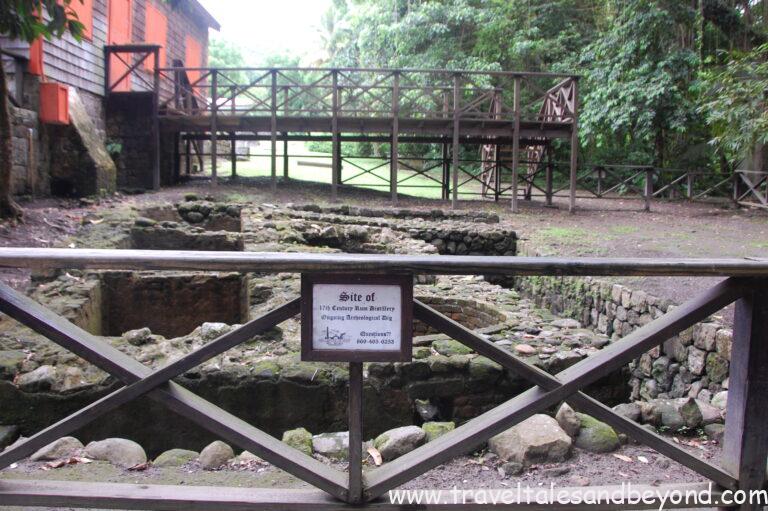
But the most historically striking feature is tucked at the back of the estate: the ruins of a 17th-century rum distillery, currently the subject of an ongoing archaeological dig. A wooden walkway leads you over the excavated stone foundations — you can see the remnants of fermentation tanks, grinding equipment bases, and stone walls slowly being uncovered after centuries underground. A small sign marks it simply as “Site of 17th Century Rum Distillery — Ongoing Archeological Dig.” For a history lover, it’s one of those quiet, unhyped spots that turns out to be the most memorable part of the day.
Tips for Romney Manor / Caribelle Batik:
- Located near Old Road Town, about 20 minutes from Basseterre
- Free to enter the estate grounds
- The batik studio is a worthwhile stop — allow an hour
- Go in the morning when it’s cooler and less crowded
Day 3 — Brimstone Hill Fortress: The Gibraltar of the Caribbean
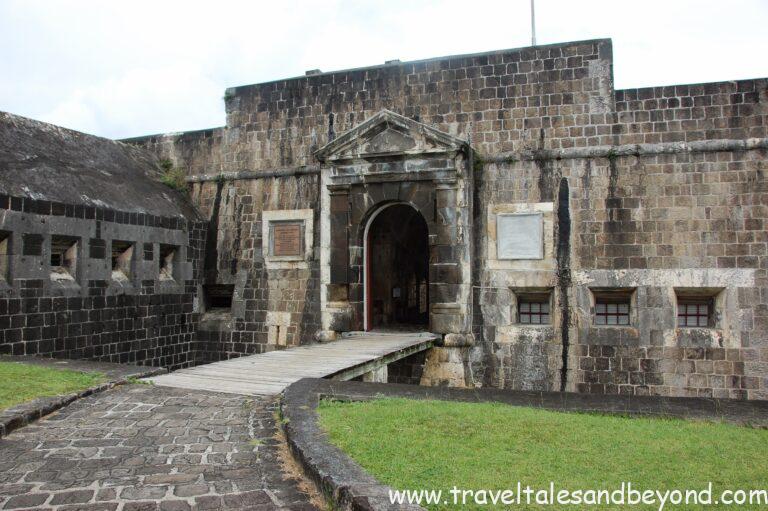
If you visit St. Kitts and only do one “big” attraction, make it Brimstone Hill Fortress. A UNESCO World Heritage Site since 1999, this extraordinary British military fortification sits 240 metres above sea level atop a dramatic volcanic hill, its black stone battlements rising from the green hillside like something from a medieval epic.
The nickname “Gibraltar of the Caribbean” is entirely earned — and I say that having stood on the Rock of Gibraltar itself. Both share that same quality of almost defiant verticality, the sense that the fortification and the landscape have fused into a single defensive statement. If you’ve been to Gibraltar, you’ll feel the echo immediately. If you haven’t, it belongs on your list too.
Construction began in the 1690s and continued for over a century, built largely by enslaved Africans using the volcanic stone of the hill itself. The result is a fortress of remarkable scale and sophistication — with multiple bastions, a citadel, barracks, a hospital, and cannons still pointing out across the Caribbean Sea and towards neighbouring islands.
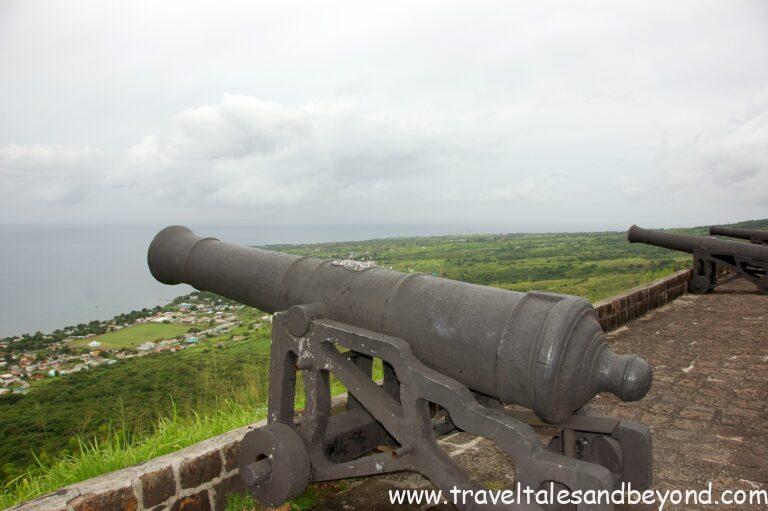
Standing on the upper ramparts with a cannon barrel in the foreground and the entire green coastal plain of St. Kitts laid out below you — with the ocean glittering in the distance — is one of those views that rewards the drive up the hill tenfold. On a clear day, you can see Nevis, Sint Eustatius, Saba, and St. Barths.
At the base of the hill, there’s a Visitors’ Centre, a small museum, and a gift shop. We had lunch at the Brimstone Canteen on site — a simple, casual spot that does the job perfectly after a morning of walking the ramparts. Allow at least two hours to explore properly — the fortress is larger than it looks from below.
Brimstone Hill Fortress tips:
- Entrance fee applies; the site is well-maintained and signposted
- Wear comfortable shoes — there’s a fair amount of walking on uneven stone
- Go early morning for the best light and cooler temperatures
- The drive up the hill in a rental car is perfectly manageable
Day 4 — Rainforest Jeep Safari with Greg’s Safaris
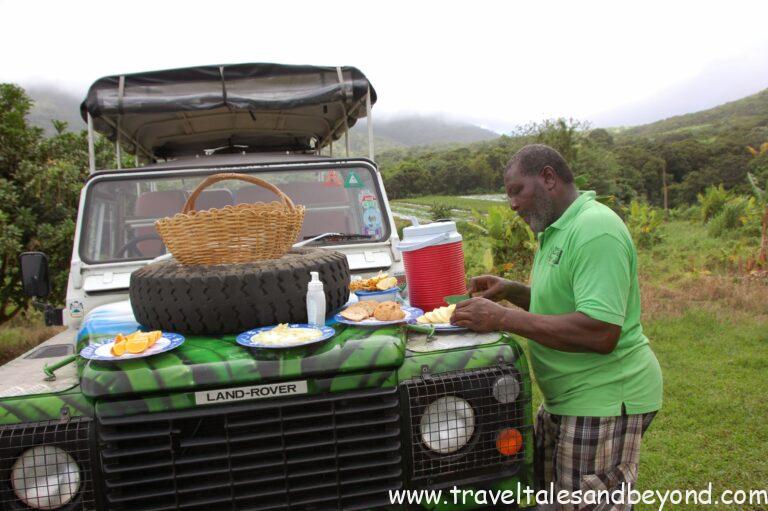
One of the most memorable days of the trip was our guided jeep safari with Greg’s Safaris — and looking back, it’s no surprise they’re consistently rated the number one tour operator on the island on TripAdvisor. We were picked up in one of Greg’s signature open-sided Land Rover Defenders, painted in wild green tropical camouflage, by our guide — a wonderfully warm and knowledgeable local man who turned out to be part driver, part botanist, and part chef.
Greg’s Safaris is the only tour company in the Federation that uses 4×4 Land Rovers for touring on both islands, and the specially modified open-sided seating means you’re immersed in the landscape rather than watching it through a window. The route wound up through the hills and into St. Kitts’ lush rainforest, which covers the upper slopes of Mount Liamuiga. Here the landscape shifts dramatically from the dry coastal scrub — you’re suddenly surrounded by towering tree ferns, dripping mossy boulders, and the sound of rushing water. We hiked along a jungle stream through dense tropical undergrowth, the kind of emerald green, rock-strewn creek that feels entirely removed from the Caribbean postcard version of the island.
The highlight? At some point mid-tour, our guide pulled over in a meadow with misty volcanic peaks in the background and proceeded to lay out a full spread of fresh fruit, local bread, and snacks across the bonnet of the Land Rover, using the spare tyre mount as a sort of improvised buffet table. Sliced pineapple, orange wedges, local cookies, a thermos of something warm — it was entirely unexpected and completely delightful. The ultimate Caribbean picnic.
Book Greg’s Safaris: Website gregsafaris.com · Tel: +1 869-662-6002. Book in advance — tours fill up quickly, especially when cruise ships are in port. Greg offers several tour options including the Cross Country 4×4 Safari, the Sugar Heritage Tour, and the Valley of Giants rainforest hike.
Day 5 — The Southeast Peninsula: Where Two Oceans Meet
No trip to St. Kitts is complete without driving the Southeast Peninsula — and specifically, stopping at the viewpoint that makes you pull over and just stare.
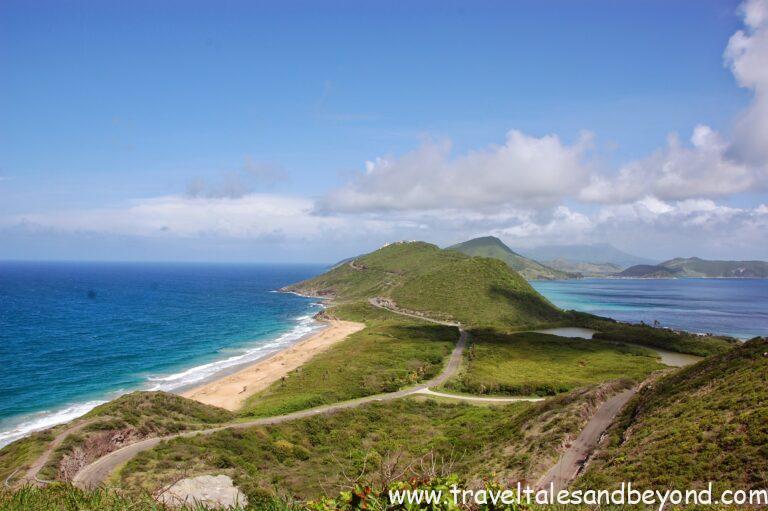
The peninsula is a narrow finger of volcanic hills stretching south from the main island, connected by the Dr. Kennedy Simmonds Highway, a smooth road that winds dramatically through the green hills with the sea on both sides. From the elevated lookout point, you can see one of the Caribbean’s most striking natural contrasts: the deep, churning Atlantic Ocean on the eastern side and the calm, impossibly turquoise Caribbean Sea on the west, separated by just a thin strip of golden beach and scrubland. On a clear day, Nevis sits perfectly framed in the distance.
The peninsula itself is sparsely developed — mostly undisturbed hills, salt ponds, and quiet beaches — which makes it feel like a genuinely wild edge of the island. The viewpoint requires no hiking; you can pull over directly from the road. But do allow time to simply stand there and take it in. It’s one of those views that doesn’t photograph as well as it looks in real life, which is saying something given how good the photos turn out.
We followed the viewpoint with lunch at the Reggae Beach Bar & Grill at Cockleshell Bay, just at the tip of the peninsula — cold drinks, grilled seafood, feet in the sand, and Nevis sitting right across the water. It’s the perfect way to end a morning on the peninsula and exactly the kind of low-key Caribbean lunch that makes you wonder why you’d ever go anywhere else.
Note for 2026 visitors: The Southeast Peninsula is also where the Sea Bridge and iConnect car ferries depart from Major’s Bay if you’re planning to take a rental vehicle across to Nevis.
Day 6 — Island Hopping: A Day Trip to Nevis
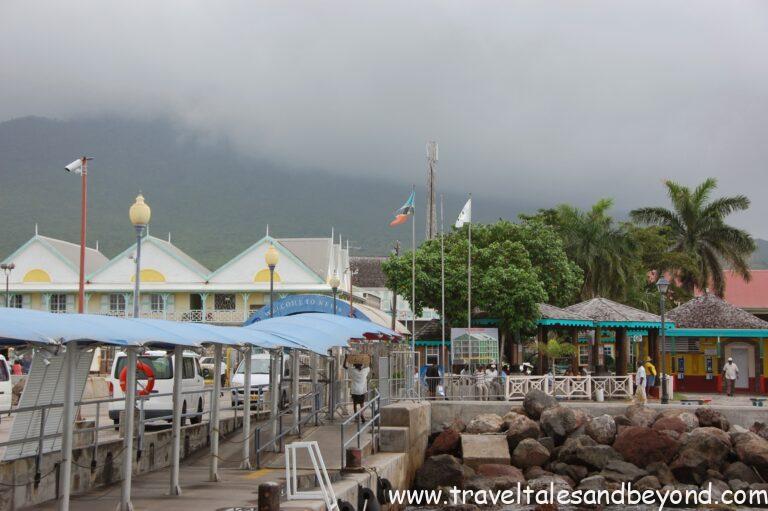
No visit to St. Kitts is complete without crossing The Narrows to its sister island. We took the passenger ferry from Basseterre Pier — a straightforward crossing that takes about 30–45 minutes and costs very little, with a clear view of Nevis Peak emerging from its perpetual halo of cloud as you approach.
Arriving at Charlestown Pier — the tiny, colourful port of Nevis’ capital — the first thing you notice is how quiet it is compared to Basseterre. The pace drops noticeably. Charlestown is charming in a completely unpolished way: painted wooden shopfronts, a small market, and the kind of main street where everyone seems to know everyone.
Nevis is above all an island of plantation history and natural beauty. The great Nevis Peak dominates everything — a near-perfect volcanic cone rising to almost 1,000 metres, usually cloud-capped. The island was once the wealthiest sugar-producing island in the British Caribbean, and the remains of dozens of plantation estates dot its lower slopes.
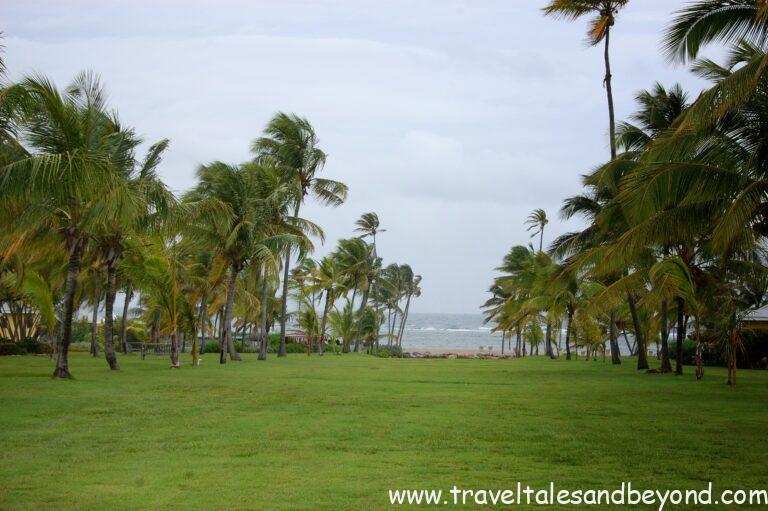
We explored independently on foot in Charlestown and by our rental car for the rest of the island, and made our way to Nisbet Plantation Beach Club for lunch — one of the finest meals of the entire trip. Originally built in 1778, Nisbet Plantation is the Caribbean’s only historic plantation inn set directly on a beach, and even if you’re not staying there, non-guests are welcome for lunch at the Sea Breeze Beach Bar, a laid-back open-air restaurant right by the water. Cold drinks, fresh seafood, hammocks swaying nearby, and a long avenue of tall palms leading down to the beach — it’s the kind of place that makes an afternoon disappear entirely. The Sea Breeze Beach Bar serves cocktails, lunch, and snacks, with waiters even delivering drinks to beachside hammocks. Highly recommended even as a non-guest.
Ferry options — St. Kitts to Nevis:
- Passenger ferry: From Basseterre Pier to Charlestown, ~30–45 min, very affordable. Multiple daily sailings.
- Car ferry (Sea Bridge / iConnect): Departs from Major’s Bay (SE Peninsula) to Cades Bay or Long Point on Nevis. Costs around EC$75 per car + EC$20 per passenger one way. However, many rental companies prohibit taking their vehicles on the ferry — always confirm with your car hire company first. If they don’t allow it, you can hire a car separately on Nevis.
Practical Tips for St. Kitts & Nevis
When to go: December to April is peak season — drier, with the best weather. We visited in the summer, which meant occasional overcast skies (as the photos show!) but also fewer tourists and lower prices. Hurricane season runs June–November.
Getting a driver’s permit: Required even with an international license. Cost is around US$24; your rental agency can usually facilitate it.
Currency: Eastern Caribbean Dollar (XCD), though US dollars are widely accepted. EC$2.70 ≈ US$1.
Driving: On the left. Roads vary — fine around Basseterre and the main tourist circuit, rougher in the hills. A regular car handles most sights; a 4WD is useful for exploring off the main road.
Don’t miss:
- The Southeast Peninsula — a narrow strip of dramatic hillside connecting to secluded beaches, best explored by car or on a tour
- Pinney’s Beach on Nevis — a long, palm-fringed stretch and the main beach of the island
- The Circus in Basseterre in the evening, when locals gather and the restaurants open up
- Caribelle Batik at Romney Manor — genuinely worth the stop and the shopping

What We Missed — And You Shouldn’t
Looking back, there are a handful of things we either skipped or simply ran out of time for. Consider this our honest “go back and do it properly” list — all verified as current and worth building into your itinerary.
🚂 The St. Kitts Scenic Railway (Sugar Train)
This is probably the single biggest gap in our trip, and it’s still running in 2026. The narrow-gauge railway was originally built between 1912 and 1926 to carry sugarcane from the island’s plantations down to the mill in Basseterre. Today it’s one of the Caribbean’s most memorable tourist experiences — a roughly three-hour loop around the island. One thing to know: only 18 of the 30 miles are covered by the double-decker train itself, with the remaining 12 miles completed by sightseeing bus — so it’s a combined rail-and-road experience rather than a pure train ride. That said, the coastal scenery, the sugar estate ruins, Mount Liamuiga looming above, and the included rum punch and cocktails make it a genuinely special few hours. Book in advance as it fills up quickly when cruise ships are in port.
🌋 Mount Liamuiga Volcano Hike
A very different experience from the Greg’s Safaris jeep tour — this is a proper full-day guided hike up to the crater rim of St. Kitts’ dormant volcano, rising to 3,800 feet through dense cloud forest. The trail is challenging but the reward is standing on the rim of a crater lake surrounded by rainforest, with views stretching across the entire island and out to neighbouring islands. You’ll need a guide — this is not a hike to attempt solo — and an early start. Greg’s Safaris also offers this as a tour option. Allow a full day and bring plenty of water.
🏛️ Alexander Hamilton’s Birthplace, Nevis
If you make it to Charlestown on Nevis, this is a must. The Museum of Nevis History is housed in the building where Alexander Hamilton — Founding Father of the United States, first Secretary of the Treasury, and now the subject of a certain Broadway phenomenon — was born in 1755. It’s a modest but genuinely interesting museum covering both Hamilton’s life and the broader plantation history of Nevis. Worth an hour of your time in Charlestown and easy to combine with the ferry day.
🤿 Snorkelling & Diving
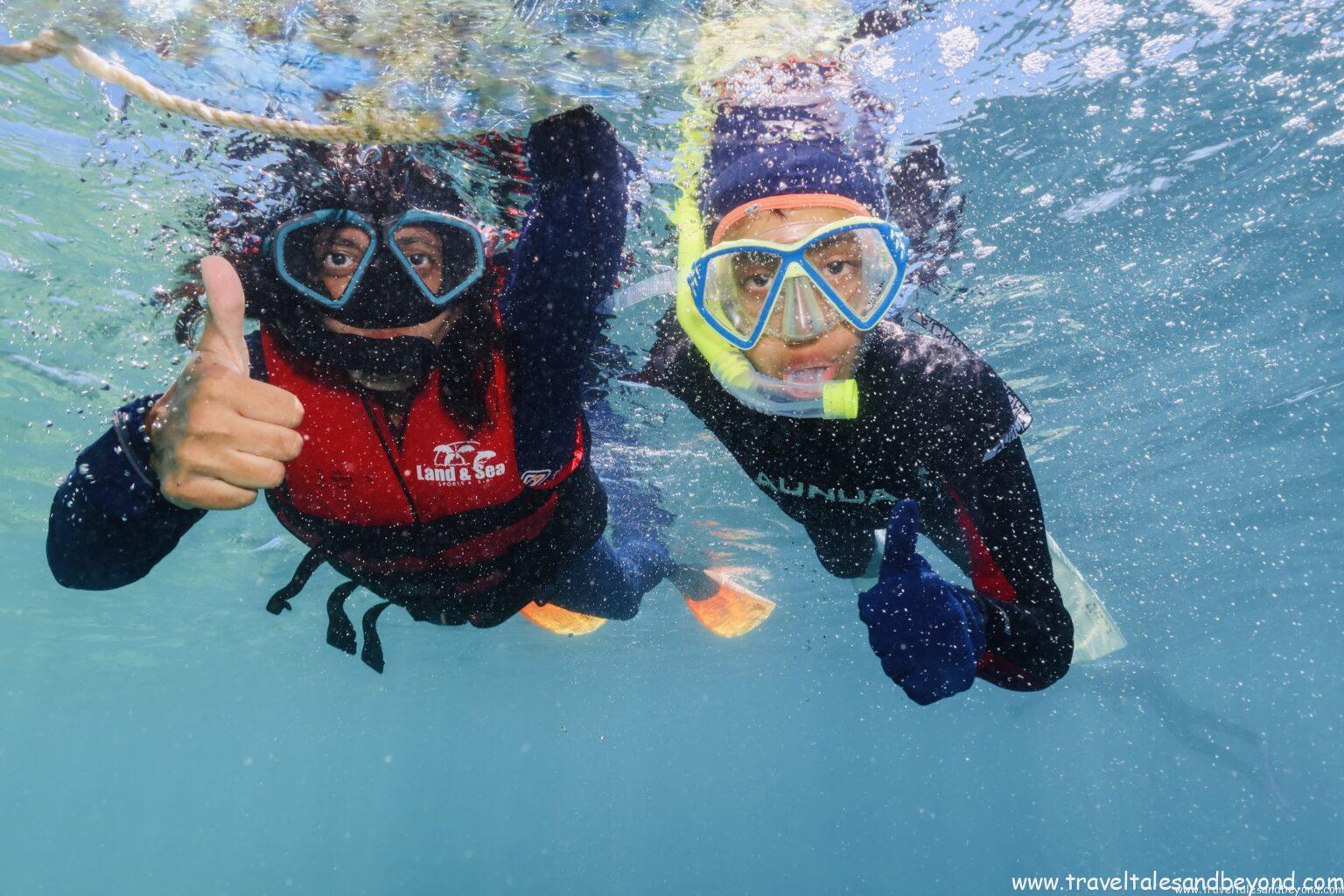
The underwater world around both islands is world-class and something we didn’t touch at all. The waters around St. Kitts and Nevis are home to historic shipwrecks, geothermal volcanic vents on the seafloor, coral gardens, nurse sharks, moray eels, and an abundance of reef fish. Even if you’re not a certified diver, a snorkelling trip off Cockleshell Bay or Oualie Beach on Nevis is well worth half a day. Several dive operators are based on both islands.
If you loved reading this post, here are some other posts. For complete list click here
Shaminee is a U.S.-based mom and family travel blogger who designs detailed itineraries for her own family and turns them into practical guides for others. Her goal is to make family travel simpler, more organized, and more enjoyable.
Read more →
Discover more from Travel Tales And Beyond
Subscribe to get the latest posts sent to your email.