On our way back from an unforgettable morning at Ngorongoro Crater, we stopped at a Maasai village — and it turned out to be one of the most memorable parts of our Tanzania safari. This was part of our 7-day Tanzania safari itinerary and if you’re packing for a similar trip, check out our Tanzania Safari Packing List.
We were there for only about 30 minutes, but that short visit packed in a surprising amount: a lively welcome dance, a look inside a traditional home, a fire-making demonstration, and time to browse handmade jewelry and other crafts.
What stayed with us most wasn’t simply seeing traditional Maasai customs. It was seeing how this particular community was balancing those traditions with education, tourism, employment, and other aspects of modern life.
Here’s what we saw, what we learned, what our visit cost, and what you can expect if you visit a Maasai village in Tanzania.
At a Glance
- Location: Near the Ngorongoro Conservation Area, northern Tanzania
- Cost: $50 per person for our visit
- Duration: Approximately 30 minutes
- How we arranged it: Through our driver-guide
- What we experienced: Welcome dance, house visit, fire-making demonstration, school, and handicraft market
- Best souvenir: Maasai beaded jewelry

How We Arranged the Visit
This stop wasn’t part of our original safari camp itinerary. Our driver-guide arranged it for us on the way back from Ngorongoro Crater.
We paid $50 per person and spent about 30 minutes in the village. It was a short visit, but it was packed: the welcome dance, a walk through the compound, the fire-making demonstration, and time at the small market where women from the community sold their handicrafts.
If you’re interested in doing something similar, ask your safari operator or driver-guide whether a village visit can be arranged. The exact experience and price can vary depending on the community and operator, so it’s worth asking what is included before you go.
Tip: If a village visit isn’t already included in your safari itinerary, ask your driver-guide about arranging one along the route to or from Ngorongoro Crater or the Serengeti.
Who Are the Maasai?
The Maasai are a semi-nomadic pastoralist people whose communities are found across northern Tanzania and southern Kenya. They’re particularly well known for maintaining important cultural traditions centered around livestock, family, community, ceremonies, clothing, and beadwork. Physically, the people we met were mostly tall and lean.
It’s worth remembering that there isn’t one single “Maasai lifestyle.” Communities differ, and daily life continues to change as people participate in education, tourism, wage employment, markets, and healthcare alongside traditional practices.
At the village we visited, our guide explained that extended families live together within a larger community, with households organized around individual family units.
We also learned that polygyny — a marriage in which a man has more than one wife — is traditionally practiced in some Maasai communities. At the village we visited, each wife had her own hut within the family compound. Combined with generally large families, this is part of how villages grow over generations. Raising those children is very much a community effort, too — we were told the whole village helps look after the kids as they grow up, rather than it falling solely on individual parents.
The village also had a recognized leader who helped oversee community affairs — usually a male member of the village, our guide told us. Much of what we learned about how the community was organized came through a member of the village who spoke English and walked us through what we were seeing.

A Warm (and Energetic) Welcome
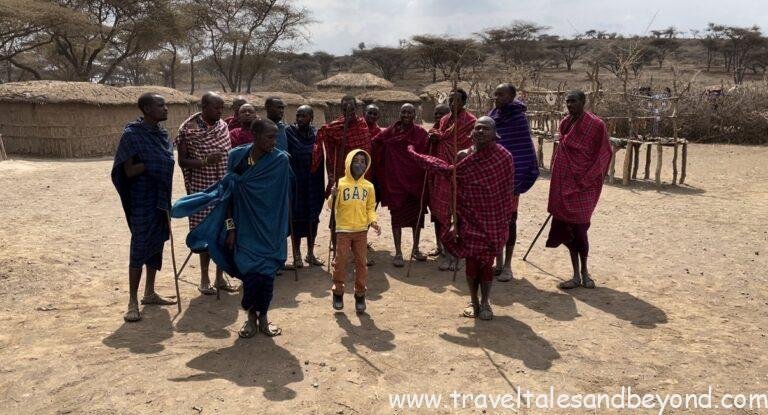
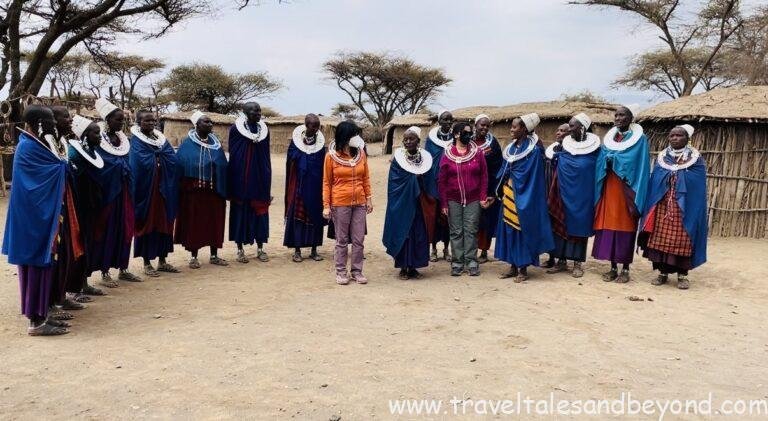
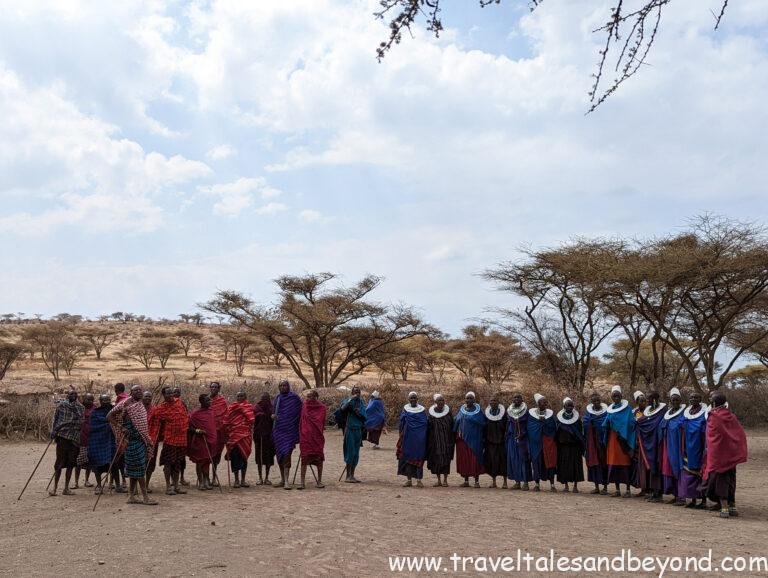
Our visit began with the famous Maasai welcome dance — and then we were invited to join in.
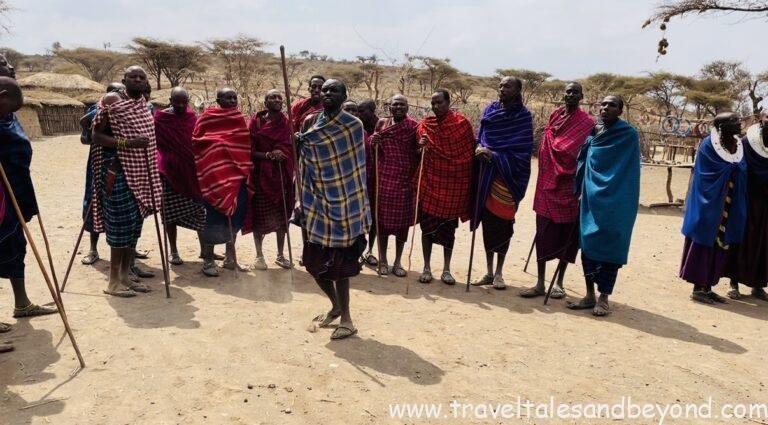
The young men doing most of the jumping were introduced to us as morans, traditionally associated with the warrior stage of the Maasai age-set system. The men took turns jumping vertically while the group sang and chanted together. There were no instruments — the rhythm came entirely from their voices and movement.
The women’s dance was different, with smaller, more rhythmic movements and some jumping of their own.
Once they waved us into the circle, we happily gave it a try.
It’s one thing to watch the jumping dance, sometimes referred to as adumu, in a video. It’s another thing entirely to try it yourself and discover just how much control and stamina it takes to jump that way!
For us, this was one of those travel moments that photographs don’t quite capture. The energy of everyone singing and moving together made the experience feel much more memorable than simply watching a performance.

Life Inside the Village
We were traveling with a friend’s family, and once the dance was over, the village divided us into smaller groups. Our family was shown into one house while our friends were taken to another.
That made the visit feel more personal than simply walking through a village as one large tourist group. We were able to spend a few minutes inside a household and see some of the everyday details of the home.
There was also a clear expectation that visitors would have an opportunity to purchase something from the household or community before leaving. We didn’t find that uncomfortable. Given that we’d been welcomed into someone’s home and community, buying a small handmade item felt like a reasonable way to participate in the visit and support the people we had met.
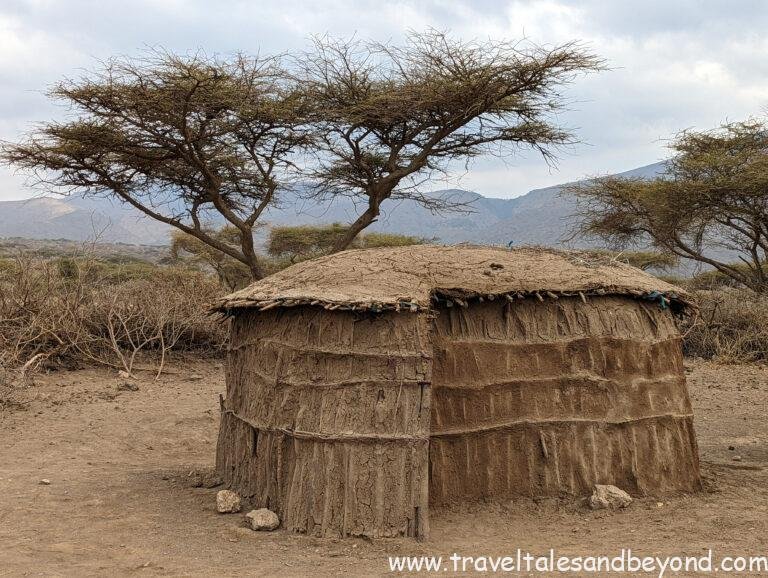
The homes we saw were simple and functional. The huts were arranged within a larger homestead, known in Maasai communities by terms such as boma or enkang, and thorn fencing can be used around homesteads to help protect livestock.
We were told that traditionally, women build the huts using locally available materials such as sticks, mud, grass, and cow dung.
Inside the house we visited, the sleeping platform was made from narrow pieces of wood. There was no conventional mattress or bed frame — just a simple raised sleeping surface.
It was one of those details that stayed with us because every part of the home seemed designed around practicality and the materials available locally.
We also noticed very little technology during our short visit. We remember seeing only one phone, carried by a younger man. Of course, that was simply what we happened to observe during a 30-minute visit — not a reflection of technology use across Maasai communities generally.

Making Fire the Traditional Way
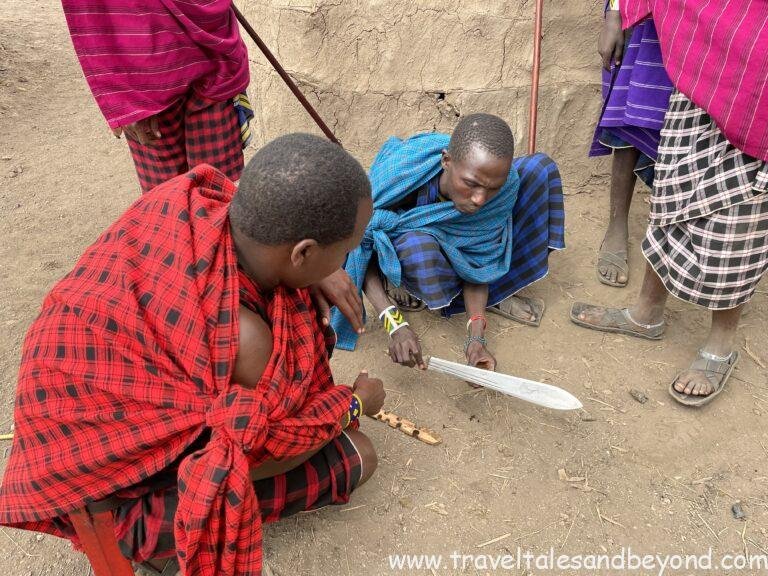
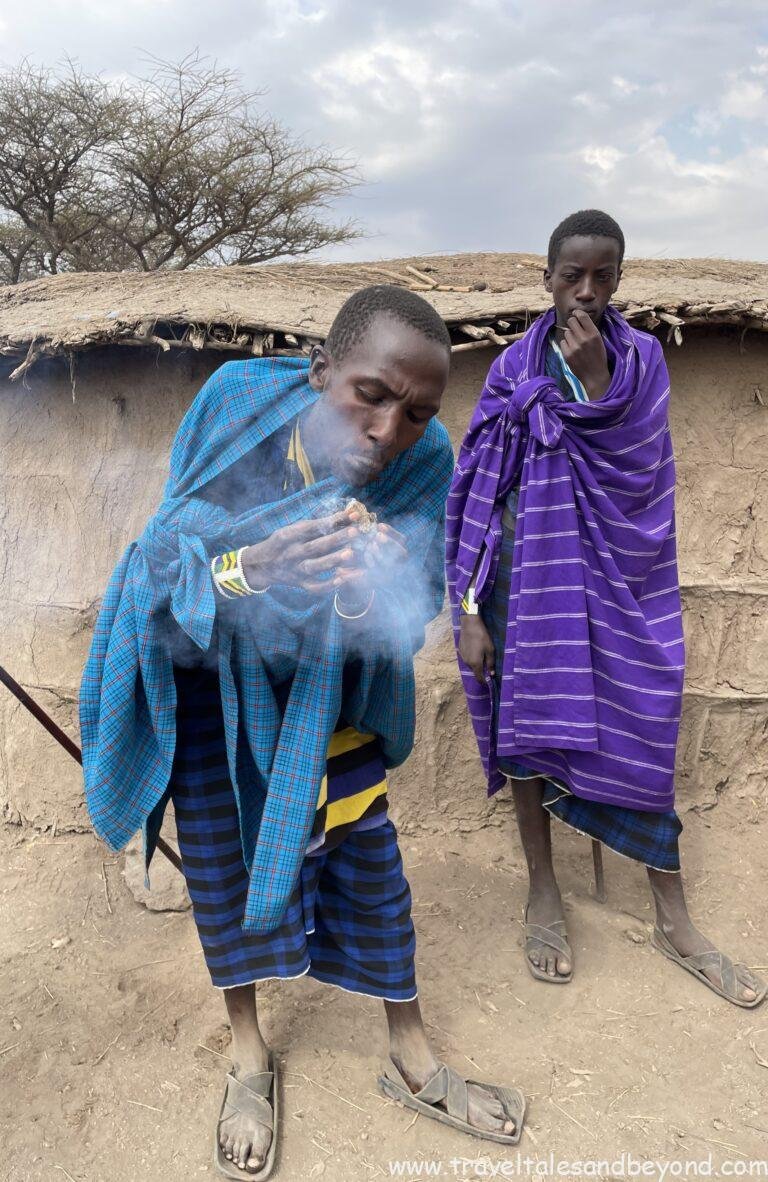
One of the highlights of our visit was watching a village member start a fire using a knife and a piece of wood.
There were no matches or lighter involved. It took patience and considerable skill, but within a few minutes a small flame appeared and was used to get the cooking fire going.
Cooking at the home we visited was done over a wood fire, and seeing how quickly an experienced person could create a usable flame was impressive.
For us, it was a simple demonstration, but it also gave a glimpse into the practical skills that can be passed from one generation to the next.
Food and Daily Meals
Our Maasai guide explained that food in Maasai communities has changed over time and isn’t limited to the foods often associated with traditional Maasai diets.
Historically, livestock — particularly cattle — have played an important role in Maasai foodways, with milk and meat being important foods. Blood from cattle has also traditionally been consumed in some circumstances, sometimes mixed with milk.
At the village we visited, however, we were told that foods such as rice and potatoes, along with meat, are also part of the modern diet.
That was a useful reminder that “traditional culture” doesn’t necessarily mean that everything about daily life has remained unchanged. Food habits, like many other aspects of life, evolve.

The Village School
The village had a small school where children were being taught their local language as well as English.
It was a simple, one-room setup, but education clearly played an important role in the community. English is particularly valuable for children growing up in an area where tourism provides employment and interaction with visitors.
During our visit, only a couple of the villagers spoke English fluently enough to communicate directly with us. They were mainly the people involved in welcoming and guiding visitors.
It was interesting to see education and tourism intersect so directly: children were learning skills that could potentially open opportunities beyond the village while still growing up within their own cultural community.
Traditional Dress: The Shuka
The clothing was one of the most visually striking parts of our visit.
Many of the people we saw wore brightly colored pieces of wrapped fabric commonly associated with Maasai dress, often referred to as a shuka. Red is particularly recognizable in Maasai clothing, although other colors are also commonly worn.
Our Maasai guide explained that colors and clothing can carry cultural meaning, and red has traditionally been associated with qualities such as strength and bravery.
You may also hear the claim that red clothing helps deter lions and other wildlife. This is often repeated in descriptions of Maasai culture, but we’d treat it as a traditional explanation rather than a scientifically established wildlife-deterrent effect.
The sandals were also striking. Some of those we saw were handmade from animal skin and other locally available materials, made right there in the village.
What we liked most was that the clothing didn’t feel like a costume for tourists. It was part of what people in the community were actually wearing as we encountered them during our visit.

Handicrafts and Jewelry
The handicrafts were one of the easiest ways for us to support the community directly.
Women in the village were selling beaded jewelry, with prices starting at around $10, depending on the piece. There were also simple minimalist decorative items made from wood and paint.
We eventually chose a beaded jewelry piece to take home.
What made it special wasn’t simply that it looked beautiful. We’d watched the women making the pieces only a short distance from where we bought ours, so it felt connected to the experience rather than like something picked up in an airport gift shop.
Maasai beadwork also carries cultural significance, and colors and patterns can communicate information about identity, age, relationships, and social roles. The exact meanings can vary, so it’s worth asking the person selling a piece about its particular colors and design rather than assuming every pattern has one universal meaning.
Tip: Bring small bills in USD or Tanzanian shillings if you plan to buy handicrafts. Change may be limited, and purchasing directly from the artisans gives you an easy way to support the community you are visiting.

Herding, Security, and Daily Roles
Livestock remain an important part of Maasai life, particularly cattle and goats. Cattle have traditionally represented far more than food: they can be tied to wealth, social standing, marriage arrangements, and community life.
During our visit, we also heard about another way some local Maasai men earn an income: working in security roles at nearby safari camps.
The men we spoke with described their familiarity with the landscape and wildlife as an important advantage. Growing up around livestock and living in areas where people and wild animals share the same environment can develop an impressive awareness of animal behavior and surroundings.
For us, this was another example of how traditional knowledge and modern employment can overlap. Skills associated with pastoral life can also become valuable in the tourism industry.

A Changing Way of Life
One of the more thought-provoking parts of the visit was hearing community members talk about the future.
We were told that some younger people are leaving for towns and cities in search of education, employment, and other opportunities. At the same time, there was clearly pride in maintaining cultural traditions.
That tension — between preserving traditions and adapting to a changing world — made the visit feel more nuanced than the simple idea of seeing a community “frozen in time.”
The Maasai people we met weren’t living outside the modern world. They were navigating it in their own way.
We also learned that traditional plant-based remedies are still used for some everyday ailments. Public transport connects the village to the nearest town, which they use to visit town or reach more extensive care in a bigger emergency.
Again, it was a blend of old and new rather than an either-or choice.
Is a Maasai Village Visit Worth It?
For us, yes.
Our visit was short — only about 30 minutes — so we wouldn’t pretend that we gained a comprehensive understanding of Maasai culture in half an hour.
What we did get was a brief, personal introduction to one community’s way of life. We saw a welcome ceremony, stepped inside a home, watched a traditional fire-making demonstration, learned about food and education, and bought a handmade souvenir directly from the people who made it.
The key is to approach the experience as an introduction rather than an authentic “peek into a world untouched by modernity.” The people we met are living contemporary lives while maintaining traditions that remain important to them.
That distinction made the experience more meaningful for us.
Tips for Visiting a Maasai Village
- Arrange the visit through a reputable safari operator or guide. Ask who organizes the visit and where the money goes.
- Ask about the cost beforehand. We paid $50 per person, but prices can vary.
- Bring small bills if you want to buy jewelry or handicrafts.
- Ask before taking close-up photographs of individuals, particularly children.
- Dress respectfully. You’re entering someone’s community and home, not simply visiting a tourist attraction.
- Be prepared to participate. If you’re invited to join the welcome dance, don’t be afraid to give it a try!
- Traveling with kids? Let them join in too. Our child jumped right in alongside the adults, one by one, and it ended up being one of the highlights of the whole visit — the villagers were warm and encouraging with everyone who joined, kids included.
- Don’t expect to see every aspect of Maasai life. A short tourist visit is an introduction, not a complete picture of the community.
- Ask questions. Your guide can help translate and provide context that you might otherwise miss.
- Consider buying a handmade item. It’s a simple way to support the artisans you meet, provided you feel comfortable with the purchase.
- Remember that communities differ. What we saw at this village shouldn’t necessarily be assumed to represent every Maasai community in Tanzania or Kenya.
Have you visited a Maasai village on a Tanzania safari? Let us know about your experience in the comments below!
Frequently Asked Questions
Is it appropriate to visit a Maasai village as a tourist?
Yes, provided the visit is organized respectfully and you treat the community as a living community rather than a tourist exhibit.
Ask permission before photographing people, listen to your guide, respect people's homes and personal space, and consider purchasing handicrafts directly from local artisans if you'd like a souvenir.
It's also worth asking your safari operator how the visit is organized and how the fee benefits the community.
How much does a Maasai village visit cost?
We paid $50 per person for our approximately 30-minute visit, arranged through our driver-guide.
That's our experience rather than a fixed standard price. Costs can vary depending on the village, operator, location, and what's included in the visit, so ask about the price in advance.
Where can I go to Maasai village?
Our visit was to a village near the Ngorongoro Conservation Area in northern Tanzania, on the route back from Ngorongoro Crater.
Because we visited as part of our safari itinerary, we didn't independently arrange transportation to the village.

Shaminee is a U.S.-based mom and family travel blogger who designs detailed itineraries for her own family and turns them into practical guides for others. Her goal is to make family travel simpler, more organized, and more enjoyable.
Read more →