
On our Australia trip, our son was desperate to try an introductory scuba dive on the Great Barrier Reef. But the minimum age of the tour operator was 12, and he was 10. His dad, a Master Scuba Diver, went diving, and I did the intro dive. Our son was the only one of us who couldn’t go, and he was upset.
Then in Fiji, he watched another kid about his age go scuba diving. That stuck with him too. Between those two trips, his goal was set: he wanted to get certified so he could dive with his dad.
His first real try didn’t go well, though. We were in Aruba, and he did a Discover Scuba Diving session in the ocean. The visibility was low, he couldn’t see much around him, and he got scared. What bothered him even more was that the instructor was controlling his buoyancy for him. He wasn’t in charge of his own body in the water, and he hated that feeling. We didn’t push it.
Eventually, at 11, he earned his PADI Junior Open Water Diver certification. Here’s how he got from that shaky first try to certified diver, and my honest take as a mom on whether it’s worth it.
Quick answer: Kids ages 10 to 14 can earn the PADI Junior Open Water Diver certification. At 10 and 11, they’re limited to 12 metres (40 feet) and must dive with a PADI Professional or a certified parent or guardian. We split our son’s course between home (eLearning and pool) and vacation (open water dives).
Discover Scuba Diving: Why a Pool Worked Better for Our Son
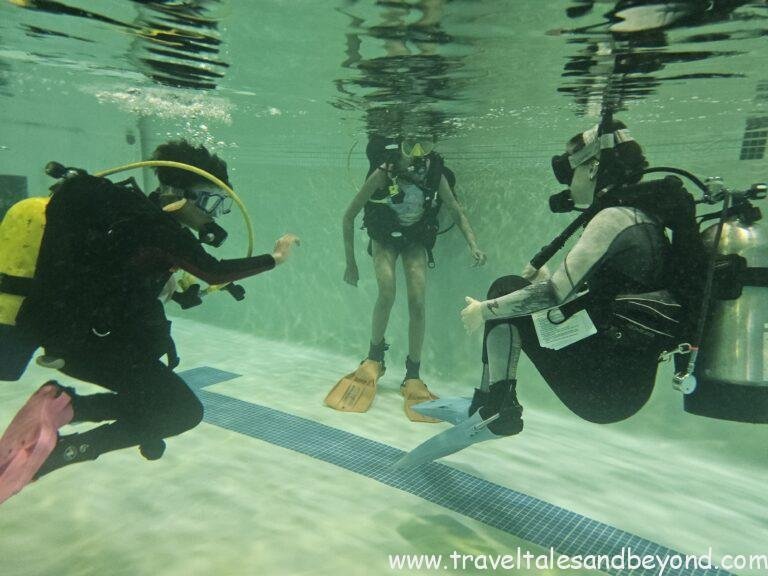
After Aruba, we started over in a pool in Seattle with Seattle Dive Tours, the dive shop my husband regularly dives with. Knowing the shop and its instructors made it an easy choice for our son’s fresh start. First, he did PADI Bubblemaker, a playful pool session no deeper than 2 meters (6 feet). Then he tried Discover Scuba Diving again, this time in the pool. (The program allows dives down to 12 meters/40 feet in open water with an instructor, but his stayed in the pool.) It was a completely different experience for him. The water was clear and calm, and he could see everything around him. That’s when it clicked.
Looking back, the order mattered. If we had pushed through after Aruba, I think he would have written scuba off. Starting over in a pool, where he felt safe and in control, is what gave him the confidence to sign up for the full certification.
Both came shortly before his certification course, and by then he knew he truly loved being underwater. For a younger child, I’d recommend that same path: Bubblemaker (from age 8, max 2 m/6 ft) in a pool first, then Discover Scuba Diving (from age 10, max 12 m/40 ft), and only then the full Junior Open Water course.
Junior Open Water Certification – PADI eLearning and Pool Training in Seattle
He started with PADI’s eLearning, about 10 hours of study material on equipment, pressure, buoyancy, dive planning, and safety. He had to finish it in just three or four days after school. Seattle Dive Tours books time at a local swimming pool, so pool slots are limited. Once we had dates, the eLearning had to be done before his first session.
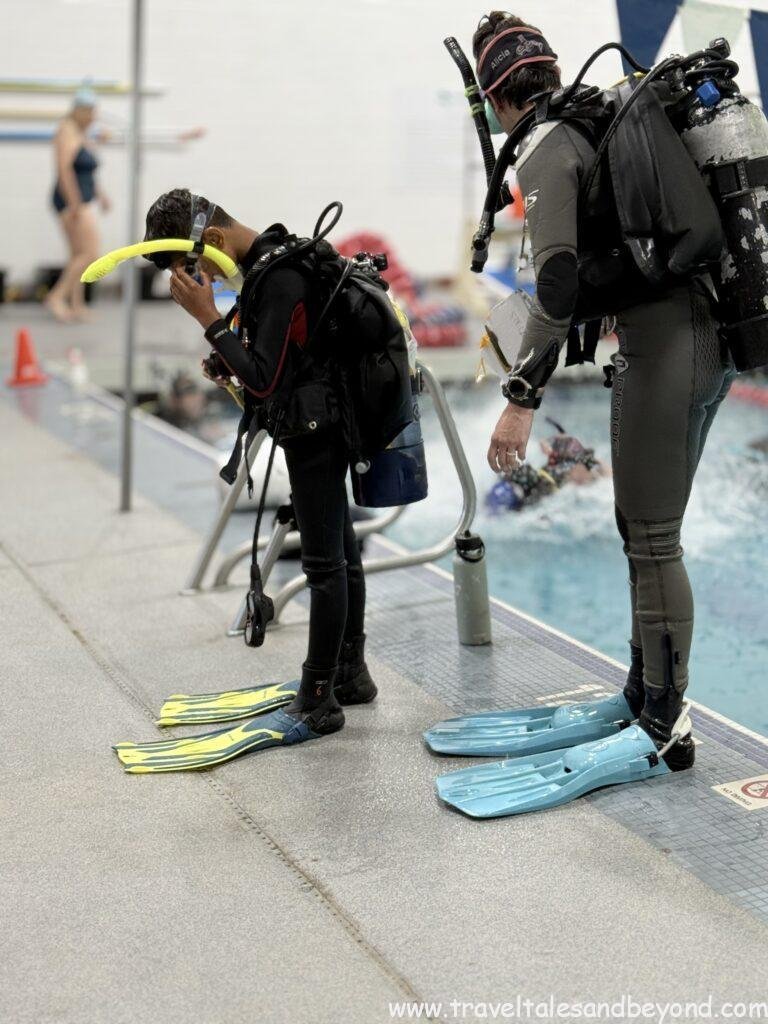
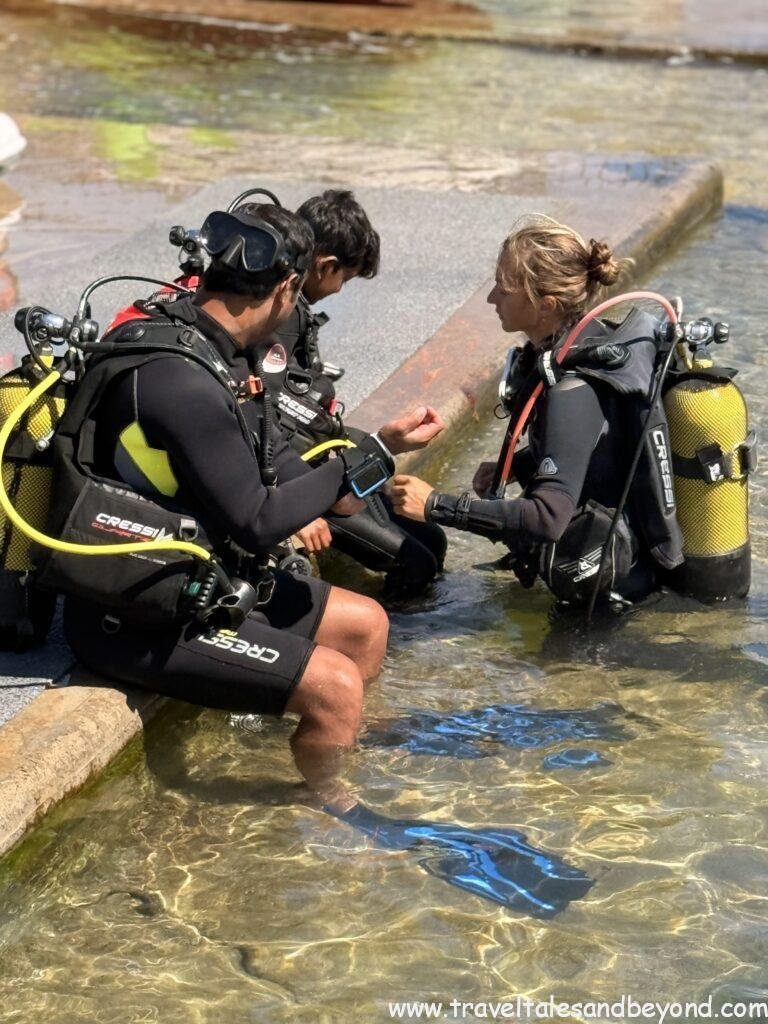
Then came two pool sessions with Seattle Dive Tours, each about 3 hours long, covering all five confined water dives. He practiced every skill on the checklist: clearing his mask, recovering his regulator, sharing air, and getting in and out of the water safely.
Seattle Dive Tours gave him the same instructor for his whole pool training, and that made a real difference. She was caring and patient, which is exactly what an 11-year-old needs to stay focused through hours of skill practice.
Most of the skills came easily to him. The hardest was the LPI, the low-pressure inflator on his BCD that adds or releases air to control buoyancy. Connecting the hose takes more hand strength than you’d think for an 11-year-old, and getting the timing right on short bursts of air takes practice. I found that funny, given that buoyancy was exactly what bothered him in Aruba. This time, though, he was learning to control it himself. That one just takes time. But he got better with more training.
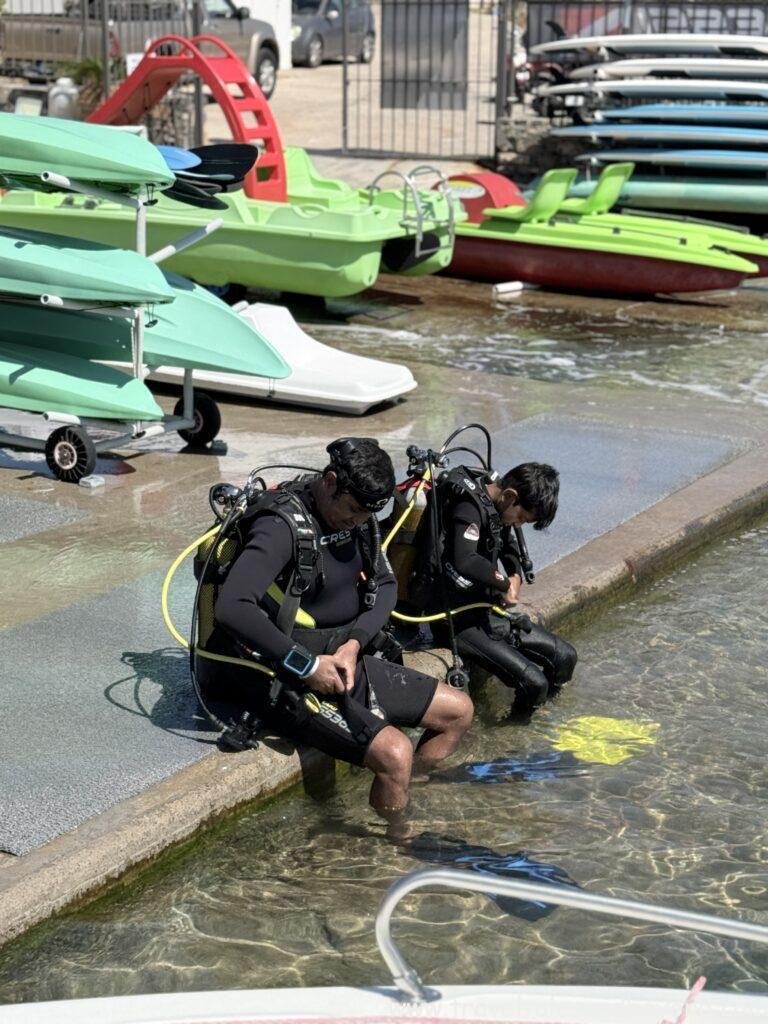
One thing I hadn’t thought about: the weight. He used a smaller tank, but even that was heavy for him out of the water. Underwater, you barely feel it. On land, it’s a lot for an 11-year-old to carry. On a shore dive, as opposed to a boat dive, divers have to carry their own gear to the water, so his pool sessions included practice handling and carrying his equipment too. If your child’s open water dives will be shore dives, ask the shop how they help kids with this.
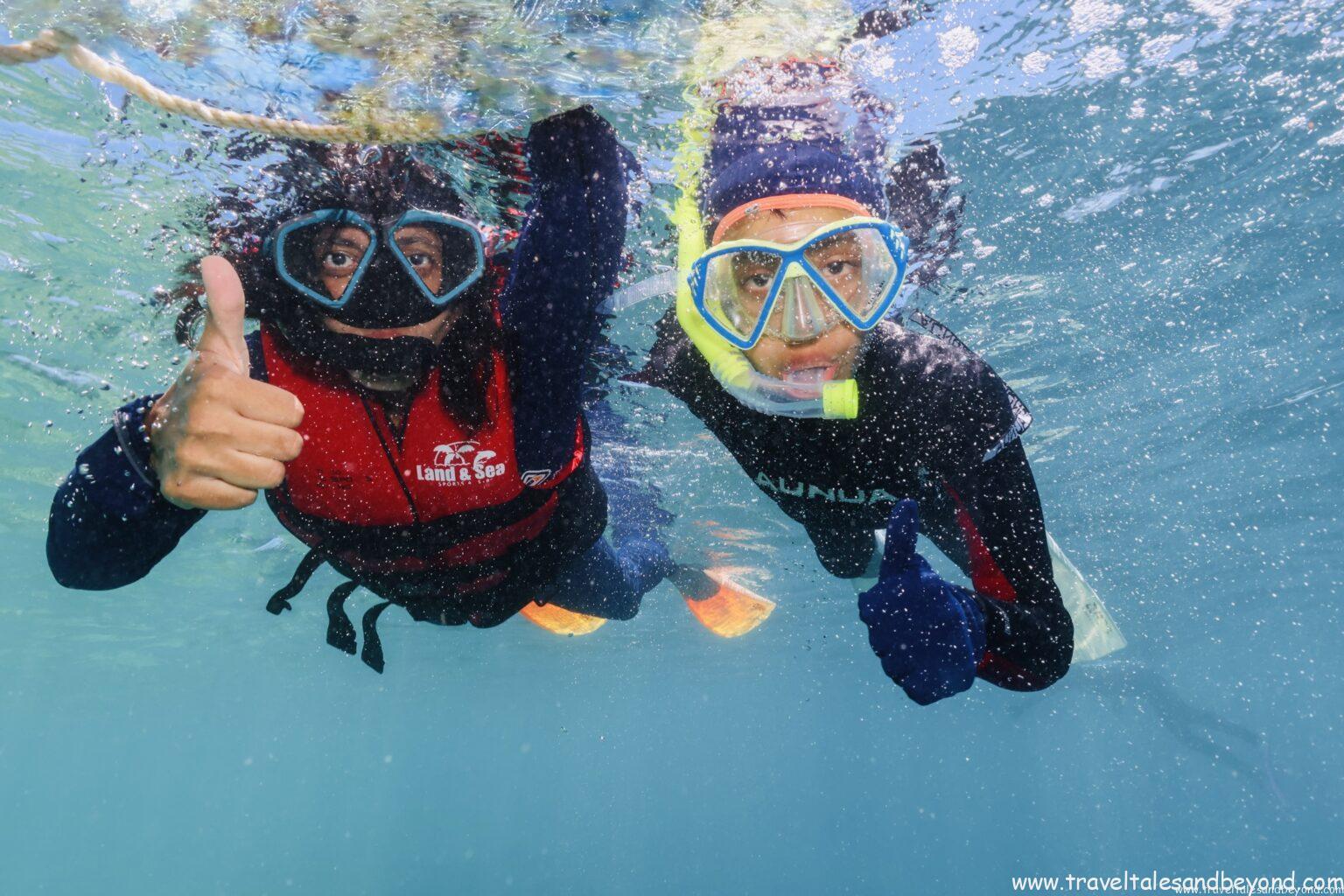
As for gear, we didn’t buy much. He already had his own wetsuit and snorkeling mask from our snorkeling trips, and he used the dive shop’s equipment for everything else. A mask that already fits well is one less thing to worry about underwater.
Open Water Dives in Crete: How the PADI Referral Worked for Us
We didn’t do his open water dives in Seattle. The water in Puget Sound is cold and dark year-round, and most local divers wear drysuits, which are more challenging to manage than a wetsuit. Instead, we used a PADI referral: he finished his eLearning and pool training at home, and the paperwork let him complete his open water dives at any PADI dive centre within 12 months.
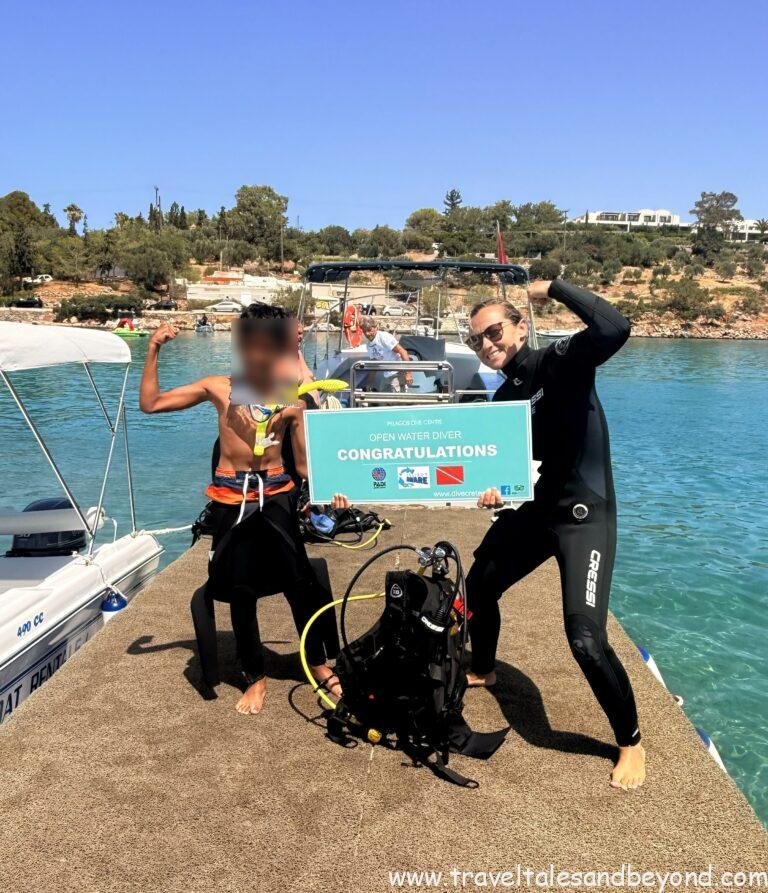
We’d already booked a vacation in Agios Nikolaos, Crete, Greece because my husband dives and the area has some good dive spots. So that’s where our son finished, with Pelagos Dive Centre: four open water dives, spread over three days so he wouldn’t get too tired. Seattle Dive Tours took care of the referral paperwork for us — they uploaded all the documents Pelagos needed, so we didn’t have to carry forms between the two shops or chase anything before we arrived.
He had the same instructor for every dive in Crete, and she was wonderful: patient, encouraging, and great at making him feel comfortable underwater. After his experience in Aruba, that mattered more than anything. If you can, ask the dive shop for one instructor throughout, especially for a younger child.
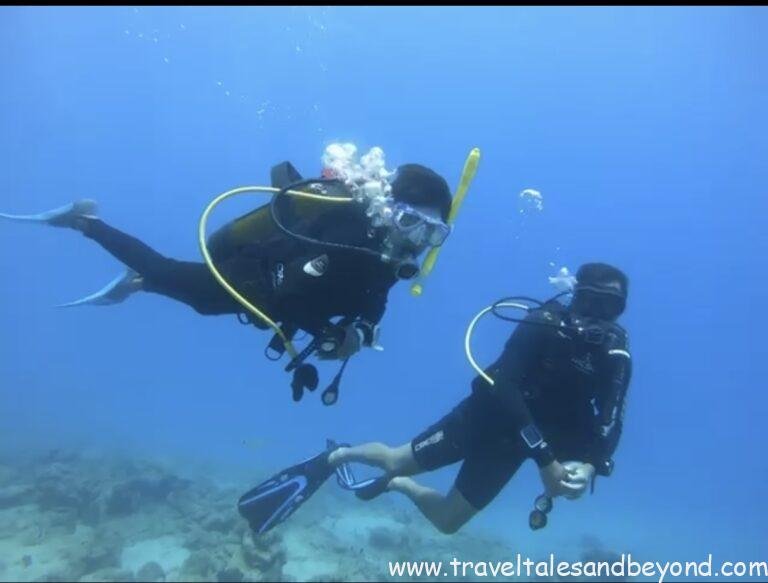
His four open water dives were spread over three days: Day 1 had a shore dive and a boat dive, Day 2 was a shore dive because it was very windy and the ocean was rough, and Day 3 was a boat dive. The first dive was from shore, which meant carrying his own gear to the water — exactly what he’d practiced in the Seattle pool. His second and fourth dives were from the boat. His dad was with him and his instructor for every one of those dives. It wasn’t required, but our son wanted his dad there — and after the Great Barrier Reef, Fiji, and Aruba, he was finally diving with his dad.
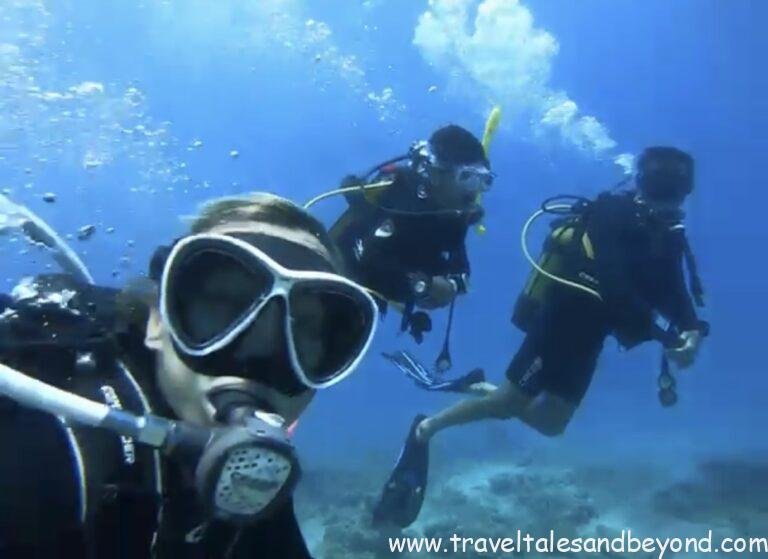
The boat dives were the hardest part for me. I waited on shore, a little worried the whole time, with no way of knowing how it was going out there. Then they came back, both of them all smiles, with the news that he’d done really well. I was so impressed.
Once he was certified, all he wanted was to have fun. By then he’d made a friend, a 12-year-old who had gotten certified the year before, and that same day the two of them spent a few hours on the banana boat and other high-speed boat rides. That was our gift to him for completing his certification, and it felt like the perfect way to celebrate.
His deepest dive was 12 metres (40 feet), right at the limit for his age.
Step | Where | Time |
|---|---|---|
eLearning | At home | About 10 hours |
Pool training | Seattle Dive Tours, Seattle | 2 sessions, about 3 hours each |
Open water dives | Pelagos Dive Centre, Agios Nikolaos, Crete | 4 dives over 3 days (2 shore, 2 boat) |
The Referral Checklist: Who Does What
Here’s how the referral split worked for us, step by step. Other shops may handle it slightly differently, so treat this as a checklist to confirm with your own shops, not a PADI-wide rule.
Your home shop (the one you train with):
- Completes your paperwork (your medical form can be used by the shop you finish with)
- Confirms that your eLearning is complete
- Completes your confined water training
- Documents everything on your training record
- Uploads everything to PADI’s online system
- Provides digital copies of your transcript, training record, medical form, and other documents
You:
- Coordinate with the receiving PADI shop or instructor
- Schedule your open water dives with them
- Provide any documents they need (not all PADI shops use the digital system)
- Pay them for the checkout dives
The receiving shop (the one you finish with):
- Reviews your training records and transcripts
- Completes your 4 checkout dives over at least 2 days
- Processes your certification
After certification : What Pelagos Dive Centre told us to do next
- Keep diving. The best way to stay in practice is simply to dive regularly, so the skills stay fresh.
- Always go with an instructor — and state his limit. We were told to specify that he only dives to 12 metres. If we’re diving in a group where the adults go deeper, he needs a separate instructor who stays within his limit.
- Book a refresher if there’s a gap. If more than 6 months pass without diving, do a refresher course first so he doesn’t forget the instructions.
Is Getting Your Kid Scuba Certified Worth It?
For our family, yes. We already snorkel when we travel, from the Great Barrier Reef to the Red Sea, and now our son has a real skill that adds a whole new layer to those trips. He’s learned to check his own gear, follow procedures, and look out for a buddy, and the certification grows with him: at 15, it automatically becomes a standard Open Water certification.
It isn’t all upside. It’s expensive, and future dives and refreshers add up, but this isn’t an area where I’d cut corners with a child. The 12-metre limit rules out some dive sites at his age. He always needs a PADI Professional or a certified parent with him. And finding rental gear that fits a growing kid takes extra care.
My verdict: if your child is water-confident, follows instructions, actually wants to learn, and your family travels to places with good diving, it’s worth every penny. If not, there’s no rush. At 12, the depth limit rises to 18 metres (60 feet).
Tips for Parents: Getting Your Kid Scuba Certified
- Try an intro program first, and pick the setting carefully. Our son’s first try in murky ocean water nearly put him off. A clear, calm pool made all the difference.
- Let them control their own buoyancy as soon as possible. For our son, feeling in control was everything.
- Start in swimming pool with bubble maker session.
- Consider a referral. If you live somewhere with cold water, you can do the eLearning and pool training at home and finish the open water dives somewhere warmer.
- Choose warm, calm water for the open water dives. Cold water, waves, and poor visibility make everything harder for a new diver.
- Read the reviews before you book, and ask the shop directly about Junior Open Water certification. We trained with Seattle Dive Tours in Seattle and finished with Pelagos Dive Centre in Agios Nikolaos, Crete, Greece — but wherever you go, check what other parents say about the shop, and ask how they handle younger divers, what their class sizes are, and whether they offer a referral option if you want to split the course like we did.
- Check the medical form early. Some answers require a doctor’s written approval, so don’t leave it until the week before.
The practical stuff worth knowing
- Equalization is usually the sticking point. Equalizing just means clearing the pressure in your ears — the same popping feeling you get on a plane. If your child’s ears won’t equalize, they can’t descend, and never dive with a cold or congestion, because blocked sinuses make it impossible and painful.
- Know the swim test bar first. PADI’s standard is a 200 m swim plus a 10-minute float, so you can judge readiness before you pay.
- Parents don’t need to be certified. A PADI Professional can be your child’s buddy. But if you want to dive with your child yourself, you need your own certification — in our family, dad dove with him and I waited on shore.
- Plan the flight home around diving. After multiple dives, the guidance is 18 hours before flying.
- Any diver can end a dive at any time. No questions, no pressure — and that rule matters most for kids.
- Check your insurance. Regular travel insurance often excludes scuba, so check coverage or look at DAN before the trip.
- Don’t buy full gear for a growing kid. Rent everything except a well-fitting mask.
- Plan for seasickness on boat dives. Queasy kids are common on boat days, so go prepared.
PADI Junior Open Water Requirements at a Glance
For the full rules, see PADI’s own pages. Here’s what most parents ask us:
- Minimum age: 10 for Junior Open Water. Ages 8+ can try pool programs like Bubblemaker and Seal Team, and ages 10+ can do Discover Scuba Diving.
- Depth and buddy rules: Ages 10–11 can dive to 12 m (40 ft) with a PADI Pro or certified parent/guardian. Ages 12–14 can dive to 18 m (60 ft) with a certified adult.
- Class size: For ages 10–11, no more than 4 students per instructor, and no more than two 10–11-year-olds in the group.
- Course parts: eLearning, five confined water (pool) dives, a swim and float test, and four open water dives.
- Cost: Prices vary widely by shop and destination. Roughly $350 to $600 USD is a common range, but that’s an estimate, not what we paid.
- Safety: Scuba isn’t risk-free for kids. The South Pacific Underwater Medicine Society has long recommended 14 as a minimum age for open water scuba, while PADI certifies from 10 under stricter rules. Talk to a doctor who understands diving medicine if you have any health questions.
PADI isn’t the only option. Other agencies, such as SSI and NAUI, also offer junior certifications, and many dive shops abroad teach SSI. We chose PADI, but if your vacation dive shop uses a different agency, check its age and depth rules, since they vary slightly.
Frequently Asked Questions
How old does a child have to be to get scuba certified?
The minimum age for PADI Junior Open Water Diver is 10. Our son was 11 when he certified.
How deep can an 11-year-old scuba dive?
Up to 12 metres (40 feet), with a PADI Professional or certified parent or guardian. Our son's deepest dive was right at that limit.
How long does the course take?
For our son: about 10 hours of eLearning, two 3-hour pool sessions, and four open water dives spread over 2/3 days.
Can my child do the pool training at home and the open water dives on vacation?
Yes. That's what we did, through a PADI referral. The referral is valid for 12 months from the last training session.
Is scuba diving safe for kids?
Scuba isn't risk-free, but PADI reduces the risk for young divers with medical screening, smaller class sizes, depth limits, and supervision rules. What mattered most for us was our son's comfort in the water, a patient instructor, and calm conditions. Talk to a doctor who understands diving medicine if you have health questions.
How much does kids' scuba certification cost?
Prices vary widely by shop and destination; roughly $350 to $600 USD is a common range, but that's an estimate, not what we paid. If you split the course with a PADI referral like we did, budget for both the home shop and the vacation dive centre.
Shaminee is a U.S.-based mom and family travel blogger who designs detailed itineraries for her own family and turns them into practical guides for others. Her goal is to make family travel simpler, more organized, and more enjoyable.
Read more →
Discover more from Travel Tales And Beyond
Subscribe to get the latest posts sent to your email.