
Planning a Bosnia and Herzegovina itinerary and wondering if you can fit it into a Croatia trip? You absolutely can — and Bosnia with kids turned out to be one of the most memorable parts of our entire Balkans summer. This 2 days in Bosnia guide covers our family road trip from Split, Croatia to Mostar and Sarajevo.
Travel Month – July
We based ourselves in Mostar for both nights, which made the rest easy. We spent one full day in Mostar — home of the iconic Stari Most (Old Bridge) and its fearless bridge divers — and did Sarajevo, the capital, as a day trip, where Ottoman bazaars, Austro-Hungarian boulevards and the story of the Siege of Sarajevo sit side by side. On our way back to Dubrovnik, we stopped at the Blagaj dervish monastery and had lunch in Neum, Bosnia’s only town on the sea. If you’re searching for a Mostar day trip from Split, things to do in Sarajevo with kids, or how to handle a Bosnia road trip in a rental car, this guide has you covered.
A quick note on what kind of trip this really was: this was a hot one. We visited in July, when Mostar regularly ranks among the hottest cities in Europe, so we planned our days around the heat — early starts, long lunches in the shade, and sightseeing again once the sun dropped. It was also a trip with real history. Bosnia’s 1990s war is recent, visible and still talked about, which makes it a powerful place for kids to see history up close. If you’re wondering whether Bosnia with kids is worth it, our answer is a strong yes — just go in prepared for both the beauty and the heavier conversations.
At a glance
- Base: Mostar (both nights)
- Route: Split → Mostar → Sarajevo (day trip) → Blagaj → Neum → Dubrovnik
- Transport: Rental car the whole way
- Drive times: Split to Mostar ~2.5–3 hrs · Mostar to Sarajevo ~2–2.5 hrs each way · Mostar to Dubrovnik via Neum ~2.5–3 hrs
Our Bosnia route — from Split to our base in Mostar, a day trip to Sarajevo, then Blagaj and Neum on the way back to Dubrovnik. Tap a numbered stop for the highlights.
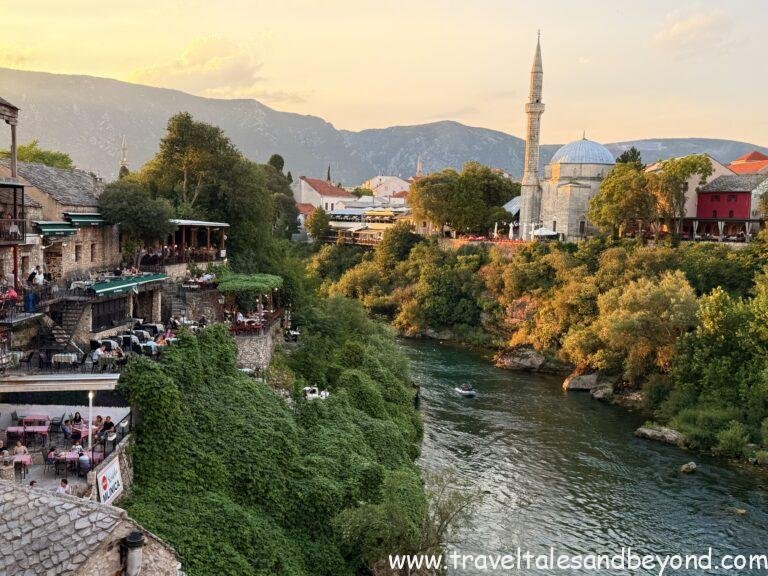
Bosnia and Herzegovina: A Short History for Travelers
Bosnia and Herzegovina sits where empires met, and you can see every layer in a single walk through Mostar or Sarajevo. A few key moments make the trip far more meaningful, especially for kids:
Year | What happened |
|---|---|
1463 | The Ottomans conquer Bosnia, bringing the mosques, bazaars and bridges you see today. |
1878 | Austria-Hungary takes over, adding European-style buildings and boulevards. |
1914 | Archduke Franz Ferdinand is assassinated in Sarajevo, sparking World War I. |
1992–1995 | After independence from Yugoslavia, war breaks out; it ends with the Dayton Agreement. Mostar’s Old Bridge, destroyed in 1993, is rebuilt and reopens in 2004 as a symbol of reconciliation. |
Today, Bosniaks, Croats and Serbs live side by side, and you’ll often see mosques, Catholic and Orthodox churches within a few streets of each other.
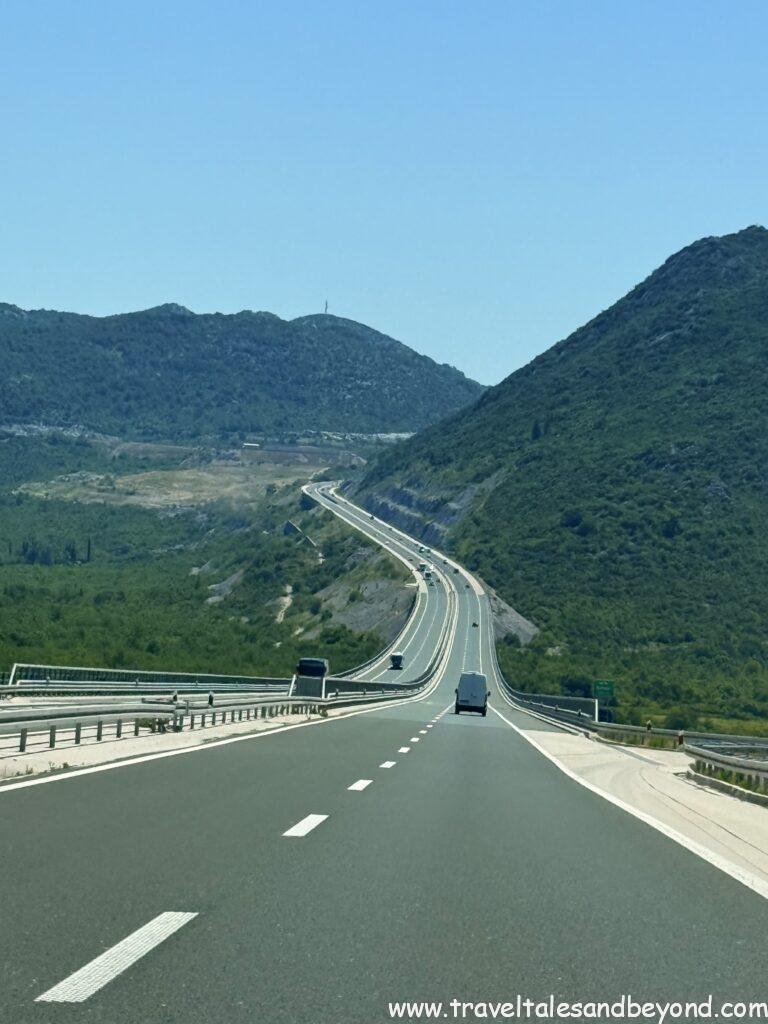
Getting to Bosnia from Split by car
We picked up our rental car in Split and drove inland toward the Bosnian border. The Split to Mostar drive is roughly 160 km (100 miles) and takes about 2.5–3 hours depending on the border queue. From Mostar, the drive north to Sarajevo follows the Neretva River canyon past Jablanica — about 130 km (80 miles) and 2–2.5 hours, and one of the prettiest drives of our whole trip.
Our crossing from Croatia into Bosnia was smooth: just a quick passport check and we were on our way.
Borders in the Balkans can be unpredictable in July. Earlier on this same trip, we sat for 2.5 hours at the Croatia–Montenegro crossing without moving and eventually turned back. In contrast, when we crossed from Bosnia back into Croatia near Dubrovnik, the border was empty. Same summer, completely different experiences.
Road trip tip: Leave early. Morning crossings in peak season are far faster than midday ones, and you’ll also beat the worst of the afternoon heat.
Rental car tip: Tell your rental company you’re driving into Bosnia and Herzegovina before you pick up the car. We mentioned it when we collected our car in Split, and they charged us an extra amount for it. Bosnia isn’t in the EU, so most Croatian rental companies charge a one-time cross-border fee (around €90 per rental for non-EU countries). Make sure the Green Card (proof of insurance) is in the car and that Bosnia isn’t crossed out on it. And since Bosnia was part of a bigger Croatia trip for us, we made sure to pick up and drop off the car in the same country (Croatia) — dropping it off in a different country would have added a large one-way fee and made the rental much more expensive.
Day 1: Mostar and the Old Bridge
We arrived in Mostar around 3 pm and headed straight for the old town. Even before you see it, you can hear it — the rush of the emerald-green Neretva River below and the buzz of the cobbled bazaar above.
We stayed at Shangri La Mansion just a few minutes’ walk from the old town, for both of our nights in Bosnia. The hotel had no restaurant or breakfast. Being that close meant we could explore in the morning, retreat to the room during the hottest hours, and walk back out for dinner by the river. One day in Mostar is enough to see the old town at a relaxed pace, especially if you stay overnight and catch both the quiet morning and the lit-up bridge at night.
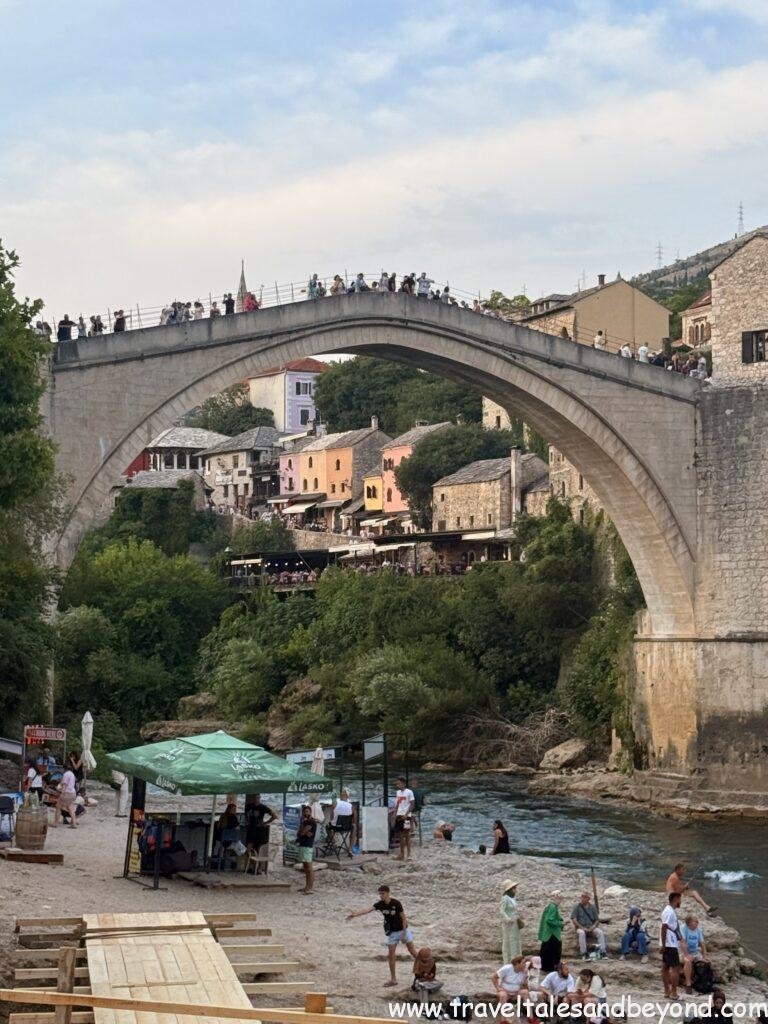
The star of Mostar is Stari Most, the Old Bridge. The original Ottoman bridge stood for 427 years before it was destroyed in November 1993 during the war. It was rebuilt using many of the original stones, reopened in 2004, and added to the UNESCO World Heritage list in 2005. Walking across its steep, polished stone hump is a little slippery — wear shoes with grip.
Mostar travel tip: The bridge is busiest from late morning to late afternoon, when day-trip buses from Dubrovnik and Split arrive. Go early or after 6 pm for photos without the crowds — and cooler temperatures. at
Watching the Mostar bridge divers
A highlight for kids is watching the Mostar bridge divers. Members of the local diving club stand on the outside of the railing, collect money from the crowd, and only jump once enough has been raised. The drop to the river is around 24 meters (79 ft), and the water is cold even in July. Diving here is a tradition that goes back centuries. But we missed it.
Exploring the old bazaar (Kujundžiluk)
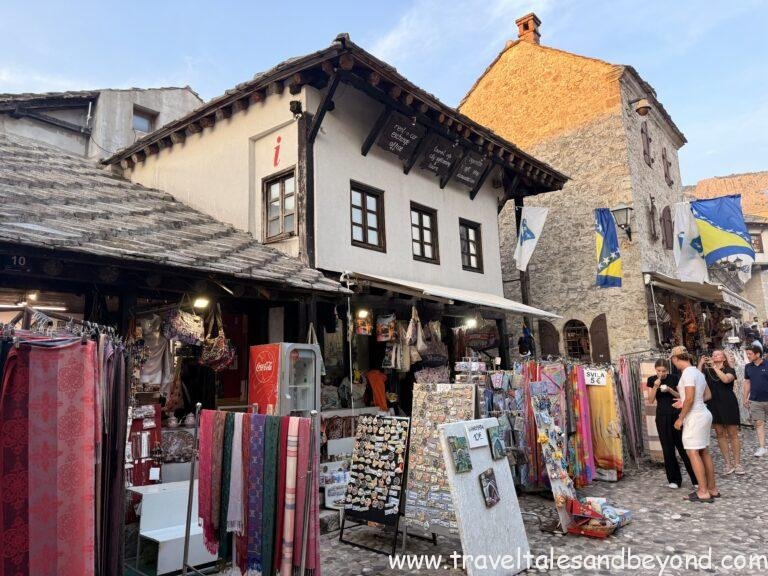
The cobbled lanes on the east side of the bridge are lined with copperware, hand-painted tiles, lanterns and souvenir stalls. The Koski Mehmed Pasha Mosque in the old town lets visitors climb its minaret for one of the best views of the Old Bridge. We didn’t climb it.
Beating the Mostar heat
Mostar sits in a valley that traps heat, and July afternoons can push close to 40°C (104°F). We stayed inside to avoid the heat and went back out in the evening, when the bridge is lit up and the riverside restaurants fill up.
Two more options which we planned but didn’t end up going are Počitelj (a hilltop Ottoman village) and Kravice Waterfalls (swimmable in summer). Both are within 30–45 minutes of Mostar.
Day 2: Sarajevo old town
Sarajevo wasn’t originally on our plan. We had booked both of our nights in Mostar, but after one full day there we felt we’d seen the old town properly. So we made a spontaneous call: drive to Sarajevo for the day and get a glimpse of the capital while we were in the country. No itinerary, no bookings, just a few hours to wander — and the drive back to Mostar the same evening.
The drive north follows the turquoise Neretva River canyon — about 2–2.5 hours and one of the most scenic drives in Bosnia. By the time we arrived it was around noon, and the city was baking in the July heat. So we kept it simple and stuck to the one area every first-time visitor should see: Sarajevo’s old town.
Honestly, we only scratched the surface of Sarajevo. But if you’re short on time (or energy in the heat), a few hours in the old town still gives you a real feel for the city — and the history packed into a few walkable streets is remarkable.
Baščaršija, Sarajevo’s old Ottoman bazaar
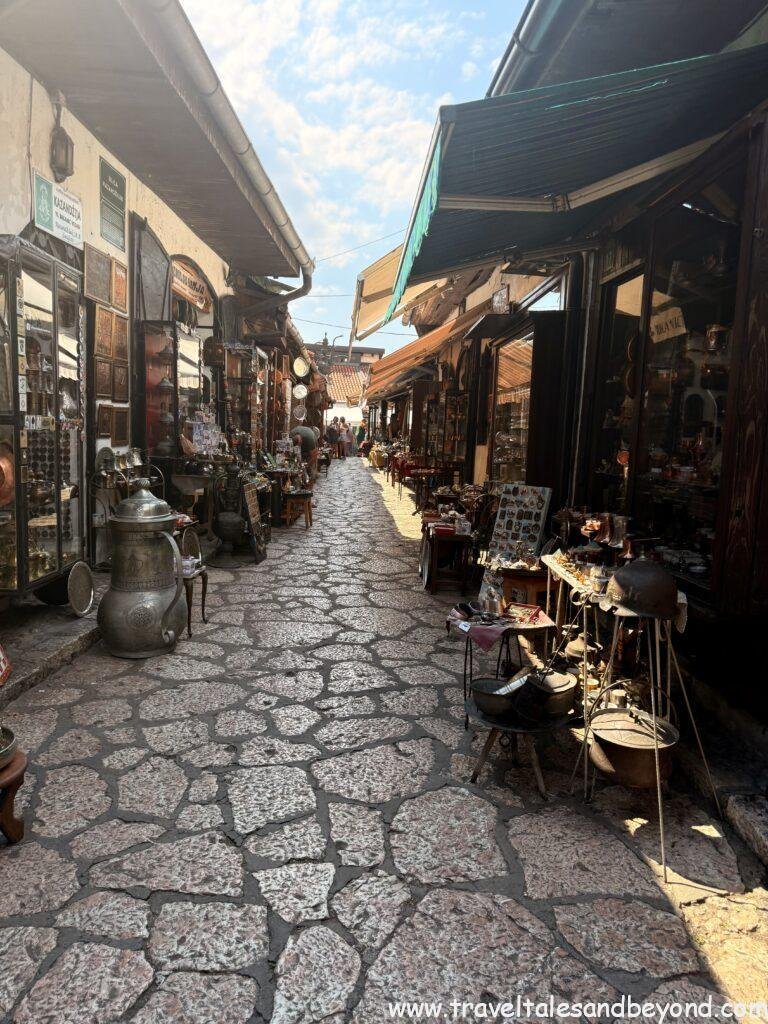
Baščaršija (pronounced bash-char-shee-ya) is the heart of old Sarajevo — a 15th-century Ottoman market of low wooden shops, copper workshops and cafés, with the wooden Sebilj fountain in the main square. It’s compact, mostly pedestrian, and easy to explore with kids.
On Ferhadija Street, look down for the “Sarajevo Meeting of Cultures” line on the pavement. Face one way and you see Ottoman Sarajevo; turn around and you’re looking at Austro-Hungarian Sarajevo.
Gazi Husrev-beg Mosque
Right in the middle of Baščaršija is the Gazi Husrev-beg Mosque, Sarajevo’s most famous mosque and the most important Ottoman mosque in Bosnia and Herzegovina, built in 1531. We didn’t go inside, but walking past its domes, minaret and fountain is part of any stroll through the old town.
Mosque visiting tip: If you do go inside, cover shoulders and knees, and women should bring a scarf for their hair. Visits pause during prayer times.
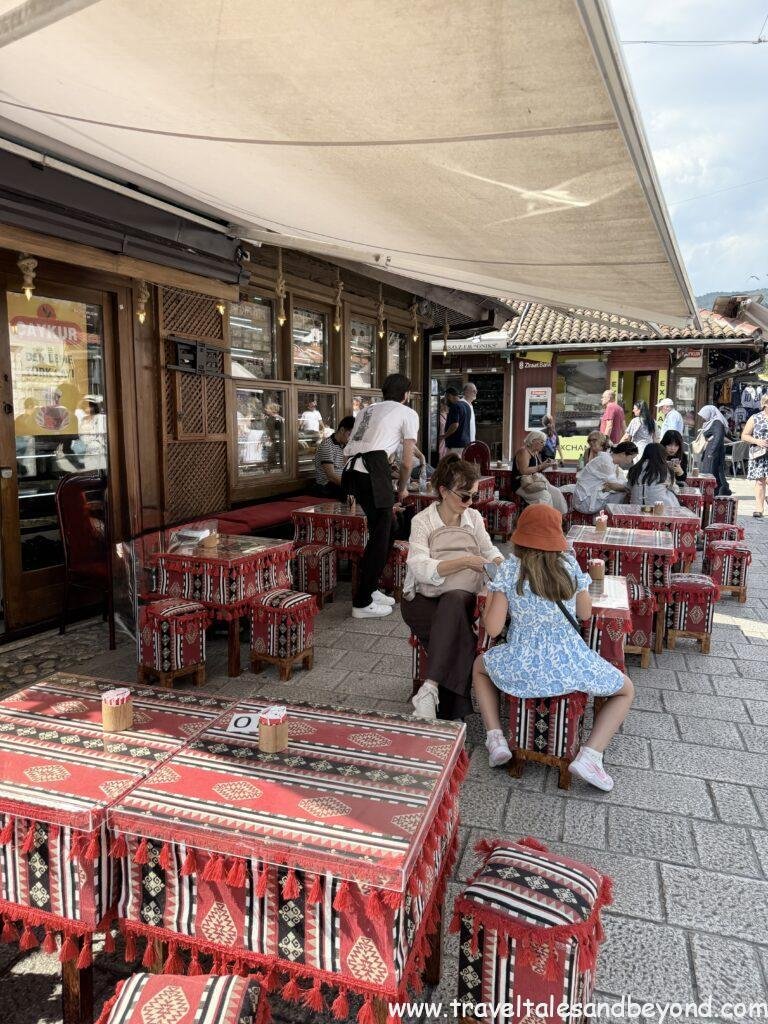
Dessert break in the old town
When the heat got too much, we ducked into one of the old town’s sweet shops (slastičarne) for a creamy, pudding-style dessert — exactly what we needed on a hot afternoon. One practical note: the sweet shop we went to only took BAM — and we didn’t have any on us, so we had to exchange our euros for BAM first. Have some local currency with you in the old town; euros or a card won’t always do. Bosnian sweet shops are known for desserts like sutlijaš (rice pudding), baklava and tufahija (a poached apple stuffed with walnuts and topped with cream). Pair one with a Bosnian coffee and it’s the perfect way to sit out the midday heat.
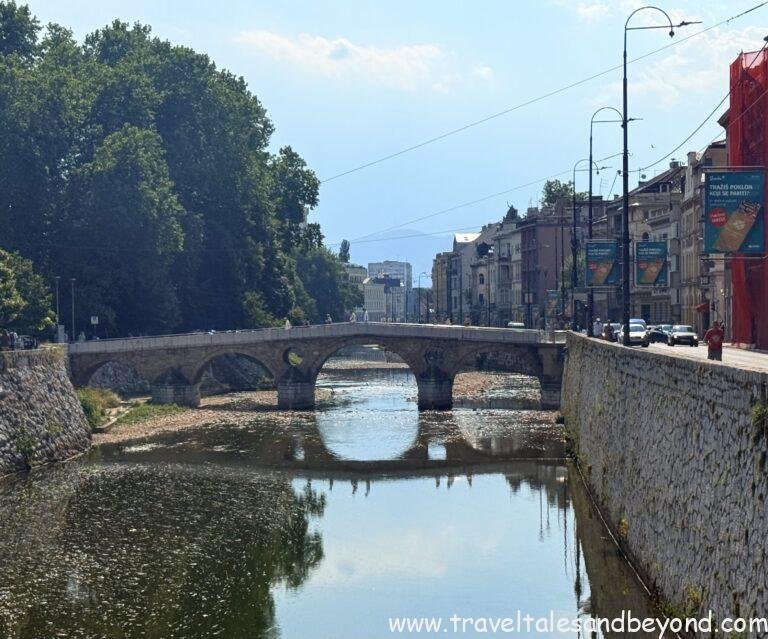
The Latin Bridge — where World War I began
A short walk from Baščaršija is the Latin Bridge (Latinska ćuprija), a small stone bridge over the Miljacka River. On the street corner next to it, on 28 June 1914, a 19-year-old named Gavrilo Princip shot Archduke Franz Ferdinand, heir to the Austro-Hungarian throne, and his wife Sophie. Within weeks, Europe was at war — the start of World War I. It’s a surprisingly ordinary spot for such a huge moment in history, which is exactly what makes it memorable.
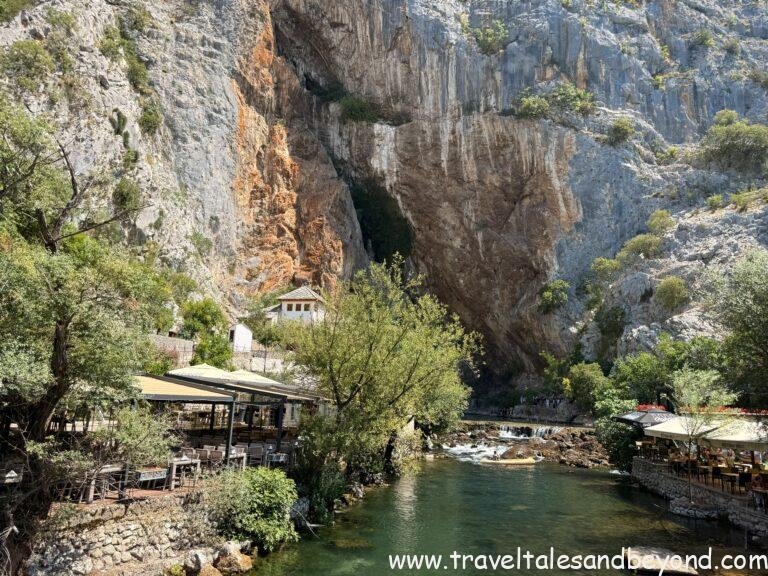
Departure morning: Blagaj Monastery and lunch in Neum
On our last morning, we checked out in Mostar and drove south toward Dubrovnik, breaking up the journey with two very different stops: a 500-year-old dervish monastery tucked under a cliff just outside Mostar, and lunch by the sea in Neum, the only coastal town in Bosnia and Herzegovina.
Blagaj Tekke, the dervish monastery
About 15 minutes south of Mostar, the village of Blagaj is home to Blagaj Tekke (Tekija), a Sufi dervish monastery built in the 16th century. It sits right at the base of a towering limestone cliff, where the Buna River bursts out of a cave. The Buna spring is one of the largest karst springs in Europe, pouring out tens of thousands of liters of water every second — and the water is an unreal shade of turquoise.
We reached Blagaj around 11 am — and we’d go earlier if we did it again. The tour buses were already there, we ended up in the extra parking area and paid the parking fee in cash, and from there it was about a 20-minute walk to the tekke, in the heat. There are fruit stalls along the walk, which helped, but wear a cap and take water with you — you’ll be glad of both by the time you arrive.
We saw the monastery from outside — we didn’t go in. Honestly, the setting is the main event here: the white house against the cliff, with the river pouring out of the cave right beside it. Entry to the house is around €5 / 10 BAM per person if you want to see the interior; the spring and the outside of the monastery, which is what we did, are free. Several riverside restaurants here serve fresh trout raised in the spring water, and small boats will take you right up to the mouth of the cave.
Blagaj travel tip: Go early — by 11 am the tour buses are already there, and the walk from parking is hot. Arriving in the morning gets you the spring and the monastery before the crowds and the worst of the heat. Shoulders and knees need to be covered inside the tekke, and women are asked to cover their hair. Scarves and wraps are available at the entrance.
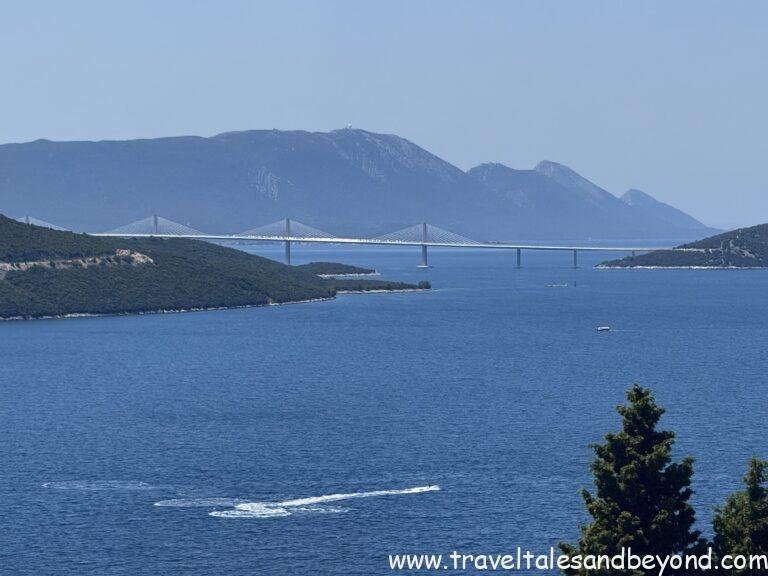
Lunch in Neum — Bosnia’s tiny slice of the Adriatic
From Blagaj, we headed to the coast and stopped for lunch in Neum.
Neum is one of the quirkiest places on a Balkans road trip, and it comes with a great story:
- Bosnia’s entire coastline is only about 20 km (12 miles) long, and Neum is the only town on it — the country’s single access point to the Adriatic Sea.
- It’s one of the shortest coastlines in the world. In Europe, only Monaco has a shorter one.
- It exists because of a 17th-century power play. At the Treaty of Karlowitz in 1699, the Republic of Ragusa (today’s Dubrovnik) handed this strip of coast to the Ottoman Empire on purpose, as a buffer zone so its rival, Venice, couldn’t march down the coast and reach it.
- That buffer still splits Croatia in two. Dubrovnik is cut off from the rest of Croatia by this little piece of Bosnia, so for decades anyone driving the coast road from Split to Dubrovnik had to cross two border posts in about 9 km.
- A bridge changed everything. In July 2022, Croatia opened the Pelješac Bridge, which lets traffic bypass Neum entirely. Today you only pass through Neum if you choose to.
- It’s a bargain stop. Prices in Neum are usually lower than in neighboring Croatian towns, which is why coaches have long stopped here for lunch and shopping.
Road trip tip: If you’re driving between Split and Dubrovnik, skipping the Pelješac Bridge and taking the old coast road through Neum is a fun way to add a “bonus country” — just bring your passports and the rental car’s Green Card.
After lunch, we crossed back into Croatia and continued to Dubrovnik, about an hour away. Unlike our 2.5-hour wait on the Montenegro border on this trip, this crossing was empty — we were through in minutes.
Bosnia Travel Tips: Borders, Money & What to Know Before You Go
Visa requirements: Many nationalities, including US citizens, can visit Bosnia and Herzegovina visa-free for short stays. Check the official requirements for your passport before you go.
Currency: The local currency is the Convertible Mark (BAM or KM), pegged to the euro at about 1.96 BAM per euro. Bosnia is generally more affordable than Croatia, especially for meals and entry fees. Euros are widely accepted in tourist areas of Mostar, but you’ll often get change in BAM — and some places take BAM only: the dessert shop we went to in Sarajevo’s old town was one of them, and we had to exchange our euros for BAM on the spot (exchange offices are easy to find in the tourist areas, at the fixed rate). Carry some BAM in cash for parking, small cafés, sweet shops and the bridge divers.
Mobile data: Bosnia is not in the EU, so EU roaming plans don’t cover it. Check your plan or buy a local or eSIM data package before you cross the border.
Driving & borders: Tell your rental company you’re entering Bosnia, carry the Green Card insurance document, and cross early in the day during summer. Border wait times can swing from minutes to hours. If Bosnia is one leg of a bigger trip, keep your rental pickup and drop-off in the same country — a cross-border one-way drop-off gets expensive fast.
Beating the summer heat: Mostar is one of the hottest cities in the region in July. Sightsee early and late, rest through the afternoon, and carry plenty of water. Sarajevo cools down in the evenings, but midday can be just as hot.
Visiting mosques: Shoulders and knees should be covered, and women may be asked to cover their hair. Some mosques provide scarves and wraps at the entrance.
Best time to visit Bosnia: May–June and September–October offer pleasant weather and fewer crowds. July and August are hot and busy, but bring the bridge-diving season and long summer evenings.
Frequently Asked Questions
Is Bosnia and Herzegovina safe for families?
Yes. Mostar and Sarajevo are welcoming and easy to explore with kids. Use normal city precautions, and outside towns stay on marked roads and trails because of leftover landmines in some rural areas.
Can you do a day trip from Split to Mostar?
Yes, but it's a long day: roughly 2.5–3 hours each way plus border time. Staying one night in Mostar lets you see the Old Bridge in the cooler morning and evening, without the tour-bus crowds.
Can you do Sarajevo as a day trip from Mostar?
Yes — that's what we did. It's about 2–2.5 hours each way along the Neretva River canyon, so it's a long driving day, but a few hours in the old town is enough to see Baščaršija, the Gazi Husrev-beg Mosque, the Sarajevo Meeting of Cultures line and the Latin Bridge. Basing ourselves in Mostar meant no hotel change and no repacking with kids.
Is 2 days in Bosnia enough?
Two days gives you a good first taste if you base in Mostar: one day for Mostar itself and one day trip to Sarajevo. On your way back to Dubrovnik, stop at Blagaj and Neum, as we did. With an extra day, add Počitelj and Kravice Waterfalls near Mostar, or the Trebević cable car and Olympic bobsled track in Sarajevo.
Can you take a Croatian rental car into Bosnia?
Yes, as long as your rental company allows it. We told our rental company at pickup in Split that we'd be going into Bosnia, and they charged us an extra cross-border fee for it (typically around €90 per rental). Make sure the Green Card insurance document in the car covers Bosnia and Herzegovina. We also picked up and returned the car in Croatia — returning it in another country would have cost much more.
When do the Mostar bridge divers jump?
There's no fixed timetable. Divers jump during the day in summer once they've collected enough money from the crowd — we missed seeing a jump on our visit, so allow time to wait if it's a must-see for you. The big annual diving competition is held in late July.
Is one day in Mostar enough?
Yes. Mostar's old town is compact, so one full day covers the Old Bridge, the bazaar, and time at the bridge in the hope of catching the divers (a jump isn't guaranteed — we missed it). Stay overnight close to the old town so you can see it early in the morning and lit up at night, without the day-trip crowds.
Is Sarajevo worth visiting if you only have a few hours?
Yes. Even a few hours in the old town lets you see Baščaršija, the Gazi Husrev-beg Mosque, the Sarajevo Meeting of Cultures line and the Latin Bridge, all within a short walk of each other.
Shaminee is a U.S.-based mom and family travel blogger who designs detailed itineraries for her own family and turns them into practical guides for others. Her goal is to make family travel simpler, more organized, and more enjoyable.
Read more →
Discover more from Travel Tales And Beyond
Subscribe to get the latest posts sent to your email.