Travel Month – August
Introduction: Why Prague is Perfect for a Weekend Trip
Prague is one of Europe’s most rewarding short-break destinations — a compact, walkable city where medieval architecture, Jewish history, and bohemian café culture collide in one of the continent’s best-preserved Old Towns. Two full days is genuinely enough to see the highlights without feeling rushed, making it an ideal weekend escape whether you’re flying in or arriving overland from a neighboring country.
We visited in August as a side trip from Germany (Check out my travel blog for Germany – Berlin, Dresden, Nuremberg) , and it instantly became one of our favorite cities in Europe. Here’s our complete 2-day Prague itinerary — with everything we did, what we’d do differently, and the practical tips you need to plan your own trip.
Getting to Prague: The Scenic Train from Dresden, Germany
In this blog, I will share our experience during our stay in Prague, or Praha as it is locally known. Initially, we considered driving from Germany and crossing the border, but we discovered that car rentals charged significantly more when the pickup and drop-off locations were in different countries. As an alternative, we opted for a train journey, a decision we were glad we made.
The two-hour journey from Dresden to Prague is genuinely scenic — rolling through lush green hills, the valley of the River Elbe, and charming villages dotted with church spires. It’s one of those train rides where you find yourself putting your phone away just to look out the window. We’d recommend this route to anyone traveling from eastern Germany.
On the return journey, we tried the Flixbus from Prague back to Nuremberg — a smooth, punctual 3-hour ride with two rest stops en route. If you’re doing a multi-city Germany trip, this combination works really well.
Getting to your hotel from Prague Main Station: Taxis and rideshares are readily available outside the station. We stayed in the Old Town area, which we’d highly recommend — it puts you within easy walking distance of virtually every major attraction.
Day 1: Old Town, Jewish Quarter & Charles Bridge
We started our sightseeing by reserving a two-hour ride in a vintage convertible after my son noticed the brochure in the hotel’s reception. Touring Prague in a vintage car is more than just transportation; it offers a captivating journey into the past. This immersive experience invites you to connect with the city’s history while enjoying the dynamic energy of its present. Our driver, doubling as a knowledgeable tour guide, guided us through the Old Town, the Jewish quarters, and the renowned Charles Bridge.
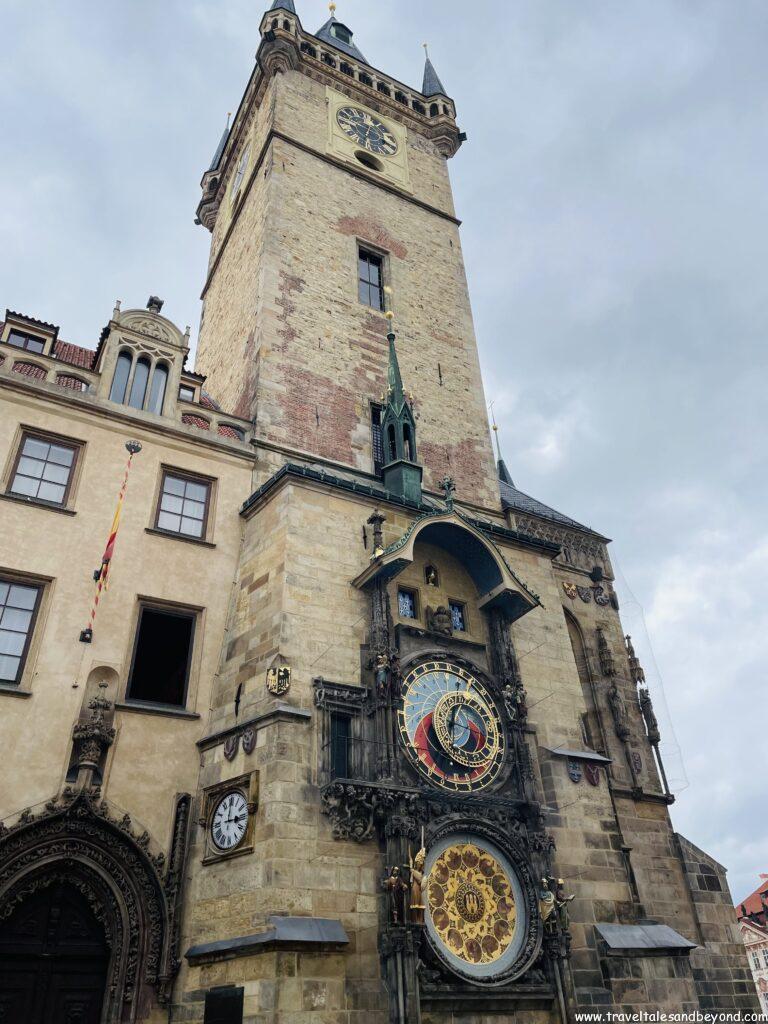
After the memorable ride, we took a quick lunch and were ready for our walking tour. The cobblestone streets of Old Town echo with the footsteps of history. As we strolled through the medieval alleys, the gothic architecture of the Old Town Square and the astronomical wonders of the Astronomical Clock took us to a bygone era. The clock is the oldest clock that is still working, and it was installed in Old Town Hall in 1410.
The vibrant atmosphere of the square, surrounded by colorful buildings and the imposing Church of Our Lady before Týn, is a living testament to Prague’s architectural legacy. The local market in the old town area also has a lot to offer from local delicacies, local crafts, and produce.
Practical info:
- Old Town Square is free to explore
- The Astronomical Clock tower can be climbed for panoramic views — tickets ~€15
- The square gets extremely crowded mid-morning; arrive early or visit in the evening for a different atmosphere
Jewish Quarter, Charles Bridge
Venturing into the Jewish Quarter, also known as Josefov, we encountered a profound narrative of resilience. The quarter contains six synagogues, a town hall, and the Old Jewish Cemetery — one of Europe’s oldest, where layers of gravestones are stacked on top of each other due to the shortage of burial space within the ghetto. The synagogues, including the Spanish Synagogue and the Old-New Synagogue, were beautiful. There we noticed a unique Hebrew clock with anticlockwise movement and Hebrew characters.
- The cemetery and most synagogues are closed on Saturdays and Jewish holidays
- Allow 2–3 hours for a proper visit
Evening: Charles Bridge at Golden Hour
We ended Day 1 at Charles Bridge — and timing it for late afternoon was the right call. The 14th-century stone bridge spans the Vltava River and is lined with 30 Baroque statues of saints, their expressions frozen in devotion and supplication. It connects the Old Town with the Malá Strana (Lesser Town) district on the western bank.
At golden hour, the light on the bridge is extraordinary — the statues glow warm amber, the river catches the last of the sun, and the castle on the hill above turns silhouette. Artists and musicians set up along the bridge throughout the day; the atmosphere is unlike anything else in Europe.
Pro tip: Charles Bridge is open 24 hours and free to walk across. Visit early morning (before 8am) or at sunset to avoid the worst of the tourist crowds.
Day 2: Prague Castle, New Town & the Vltava by Boat
Morning: Prague Castle Complex
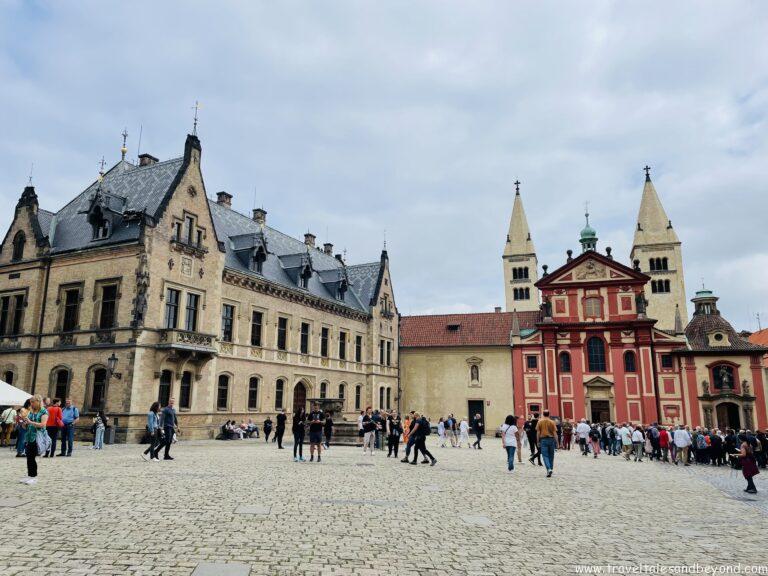
We used Day 2 to explore Prague’s New Town and the unmissable Prague Castle — the largest ancient castle complex in the world, stretching over 70,000 square metres on a hill above the Vltava River. We hopped on the hop-on-hop-off bus to get there comfortably.
The castle complex is so large that you could spend an entire day here and still not see everything. With limited time, we focused on two highlights:
St. Vitus Cathedral — the Gothic masterpiece at the heart of the complex. The soaring nave, the kaleidoscopic stained glass windows (including one designed by Art Nouveau artist Alfons Mucha), and the towering spires make this one of the most spectacular churches in central Europe. Free to enter the nave; a ticket is needed for the full interior and towers.
Basilica of St. George — one of Prague’s oldest churches, dating back to 920 AD. Its Romanesque interior is a striking contrast to the Gothic grandeur of St. Vitus next door.
After the churches, the Royal Garden at the northern edge of the castle grounds offers a peaceful green retreat with sweeping views over the red-roofed city below.
Practical info:
- Prague Castle grounds are free to enter; individual buildings require a Circuit ticket (~€15–€25 depending on which sites)
- Allow at least 3 hours
- The castle is open daily; arrive early to avoid tour groups
Afternoon: Dancing House & the New Town
Walking down from the castle into the New Town, we made a detour to see the Dancing House (Tančící dům) — one of Prague’s most talked-about modern buildings. Designed by Frank Gehry and Vlado Milunić and completed in 1996, its undulating glass-and-concrete form stands in deliberate contrast to the classical architecture around it. It’s nicknamed “Fred and Ginger” after the two dancing figures its silhouette supposedly evokes.
Late Afternoon: Sunset Boat Ride on the Vltava
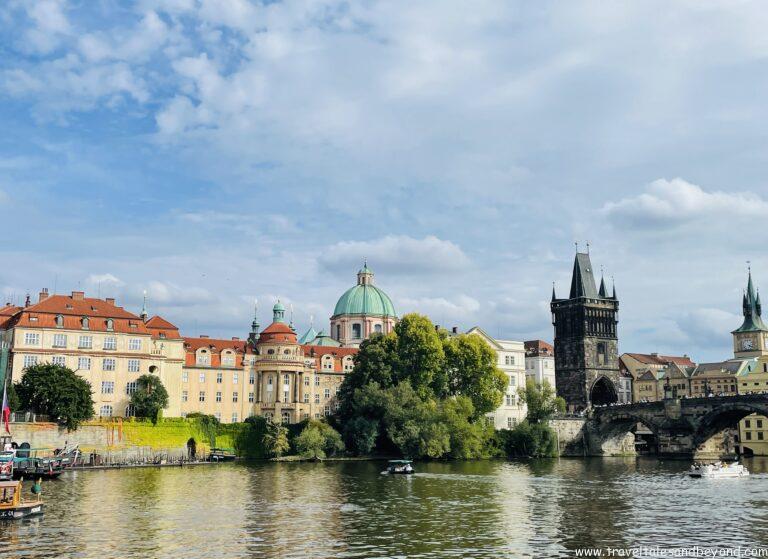
We ended Day 2 — and our Prague trip — with a boat ride on the Vltava River, and it was the perfect finale. As the golden hour light settled over the city, the castle and bridges reflected in the water, and the entire skyline seemed to exhale. One of those travel moments that stays with you.
Boat tours depart regularly from the riverbank near the Old Town, typically lasting 1–2 hours. Private rentals are also available if you want flexibility. Prices start around €15–€20 per person for a shared tour.
Day 3: Back to Nuremberg, Germany
The next day was our return journey back to Nuremberg in Germany. All the train options that we were getting had a 10-minute layover near the border. So, we decided to travel by bus instead. We tried the Flixbus option and were very glad about our choice. The 3 hours ride back was smooth and on time with two breaks in between.
Lorem ipsum dolor sit amet, consectetur adipiscing elit. Ut elit tellus, luctus nec ullamcorper mattis, pulvinar dapibus leo.
Prague Travel Tips: What You Need to Know Before You Go.
Visas & Entry
Czech Republic is a member of the Schengen Area. EU and EEA citizens enter freely. Citizens of the US, UK, Canada, Australia, and most other Western countries can visit visa-free for up to 90 days in any 180-day period. Always verify current requirements for your nationality before booking.
Best Time to Visit Prague
Spring (April–May): Mild weather, blooming parks, manageable crowds. Excellent choice.
Summer (June–August): Warm and lively — but very crowded and pricier. Book accommodation early.
Autumn (September–October): Beautiful golden light, fewer tourists, comfortable temperatures. Our top pick.
Winter (December–February): Cold, but the Christmas markets (November–January) are magical. Fewer crowds post-Christmas.
Getting Around Prague
On foot: The Old Town is extremely walkable. Most Day 1 sights are within 15–20 minutes on foot of each other.
Metro & tram: Prague has an excellent, affordable public transport network. Buy a 24-hour pass (~€5) for unlimited metro, tram, and bus travel.
Taxi: Use the Bolt or Uber apps for transparent pricing — avoid hailing unlicensed taxis on the street, particularly near tourist spots.
Hop-on-hop-off bus: Useful for reaching Prague Castle and the New Town without navigating on foot.
Money & Budget
Currency: Czech Koruna (CZK/Crown). Note: Czech Republic uses CZK, not the Euro — though many tourist-area shops accept euros and US dollars, the exchange rate is usually poor.
ATMs: Widely available; avoid the exchange booths near the main tourist spots which charge high fees.
Budget estimate: Prague is excellent value by Western European standards. Mid-range travelers should budget around €80–€130/day per person including accommodation, meals, transport, and entrance fees.
Tipping: 10% is standard in restaurants.
Where to Stay
The Old Town (Staré Město) is the best base for a short trip — walking distance from virtually everything and full of restaurants and cafés. Malá Strana (Lesser Town, below the castle) is quieter and characterful. Vinohrady is a good option if you want something more residential and local-feeling, with easy metro access to the center.
Language
Czech is the official language. In tourist areas, English is widely spoken. A few words of Czech — děkuji (thank you), prosím (please) — are always appreciated.
What to Pack
Comfortable shoes: Prague’s Old Town is almost entirely cobblestone — sturdy, flat-soled footwear is essential.
Power adapter: Czech Republic uses Type E plugs (European round-pin), 230V.
A light jacket: Even in summer, evenings on the river can be cool.
Cash: Some smaller cafés and market stalls are cash-only.
If you loved reading this post, please check out my other posts here.
Few recent posts
- Spain – Barcelona, Valencia, Seville, Madrid
- Germany – Berlin, Dresden, Nuremberg
- Belgium – Brussels, Bruges, Ghent, Dinant
- Netherlands – Amsterdam – Canals, Dykes, Zaanse Schans, Giethoorn & the Johan Cruyff Arena
- Luxembourg – A guided half day tour from Brussels
- Portugal – A week long trip to Lisbon, Porto, Nazare, Duoro valley
- Tanzania – A 7-day trip to African safari
- Chile – A week long trip to breathtaking Patagonia
- Gibraltar – A day trip from Spain
- Australia – A 2 week itinerary
- Fiji – A four-day stopover
- Turkey – A 10 day trip to Istanbul and Cappadocia region
- Costa Rica – A 10 day trip to the Central American paradise
Shaminee is a U.S.-based mom and family travel blogger who designs detailed itineraries for her own family and turns them into practical guides for others. Her goal is to make family travel simpler, more organized, and more enjoyable.
Read more →