
We spent Christmas in Egypt — 9 hectic days covering Cairo, Aswan, Abu Simbel, Kom Ombo, Edfu, and Luxor with a group of 19 family and friends, with our family of three splitting off at the end for the Red Sea in Sharm el-Sheikh. Our checked luggage never arrived after a missed connection at Heathrow, so we did the entire trip out of our carry-ons. Highlights: the Pyramids of Giza, Abu Simbel, a sunrise hot air balloon ride over Luxor, the extra-ticket tomb of Queen Nefertari — the most beautiful tomb we saw in Egypt — and diving and snorkeling the Red Sea reefs. Most of the group flew home on New Year’s Eve; we stayed on in Sharm el-Sheikh for a few extra slow days.
Travel Month – December
Our Egypt trip started with a disaster
We were flying to Cairo for Christmas — a group of 19 family and friends, some flying in from different countries, the rest of us US-based — when we missed our connection at Heathrow in the middle of holiday-season chaos. Our checked bags didn’t make that flight. Or the next one. In fact, they never caught up with us at all — not in Cairo, Aswan, Luxor, or Sharm el-Sheikh. For nearly two weeks, the three of us lived entirely out of our carry-ons.
Looking back, the single best packing decision I’ve ever made was putting all of my son’s clothes and all our warm clothes in the carry-on. That one habit saved our trip.
And yet — hectic, bagless, and running on fumes — Egypt remains one of the most memorable trips we’ve taken as a family. Here’s how the nine days unfolded.
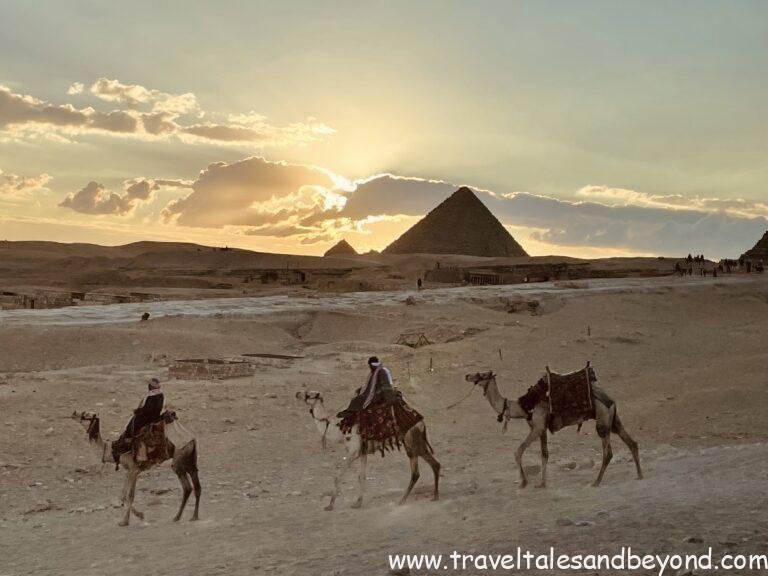
The group: 19 people, one private bus
With 19 of us traveling together, we had a private bus and our own Egyptologist guide for the whole trip — and he was exceptional. He could actually read hieroglyphs, so instead of just pointing at temple walls, he translated them for us: the stories, the gods, the pharaohs’ boasts, all of it unfolding panel by panel. It changed the temples from pretty ruins into actual narratives.
There was also an armed police officer riding with our bus for the entire trip. We’d assumed it was because several of us are US citizens — but it’s actually standard Egyptian protocol for tour groups, a practice going back to the 1990s. Our tour company arranged it; we didn’t ask for it, and after the first day we barely noticed him.
We didn’t do a Nile cruise, which is how many visitors travel between Aswan and Luxor. With 19 of us, a private tour with our own bus turned out to be more flexible and more cost-effective. We could set our own timings, skip or add stops, and choose our own hotels at each stop instead of following a fixed boat schedule.
Our 9-day Egypt route — from Cairo’s pyramids to Abu Simbel, Luxor’s temples and a Red Sea finale in Sharm el-Sheikh. Tap a numbered stop for the highlights.
Table of contents
- Day 1 — Back from the desert, on to Cairo
- Day 2 — Giza, Saqqara & Memphis
- Day 3 — Fly to Aswan, High Dam & Philae Temple
- Day 4 — Abu Simbel
- Day 5 — Kom Ombo & Edfu, on to Luxor
- Day 6 — Luxor’s West Bank & the Nefertari tomb
- Day 7 — Sunrise balloon, Karnak & Luxor Temple
- Day 8 — Sharm el-Sheikh & the Red Sea
- Day 9 — The group flies home, we stay on
- Good to know: tour, tipping & pace
- Buying tickets
- Frequently asked questions
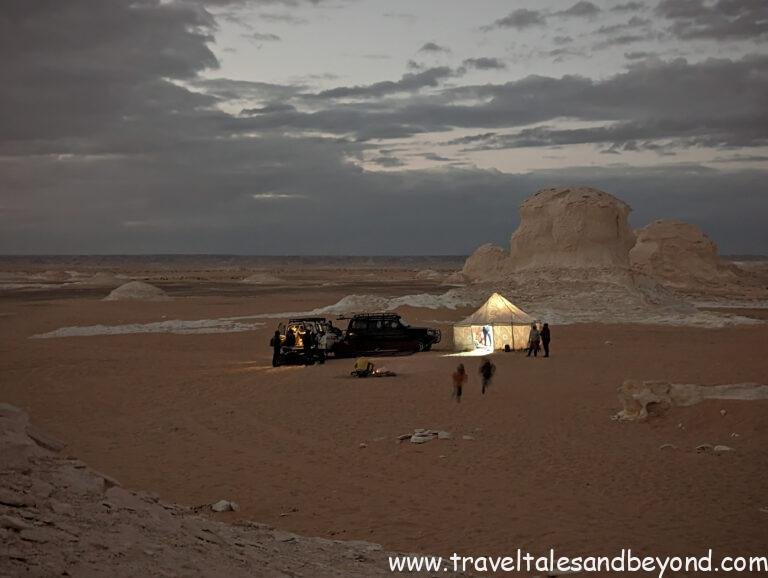
Day 1 — Back from the desert, on to Cairo
After our 3-day desert safari through Fayoum and the White and Black Deserts, we headed back to Cairo to meet up with the rest of our group. With everyone together, the temple-and-tomb part of the trip could begin. We stayed in Hotel Sofitel, Cairo
Day 2 — Giza, Saqqara & Memphis
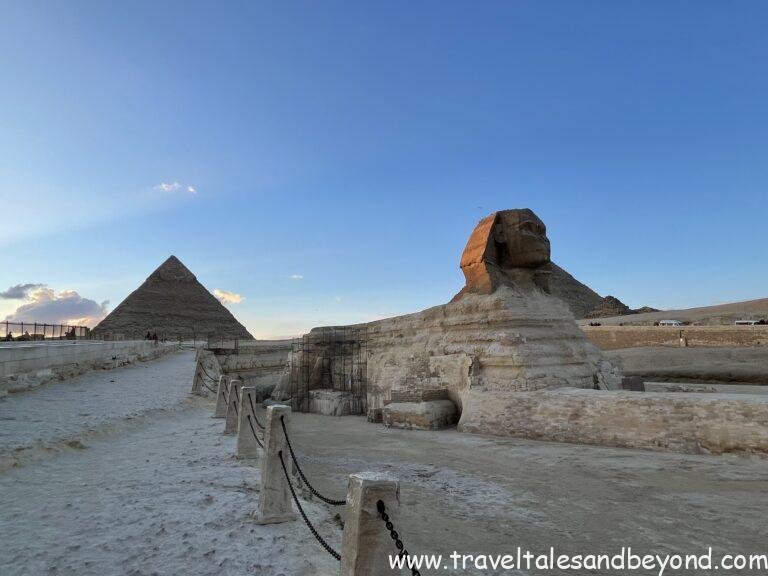
The big day: the Pyramids of Giza — Khufu, Khafre and Menkaure — plus the Great Sphinx. The Great Pyramid alone is worth the trip: built around 2560 BCE for Pharaoh Khufu, it was the tallest human-made structure on earth for more than 3,800 years, assembled from some 2.3 million stone blocks — and it’s the only surviving Wonder of the Ancient World. The Sphinx, carved around 2500 BCE with the face believed to be Pharaoh Khafre, stretches 73 meters long.
Going inside the Great Pyramid needs a separate ticket, and only a few of our group did it. Our guide was honest with us: the entrance passage is low, narrow and gets congested, and there isn’t much to see inside beyond a stooped climb up to a bare granite burial chamber. Since we were visiting more pyramids at Saqqara that afternoon anyway, most of us skipped it and spent the time out on the plateau instead. With younger kids, or anyone claustrophobic, we’d skip it again.
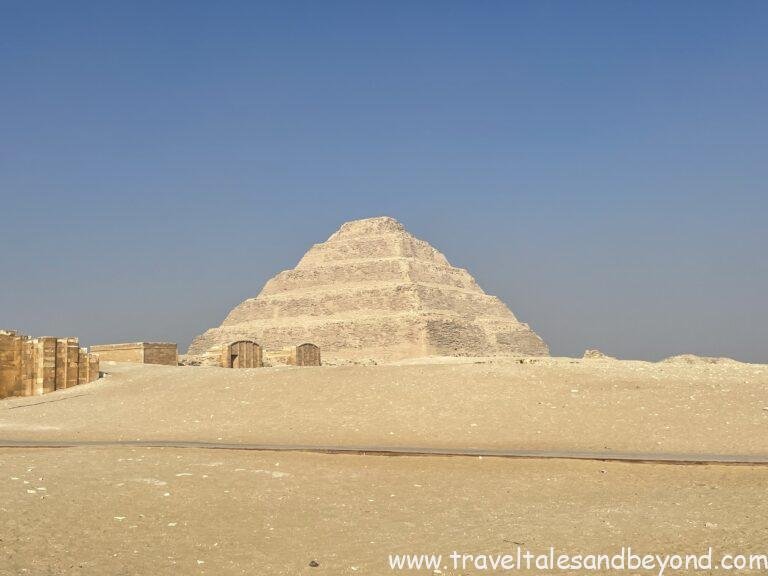
Then on to Saqqara to see the Step Pyramid of Djoser — designed by the architect Imhotep around 2670 BCE, the first pyramid ever built and the prototype for everything at Giza. Finally Memphis, Egypt’s first capital, founded around 3100 BCE, with its colossal 10-meter fallen statue of Ramses II and the Alabaster Sphinx. A full day, and our guide’s hieroglyph translations were already earning their keep.
Travel times: central Cairo to Giza, 45–60 minutes depending on traffic · Giza to Saqqara, about 45 minutes · Saqqara to Memphis, about 15 minutes · Memphis back to central Cairo, 1–1.5 hours.
Day 3 — Fly to Aswan, High Dam & Philae Temple
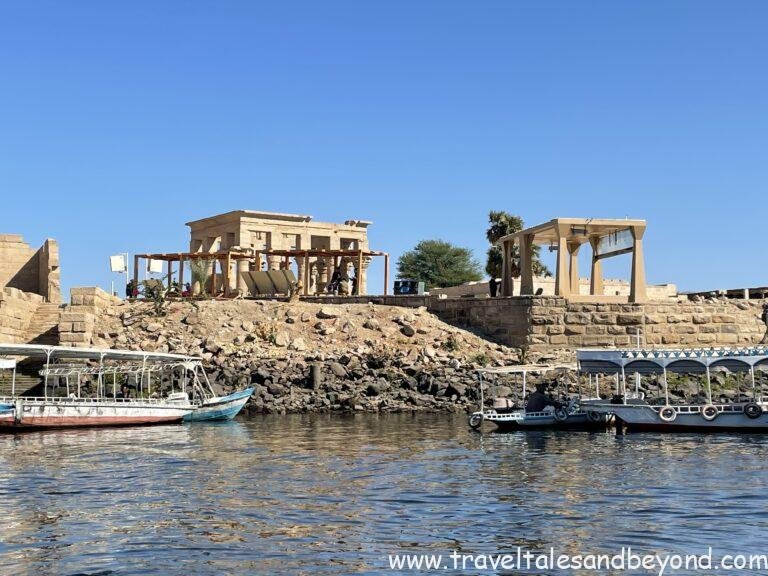
We flew from Cairo to Aswan (about 1 hour 20 minutes in the air), and the afternoon took us to the Aswan High Dam — completed in 1970, it tamed the Nile’s floods and created Lake Nasser, one of the largest artificial lakes in the world — and the Temple of Philae, the beautiful Ptolemaic-era Temple of Isis. Philae sits on an island, so you reach it by a short motorboat ride, which is a fun bonus for kids.
Philae has its own rescue story: when the dams’ waters threatened it, UNESCO dismantled the entire temple block by block in the 1970s and rebuilt it on higher ground on Agilkia Island. It was also one of the last places the old religion survived — the latest known hieroglyphic inscription, dated 394 CE, was carved here. We skipped the felucca sail on the Nile and relaxed at our hotel, the Mövenpick Resort Aswan.
Travel times: Aswan airport to the High Dam, about 20 minutes · High Dam to the Philae boat dock, about 10 minutes · motorboat to the island, about 10 minutes.
Day 4 — Abu Simbel
The long day trip south to Abu Simbel: Ramses II’s colossal rock-cut temples staring out over Lake Nasser, built in the 13th century BCE as a monument to the pharaoh’s own greatness — the four 20-meter seated statues on the facade are him, four times over. Beside the great temple stands the smaller one dedicated to his queen Nefertari and the goddess Hathor.
Like Philae, these temples were saved from the lake: in the 1960s, engineers cut the entire mountainside into blocks and reassembled it on higher ground in a UNESCO-led operation. Twice a year — February 22 and October 22 — the rising sun still reaches the inner sanctuary to light up three of the four seated gods, almost exactly as designed 3,200 years ago (the move shifted the dates by about a day). It’s about 280 km each way from Aswan — an early start, a lot of desert highway, and absolutely worth it.
Travel time: 3.5–4 hours each way by road, so most tours leave Aswan very early morning. Bring pillows, snacks and downloaded shows for the kids. There’s also a short flight from Aswan (about 45 minutes) if a 7–8-hour round-trip drive is too much for your family.
Day 5 — Kom Ombo & Edfu, on to Luxor
(this is the stretch most people cover on a Nile cruise; by road, it’s a single day)
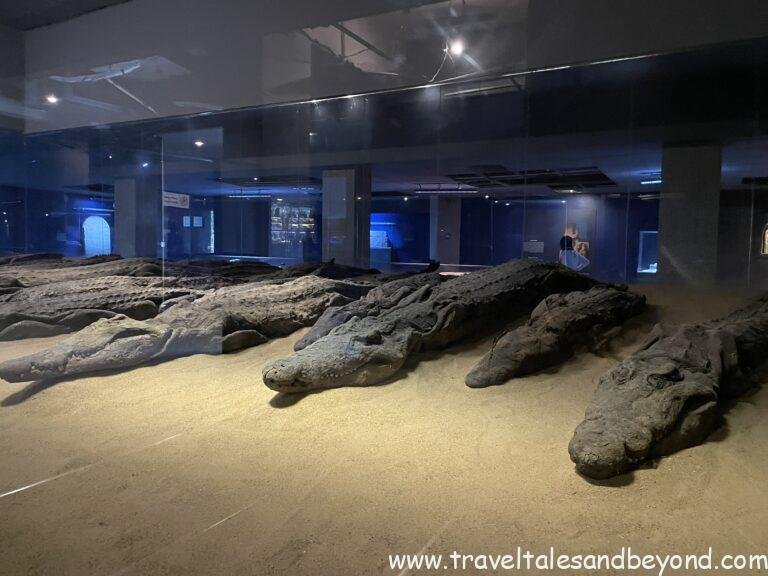
We checked out of Aswan and drove north along the Nile, stopping first at Kom Ombo — the unusual Ptolemaic double temple, half dedicated to Sobek the crocodile god and half to Horus the Elder, literally two temples mirrored in one building. The mummified crocodiles on display next door are a guaranteed hit with kids. Next came Edfu’s Temple of Horus, built between 237 and 57 BCE and the best-preserved ancient temple in Egypt. We reached Luxor by evening, tired and temple-happy.
Travel times: Aswan to Kom Ombo, about 1 hour · Kom Ombo to Edfu, about 1 hour · Edfu to Luxor, about 2 hours. It’s roughly 4 hours of driving, plus time at each temple.
Day 6 — Luxor’s West Bank and the Nefertari tomb
West Bank day: the Valley of the Kings — the burial ground of New Kingdom pharaohs for nearly 500 years, holding 63+ tombs including Tutankhamun’s, found intact by Howard Carter in 1922 — the terraced mortuary Temple of Hatshepsut at Deir el-Bahari, built for the woman who ruled as pharaoh for two decades in the 15th century BCE, and the Colossi of Memnon: two 18-meter statues of Amenhotep III, all that remains of his mortuary temple, which ancient travelers swore “sang” at dawn.
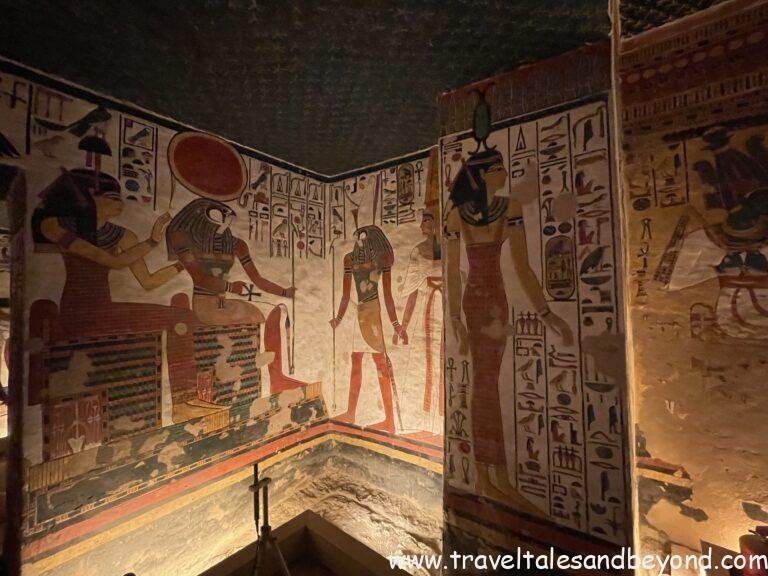
And then the splurge — we paid extra for the tomb of Queen Nefertari (QV66) in the Valley of the Queens. Entry is limited and the ticket costs extra on top of everything else, but it was worth it: the tomb of Ramses II’s beloved queen is often called the Sistine Chapel of ancient Egypt, its painted ceilings and wall reliefs astonishingly vivid after 3,200 years — the most beautiful tomb we saw in all of Egypt.
Travel times: Luxor’s East Bank hotels to the Valley of the Kings, 30–40 minutes by road · the West Bank sites are 10–15 minutes apart, and the Colossi of Memnon are on the way.
Day 7 — Sunrise balloon, Karnak & Luxor Temple, fly to Cairo
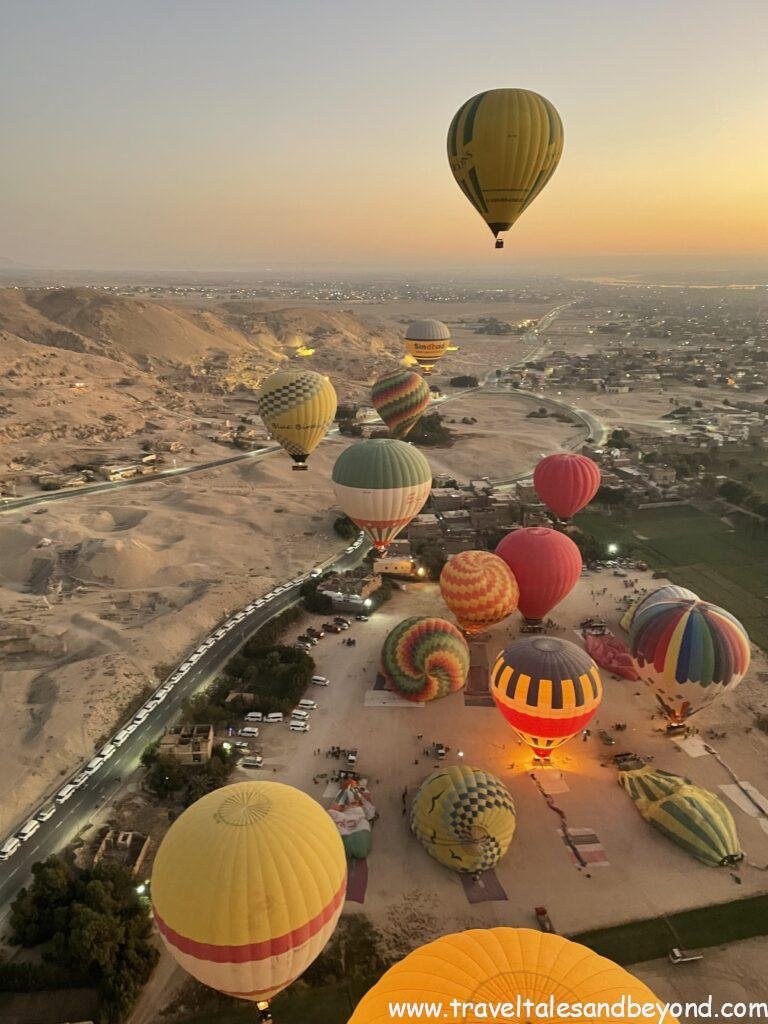
We started the day before dawn with the optional hot air balloon ride over Luxor — drifting above the West Bank as the sun came up over the Nile. It was our first balloon ride ever, and we loved it: the Valley of the Kings, Hatshepsut’s temple and the green strip of farmland along the river all laid out below in the early light. The kids in our group were thrilled, both by the new adventure and by a morning off from visiting temples.
Family note: most Luxor balloon operators don’t allow children under 6 — kids need to be at least 6 and accompanied by an adult.
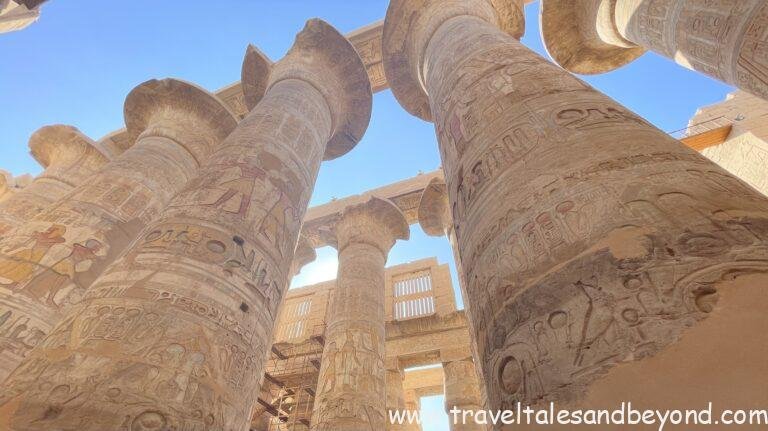
Then Karnak Temple — one of the largest ancient religious complexes in the world, built and expanded over some 2,000 years: the Avenue of Sphinxes, the Hypostyle Hall with its 134 massive columns (the tallest 21 meters high), the obelisks — followed by Luxor Temple, built largely by Amenhotep III and Ramses II and once linked to Karnak by a 3-kilometer avenue of sphinxes. Karnak’s sheer scale is hard to overstate; you walk between columns and feel very small, in the best way.
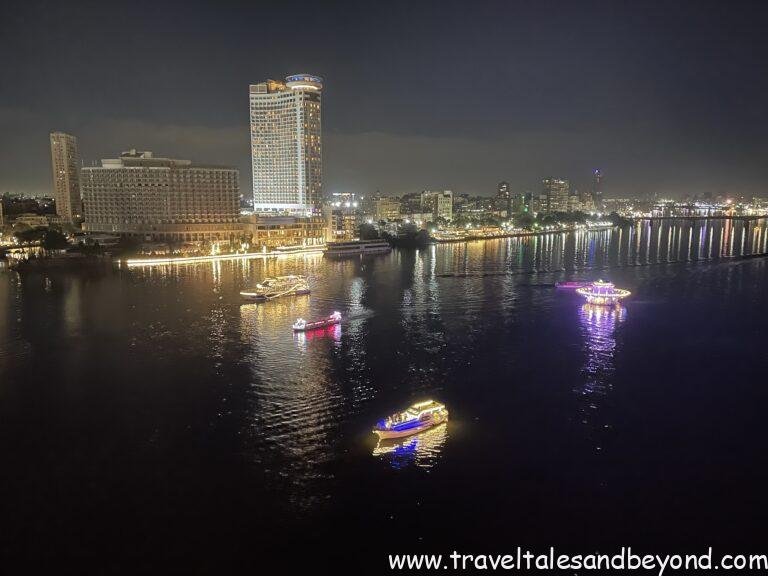
That evening, the whole group flew from Luxor back to Cairo. There, our family of three split off: while everyone else stayed in Cairo for one more day of sightseeing, the three of us caught another flight to Sharm el-Sheikh for a Red Sea finale.
Travel times: Karnak to Luxor Temple, about 10 minutes by road · Luxor to Cairo, about 1 hour by air · Cairo to Sharm el-Sheikh, about 1 hour by air.
Day 8 — Sharm el-Sheikh and the Red Sea
While the rest of the group spent Day 8 on Cairo sightseeing — the Egyptian Museum, Coptic Cairo, the Citadel — our family of three was in Sharm el-Sheikh. After eight days of temples, tombs, and desert highways, we wanted salt water.
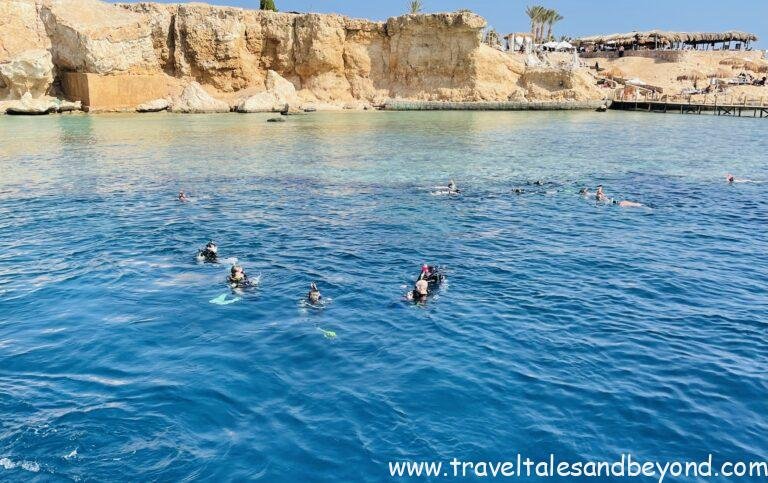
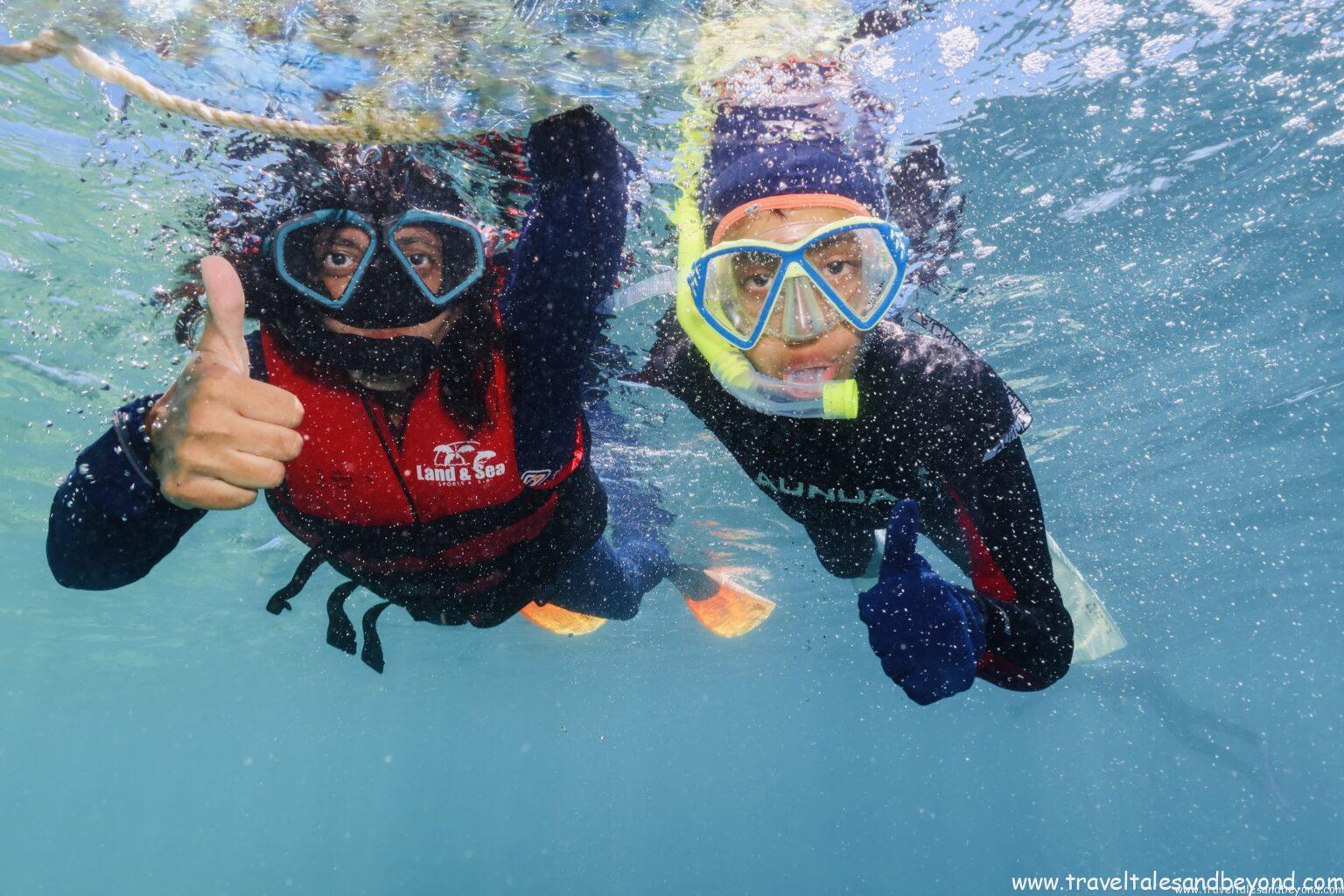
The Red Sea off Sharm is one of the world’s great diving and snorkeling destinations: coral gardens, steep drop-offs, and water so clear it barely looks real — warm enough to swim comfortably even in late December. This stretch of coast, including the renowned Ras Mohammed National Park at Sinai’s southern tip, holds some of the most celebrated dive sites on the planet. My husband went diving — he says it’s the best diving he’s done anywhere — while my son and I snorkeled the reefs, floating over coral gardens teeming with reef fish. After the hectic pace of the week, it was exactly the exhale we needed.
Travel times: Sharm el-Sheikh airport to most resorts, 15–20 minutes · boat trips to Ras Mohammed National Park, about 1–1.5 hours from the marina.
Day 9 — The group flies home, we stay on
New Year’s Eve: most of the group flew home, while our family of three stayed on in Sharm el-Sheikh for 3–4 more days. We rang in the new year on the beach instead of in transit.
We kept those extra days deliberately unscheduled. We’d booked an all-inclusive hotel, so the days fell into an easy rhythm of snorkeling, pool time and doing very little. After nine days of temples at a forced march, it felt luxurious.
And the luggage saga finally got its happy ending: back at Cairo airport on our way home, our missing bag was there waiting for us — nearly two weeks late. We checked it straight back in for the flight home.
Good to know
- Route: Cairo → Aswan → Abu Simbel → Kom Ombo → Edfu → Luxor → Cairo → Sharm el-Sheikh (our family of three split off for the Red Sea; the group finished with Cairo sightseeing)
- Tour operator: Luster Egypt Tours — a private tour for our group of 19, with a private bus and Egyptologist guide throughout. Their brochure at the time listed $575 per adult with kids free; hotels, international and domestic flights (Cairo–Aswan, Luxor–Cairo), the Egypt entry visa, and tips were extra.
- Payment: We paid for the tour in crisp US dollar bills. In Egypt, USD cash is widely accepted — but bring crisp, unmarked notes. Worn, torn, or heavily creased bills can get refused, so pick through your cash before you fly.
- Tipping: Budget for tips on top of the tour price. Tipping is deeply ingrained in Egypt — we tipped our guide and driver along the way, and small tips come up constantly (restrooms, porters, photo stops). Carry small bills.
- Hotels: not included in the tour — we booked all of our own accommodation along the route.
- Pace: honestly hectic. Two domestic flights, one very long driving day (Abu Simbel), and a sight nearly every half-day. With kids, 11–12 days would let you actually breathe between temples.
- Accessibility: Most of the sites on this itinerary aren’t wheelchair/stroller friendly, and they involve a lot of walking, often on uneven stone, sand and steps. Plan for long days on your feet, and if anyone in your group has limited mobility, talk to your tour operator before booking about which sites are manageable and where a vehicle can get you closer.
Buying tickets
Ticket prices for foreign visitors change often, so check current prices and book online at egymonuments.com, the Ministry of Tourism and Antiquities’ official ticketing site. Tickets are non-refundable, so double-check your dates before you pay. Our guide handled all of our tickets, but the major sites have gone cashless since our trip, so bring a Visa or Mastercard if you’re buying at the gate.
Three things are worth planning around:
- Inside the Great Pyramid: daily tickets are very limited, so book ahead.
- Nefertari’s tomb (QV66): it’s an extra ticket on top of the Valley of the Queens entry, and visits are capped to short time slots. Go early in the day, or have your guide or tour operator arrange it in advance.
- Abu Simbel on Sun Festival days (Feb 22 and Oct 22): these sell out, so book your transport and tickets 2–3 months ahead.
Everything else on this itinerary (the Giza plateau, Saqqara, Philae, Kom Ombo, Edfu, the Valley of the Kings, Karnak, and Luxor Temple) is a straightforward at-the-gate purchase.
Hot air balloon: budget roughly $120–180 per person, depending on the operator.
Note: some sites may be closed for restoration, so check with your guide or in travel forums for the latest updates.
Frequently Asked Questions
Is Egypt safe to visit with kids?
We felt safe throughout our trip, including with our son. Tourist groups travel with visible security — our bus had an armed police officer for the entire route, which is standard Egyptian protocol for tour groups. Use the usual common sense: stay with your group, drink bottled water, and book through a reputable operator.
When is the best time to visit Egypt?
Winter — roughly October through April — is the best time, with mild days that are ideal for sightseeing. We went over Christmas week: perfect temple weather, but it's peak season, so expect higher prices and bigger crowds. Summer in Luxor and Aswan can top 40°C (104°F), which is brutal for full days of ruins.
How many days do you need for Cairo, Luxor, and Aswan?
Nine days covered the essentials — Giza and Saqqara, Aswan and Abu Simbel, Kom Ombo and Edfu, and both banks of Luxor — but the pace was hectic. If you can stretch it to 11–12 days, you'll actually breathe between temples. Add 2–3 days in Sharm el-Sheikh if you want Red Sea time like we did.
How much does a family trip to Egypt cost?
It varies widely by travel style, but a mid-range guided tour with domestic flights, hotels, and entry fees typically runs a few thousand dollars per person for 9–10 days. Our tour operator's brochure listed ~$600 per adult (kids free) for the guided portion, with hotels, flights, visa, and tips extra. Budget separately for add-ons: the Nefertari tomb ticket, the hot air balloon, and daily tipping.
Should you book a guided tour or travel independently in Egypt?
With kids — and especially for a first visit covering this much ground — we'd recommend a guided tour. Ours handled all transport, entry tickets, and logistics across four cities, and our Egyptologist guide (who could read hieroglyphs) transformed the temples from pretty ruins into actual stories. Independent travel is doable, but the distances and logistics make a tour far less stressful for families.
Is the tomb of Queen Nefertari worth the extra ticket?
Yes — it was the highlight of our West Bank day. Entry is limited and costs extra beyond the standard Valley of the Queens ticket, but the colors and detail inside QV66 are unlike anything else we saw in Egypt. Go early in the day if you can.
Is there an age limit for the Luxor hot air balloon ride?
Yes. Most Luxor balloon operators require children to be at least 6 years old, and kids must be accompanied by an adult. If you're traveling with a younger child, check with your operator — some allow under-6s to wait with the ground crew.
Is Sharm el-Sheikh worth adding to an Egypt itinerary with kids?
Absolutely — it was our favorite exhale after eight hectic days of temples. The Red Sea reefs are spectacular for snorkeling, which works for confident young swimmers, and the water is swimmable even in December. We stayed at an all-inclusive resort, which made the slow days easy: snorkel in the morning, pool in the afternoon. If anyone wants to scuba dive, check minimum ages with operators in advance, as many set limits for kids.
Nile cruise or road trip: which is better for families?
A cruise is relaxing and bundles your hotel, meals and transport between Aswan and Luxor. For our large group, a private tour by bus was more flexible and more cost-effective: we set our own pace, picked our own hotels, and covered Kom Ombo and Edfu in a single day by road. Smaller families who want a slower pace may prefer the cruise.
Shaminee is a U.S.-based mom and family travel blogger who designs detailed itineraries for her own family and turns them into practical guides for others. Her goal is to make family travel simpler, more organized, and more enjoyable.
Read more →
Discover more from Travel Tales And Beyond
Subscribe to get the latest posts sent to your email.