
Travel Month – August
Belgium had always intrigued us with its charming medieval towns, vibrant city squares, and famous chocolates. With only two days to explore, we knew we had to plan carefully—but the beauty of the country made every moment worth it.
During our whirlwind trip, we discovered the best Belgium has to offer: the stunning architecture of Brussels, the fairy-tale canals of Bruges, and the lively history of Ghent. This guide will show you exactly what we did, what worked, and tips for planning your own 3-day Belgium itinerary—perfect for first-time visitors, families, or anyone traveling short on time.
Here are few interesting facts about this country.
Belgium has more castles per miles than any other country in the world. It is the birthplace of fries and not France as we all think when we think about French fries. Belgium is home to some of the world’s most famous comics — The Smurfs, Tintin, and Lucky Luke all came from Belgian artists. There’s even a Comic Strip Museum in Brussels!
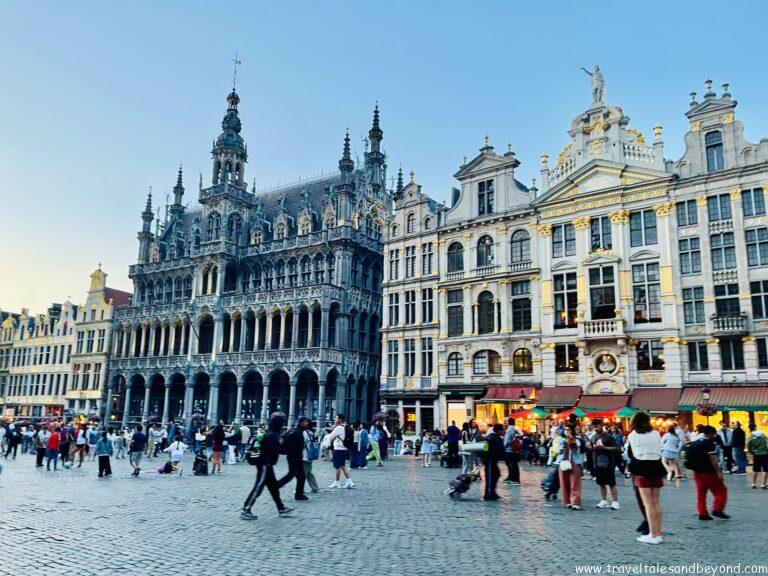
Day 1: Arriving in Brussels
We hopped on the train from Paris Gare du Nord and three hours later pulled into Brussels-Midi station. It’s one of those train journeys that makes you wonder why you’d ever fly between European cities — no airport queues, no security theatre, just a coffee and flat Belgian countryside sliding past the window, and then suddenly you’re there.From Brussels-Midi, a quick taxi dropped us at our hotel near the Grand Place. The moment we stepped out onto the cobblestones we knew we’d picked the right neighbourhood. The Grand Place was a five-minute walk, the waffle shops were impossible to avoid, and the whole area had that particular hum of a city that knows it’s beautiful and is quietly pleased about it.We dropped our bags, resisted the urge to nap, and headed straight out.
AtomiumOur first stop was the Atomium, a short metro ride from the city centre, and it’s one of those landmarks that genuinely surprises you in person. Built for the 1958 World’s Fair, the structure represents an iron crystal magnified 165 billion times — nine steel spheres connected by tubes, rising 102 metres above the Laeken plateau. It sounds industrial. It looks extraordinary.
Practical note: book tickets online in advance, especially in summer. The queues for walk-ins can be long and the timed entry system moves quickly once you’re inside.
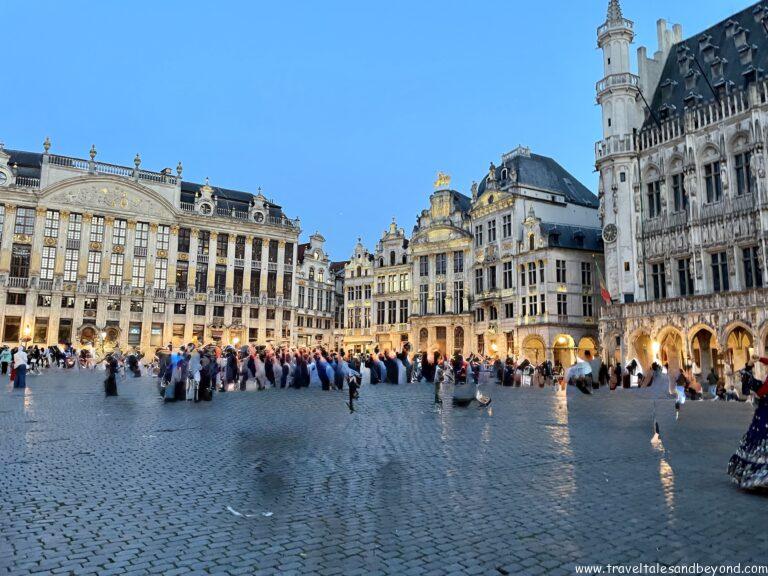
Grand Place
We saved the Grand Place for the evening and it was exactly the right call.
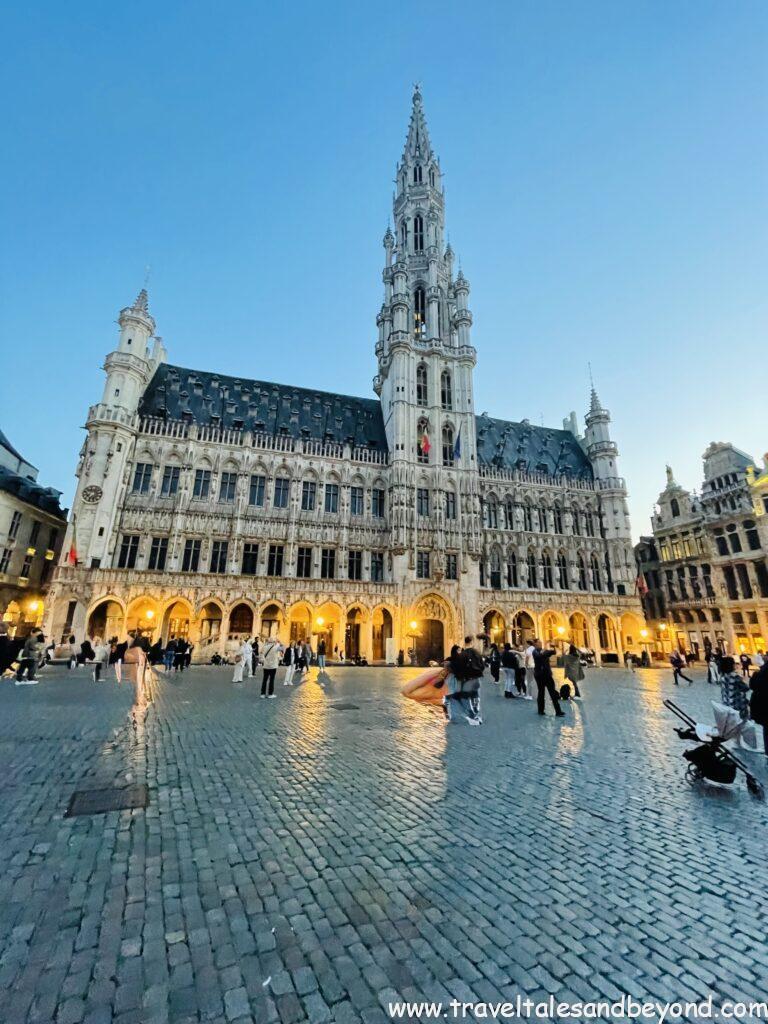
Arriving as the sun dropped and the floodlights came on, the square stopped us in our tracks. Every building around the perimeter — the Gothic Town Hall, the King’s House, the guild halls with their gilded facades — was glowing gold against the darkening sky. It is one of the most beautiful squares in Europe, and photographs do not fully prepare you for the scale and the detail of it in person.
We found a spot to sit on the cobblestones with paper cones of frites — double-fried, served with Andalouse sauce, and completely addictive — and just watched the square fill up with evening visitors. Street musicians set up on one corner.
A couple of things worth knowing: the Grand Place is beautiful at any time of day but genuinely magical after dark. If you’re arriving in the afternoon, resist visiting until the evening. And the frites stand in the streets just off the square — not the sit-down restaurants facing it — is where you want to eat. Better food, a fraction of the price.
Manneken Pis
A five-minute walk from the Grand Place, the Manneken Pis is one of those landmarks that exists primarily to be found, photographed, and mildly puzzled over. The statue is tiny — genuinely, surprisingly small — which is part of what makes it charming. Brussels has an entire culture built around it: the little figure has over a thousand costumes and is dressed in different outfits on significant dates throughout the year. Check in advance whether he’ll be wearing something interesting on the day you visit.
By the time we wandered back to the hotel, Brussels had already done its work on us. It’s a city that earns its reputation slowly and then all at once — you arrive expecting a stopover and leave wondering why you didn’t stay longer.
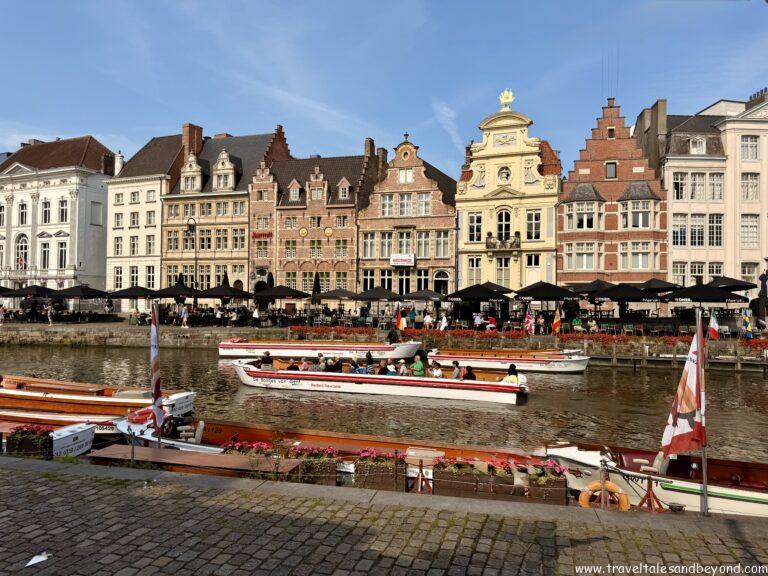
Day 2 – Day Trip to Ghent & Bruges
Ghent
We booked a day tour for Bruges and Ghent from Brussels. Train is another option if you want to avoid going in group.
Ghent was our first stop on the day tour from Brussels, and we had roughly an hour and a half there — not long, but enough to understand why people who’ve been keep telling others to go.
The coach dropped us in the city centre and we walked straight down to the Graslei and Korenlei, the two medieval guild-lined quaysides that face each other across the River Leie. This is the postcard view of Ghent — rows of ornate guild houses reflected in the water, old stone bridges connecting the two banks, and canal boats moving slowly underneath. On a sunny August morning it was genuinely stunning, the kind of scene that makes you stop mid-sentence and just look.
We spent most of our time here, wandering along both banks and finding a spot to sit by the water with coffee. If you have longer, the canal boat tours that depart from Graslei are worth doing — they take you under bridges and past parts of the city that you simply can’t see on foot.
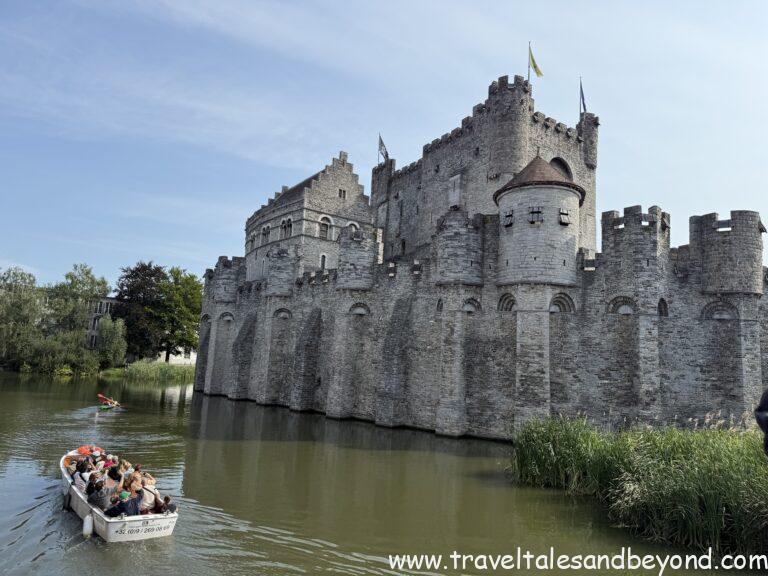
From the waterfront we walked up to Gravensteen Castle, the 12th-century fortress that rises unexpectedly from the middle of the city like something from a different era entirely. We didn’t go inside — time didn’t allow it — but even from the outside it’s an impressive thing to stand in front of. The contrast between the medieval stone walls and the modern city street surrounding it is striking. If you have a spare hour, the interior is reportedly excellent, with a collection of medieval weapons and armour and good views from the battlements.
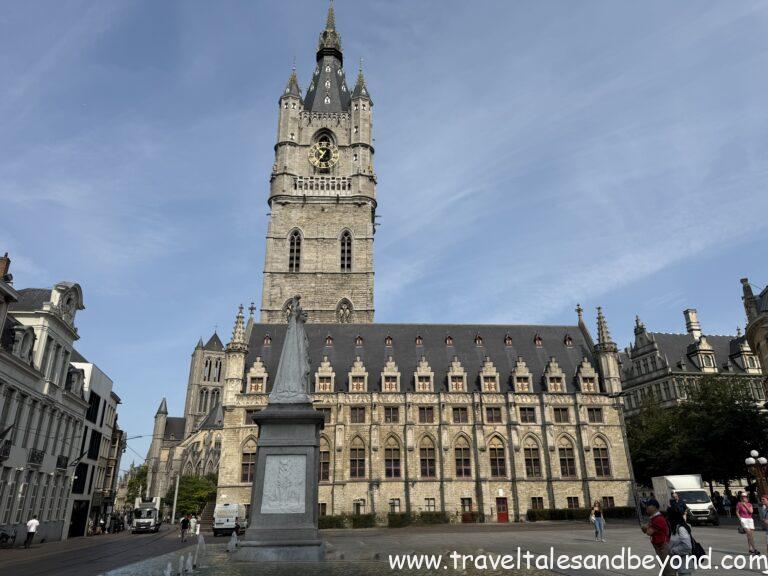
We finished with a quick look up at the Belfry of Ghent, the 14th-century tower that anchors the city’s skyline. There’s a lift to the top if you want the views — on a clear day you can see the full sweep of Ghent’s spires laid out below you — but with Bruges still ahead of us we kept moving.
An hour and a half in Ghent is enough to get a taste of it. It is not enough to do it justice. If your schedule allows, consider spending a night here rather than rushing through on a day tour — the city apparently transforms in the evening when the day trippers leave and the locals come out
Bruges
If Ghent surprised us, Bruges simply overwhelmed us. We’d seen photos, we knew it was supposed to be beautiful — and it still managed to exceed expectations the moment we stepped off the coach and into the old city.
Bruges is medieval in a way that doesn’t feel preserved or reconstructed — it feels genuinely intact. The cobblestone streets, the low brick buildings, the canals cutting through the city centre, the bridges draped with hanging baskets — it all fits together so naturally that you keep forgetting you’re in a real functioning city and not an open-air museum. People live here.
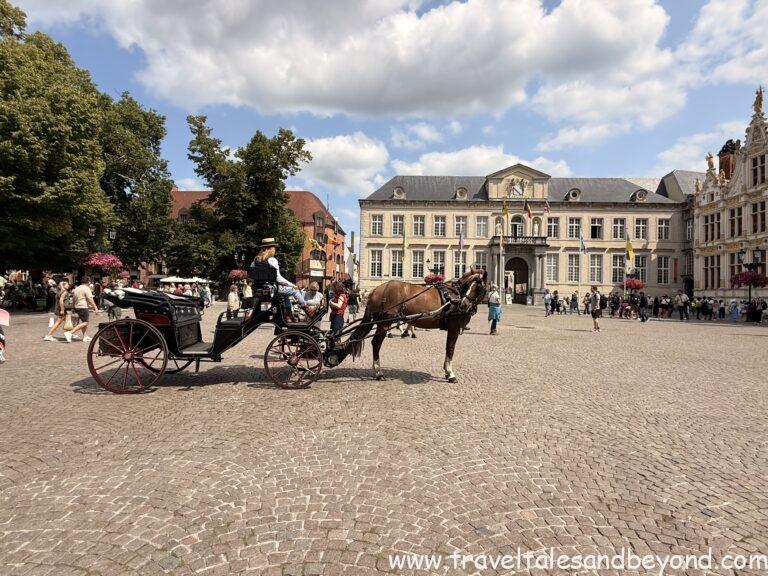
The coach dropped us at the Market — Bruges’ vast central square — and this is where you get your first proper sense of the city’s scale and ambition. The square is flanked by the stepped-gable facades of medieval guild houses, now mostly restaurants and cafés, and dominated on one side by the soaring bulk of the Belfry Tower. Horse-drawn carriages clip across the cobblestones. It sounds touristy and it absolutely is — but it earns it.
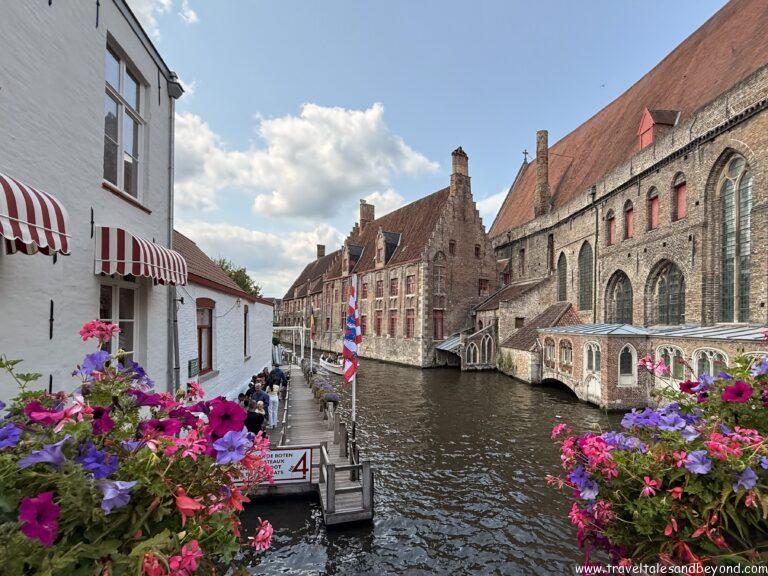
The canal boat ride was, unexpectedly, the highlight of the afternoon. The boats are small, the guides are good, and the 30-minute loop takes you through parts of Bruges that are completely invisible from street level — narrow waterways between the backs of old houses, under low stone bridges, past private gardens and hidden courtyards. The city looks entirely different from the water. If you only have time for one thing in Bruges, make it this.
We finished at Minnewater — the Lake of Love — at the southern edge of the old city, and it was the right note to end on. The lake is quietly beautiful: wide and still, fringed with trees, with a medieval lock house at one end and swans drifting slowly across the surface. A couple of hours in Bruges is genuinely not enough — the city rewards an overnight stay in a way that few places do. It was the perfect way to end the day.
By the time we got back to our hotel, we were exhausted but couldn’t stop smiling. Belgium had completely stolen our hearts — from the waffles and fries to the fairytale towns and friendly people.
Day 3 – A day tour to Luxembourg and Dinant
Luxembourg
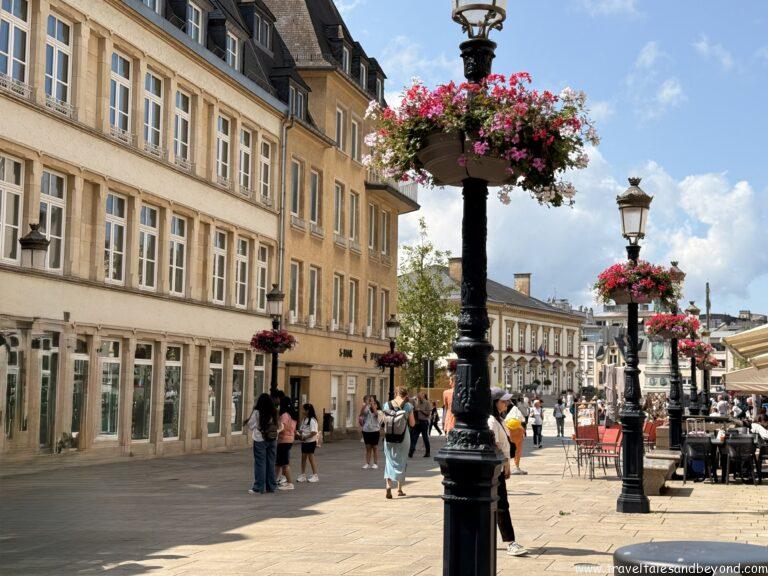
After exploring Brussels, Bruges, and Ghent, we decided to spend a day visiting a new country altogether — Luxembourg! One of the best things about traveling in Europe is how easy it is to hop between countries, and Luxembourg is just a short train ride away from Brussels. However, we took a bus tour from Brussels to Luxembourg. Details are in the Luxembourg post.
Dinant
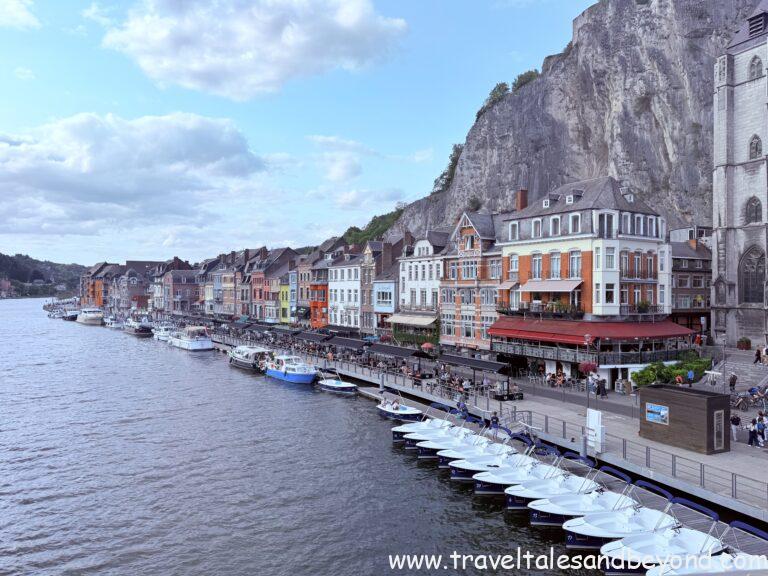
Dinant was an unplanned bonus — a stop on the way back from Luxembourg that turned out to be one of the most visually striking moments of the entire trip.
The town announces itself dramatically. As the coach rounded a bend in the road, the full view opened up at once: a narrow strip of town squeezed between the River Meuse and a sheer limestone cliff face, with the pale Gothic tower of the Collegiate Church rising from the riverbank and the medieval Citadel perched improbably on the rock above it.
We had an hour or so to wander, which turned out to be just enough to get a proper feel for the place.
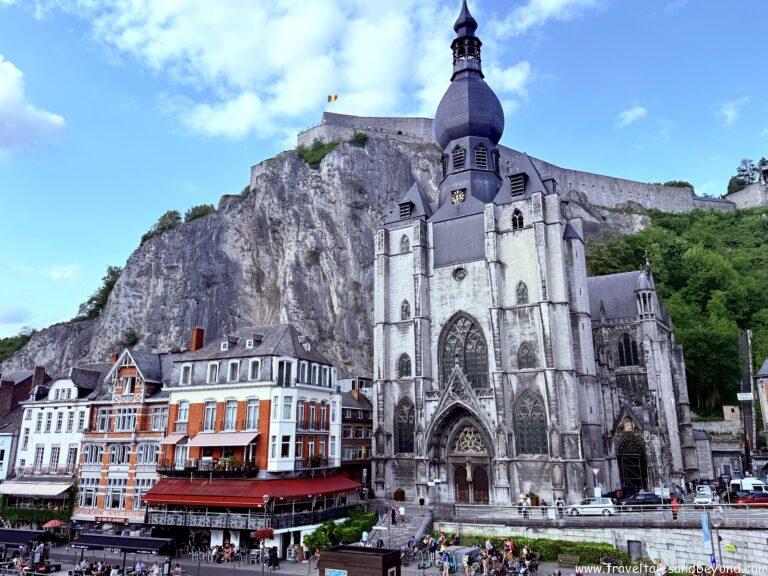
The Collegiate Church of Our Lady
The Collegiate Church sits right at the base of the cliff, its distinctive bulbous spire almost touching the rock face behind it. We went inside briefly and it’s worth a few minutes — the interior is cool and quiet, with good light in the afternoon, and the architecture has that particular solidity of medieval Belgian Gothic that you also see in Ghent and Bruges. The setting alone, wedged between river and cliff, makes it unlike any church we’ve visited elsewhere.
The Citadel
We didn’t go up to the Citadel — time didn’t allow it — but it dominates the town from every angle and is hard to ignore. The fortress dates back to the 11th century and was rebuilt multiple times, most recently after significant damage in both World Wars. You can reach it by cable car from the riverfront or by climbing 408 steps cut directly into the cliff face. The views from the top are reportedly exceptional. If you’re visiting Dinant independently rather than as a tour stop, this is worth building time around.
The Adolphe Sax House
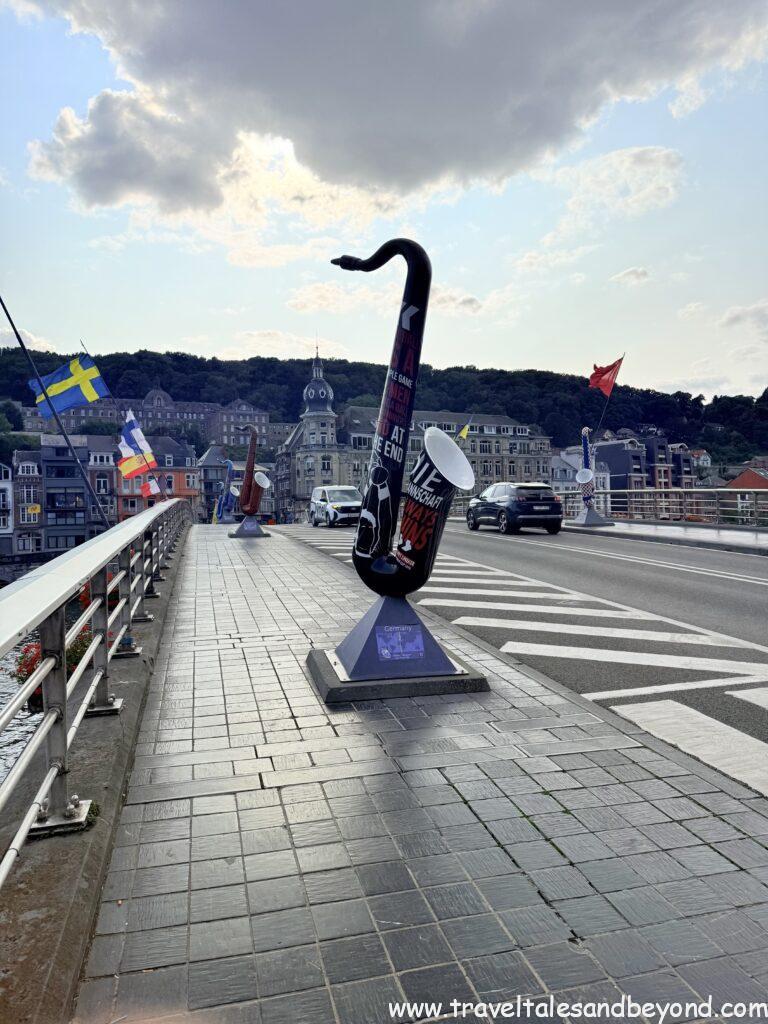
One of the more unexpected things about Dinant is that it’s the birthplace of Adolphe Sax — the inventor of the saxophone. The house where he was born in 1814 is marked on the main street, and the town celebrates the connection enthusiastically: saxophone-shaped sculptures in various colors are dotted along the riverfront and through the streets, each one painted differently. It’s a charming quirk that gives the town a personality beyond its dramatic scenery.
After our Dinant stop, we made our way back to Brussels and next day we hopped on a train to Amsterdam — just a 2-hour journey and a brilliant way to extend a Europe trip. You can read all about our Amsterdam family trip here.
Belgium Travel Tips: What You Need to Know Before You Go.
1. Trains are convenient
Belgium’s train system is super easy to use and very efficient. Trains between Brussels, Ghent, and Bruges run frequently — usually every 20–30 minutes — so you don’t need to book ahead. Just grab tickets at the station or use the SNCB/NMBS app. If you’re continuing through Europe, Germany makes a brilliant next stop — here’s our Berlin, Dresden & Nuremberg itinerary.
2. Stay in the Old Town
If you’re visiting Brussels, pick a hotel or Airbnb near the Grand Place or Sainte-Catherine area. You’ll be close to all the main sights, restaurants, and bars, and you can walk pretty much everywhere.
3. Food to try (and love)
You can’t leave Belgium without tasting:
- Belgian waffles – crisp on the outside, fluffy inside (try Maison Dandoy in Brussels)
- Fries (frites) – double-fried perfection, usually with mayo or Andalouse sauce
- Mussels (moules-frites) – especially in Brussels or Bruges
- Belgian chocolate – go for brands like Neuhaus, Pierre Marcolini, or The Chocolate Line
- Beer – even if you’re not a big beer fan, Belgian brews are next level
4. Day trips are totally worth it
Ghent and Bruges are easy to visit in one day from Brussels, but if you have more time, staying overnight in Bruges is magical — the town at night is pure fairytale.
5. Although card works in most places, don’t forget to carry Euros too.
If you liked reading this post, here are few more
- Luxembourg – A guided half day tour from Brussels
- Portugal – A week long trip to Lisbon, Porto, Nazare, Duorro valley
- Germany – Berlin, Dresden, Nuremberg
- Spain – Barcelona, Valencia, Seville, Madrid
- Prague – A 2-day escape to Bohemian beauty
- Gibraltar – A day trip from Spain
- Chile – A week long trip to breathtaking Patagonia
- Australia – A 2 week itinerary
- Fiji – A four-day stopover
- Turkey – A 10 day trip to Istanbul and Cappadocia region
- Costa Rica – A 10 day trip to the Central American paradise
- Tanzania – A 7-day trip to African safari
Over to you
Three days in Belgium felt like nowhere near enough — we left with a list of reasons to go back. Have you ever had a trip that surprised you like that?

Shaminee is a U.S.-based mom and family travel blogger who designs detailed itineraries for her own family and turns them into practical guides for others. Her goal is to make family travel simpler, more organized, and more enjoyable.
Read more →
Discover more from Travel Tales And Beyond
Subscribe to get the latest posts sent to your email.