
At a Glance
| Destination | Torres del Paine National Park, Chile |
| Travel month | April (autumn — highly recommended) |
| Child’s age | 9 years old |
| W Trek legs completed by child | French Valley (12 miles), Glacier Grey (7 miles one way) |
| Group split day | Base of Towers — dad did full 14-mile hike, son did Los Bosques trail + Gaucho barbecue |
| Operator | Knowmad Adventures + Hotel Explora |
| Cost | ~$14,500 for family of 3 (excluding international flights) |
| Verdict | Yes — but only with the right operator |
| Full itinerary | 1 Week in Patagonia → |
Table of Contents
- The Question Every Parent Asks
- Our Son’s Hiking Record — Honestly
- The Hikes He Did — And How He Really Did
- What Made It Work — Practically
- What Was Hard — The Honest Part
- His Personal Highlight — It Wasn’t the Hiking
- The Operator Question — Why It Matters More Than Anything
- What Age Is Right for Patagonia with Kids?
- Our Honest Verdict
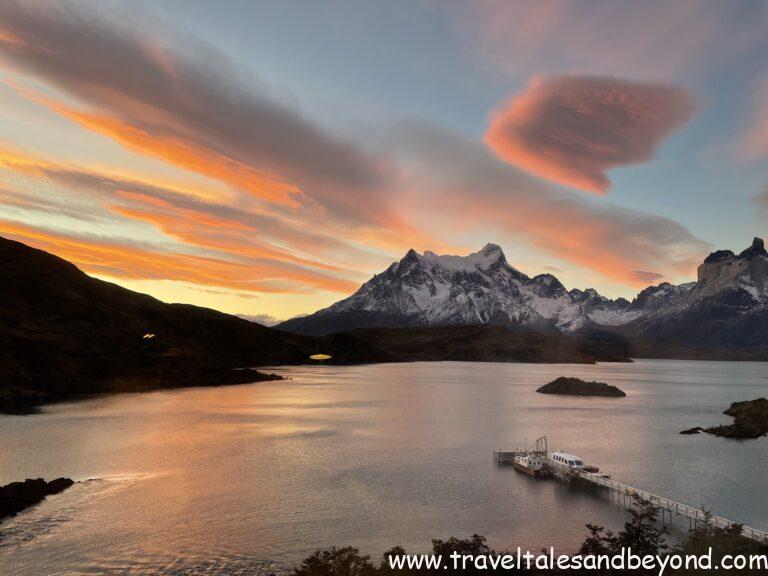
The Question Every Parent Asks
It started with a conversation a few months before the trip. Our son was 9, physically active, sporty — the kind of kid who runs when he could walk and climbs anything within reach. Someone floated the idea: could he do the Everest Base Camp (EBC) trek?
The answer was probably yes. But EBC requires a long school break we couldn’t make work and we were not sure about altitude sickness. So we did what any adventure-loving family does — we found the next best thing. Patagonia. Torres del Paine National Park. The W Trek. One of the most dramatically beautiful and physically demanding hiking destinations on the planet.
And because another family of close friends was coming with us — including a child the same age — we had one more reason to say yes. Two 9-year-olds keep each other going in ways that no amount of parental encouragement can replicate.
So when people ask us whether Patagonia is doable with kids, our answer isn’t a simple yes. It’s a story.
This is that story — the honest version. The two W Trek legs he completed, the one leg we split as a group and why that was the smartest decision we made, the moments that were genuinely hard, and the reason his favourite memory from the entire trip had nothing to do with glaciers or granite towers.
If you’re sitting with a browser full of tabs wondering whether to bring your child to Torres del Paine, read this first.
Our Son’s Hiking Record — Honestly
Let’s set the record straight before we get into the day-by-day detail.
Our son was 9 years old, physically active, and sporty. He plays sport year-round, rarely sits still, and has the kind of energy that makes other parents quietly exhausted just watching him. None of that is an exaggeration — but none of it is the same as being prepared for a 12-mile hike in Patagonian wind.
In the months before the trip we did some local hiking in the Pacific Northwest — a mix of easy and moderate trails, nothing that would be described as serious preparation. We live in a part of the world where good hiking is accessible and we used it. But the longest, most challenging trail we did before Chile was nowhere close to a full day in Torres del Paine. We weren’t training him — we were just making sure he remembered he liked being outside.
That was our preparation. It was enough — but only because of who he is, not because of what we did.
Here’s what that actually looked like on the trail.
The first few hours of every hike he was at the front. Not near the front — at the front. Setting the pace, pointing things out, asking the guides questions, completely in his element. If you’d watched him in the first three hours of the French Valley hike you’d have thought Everest Base Camp was a conservative ambition.
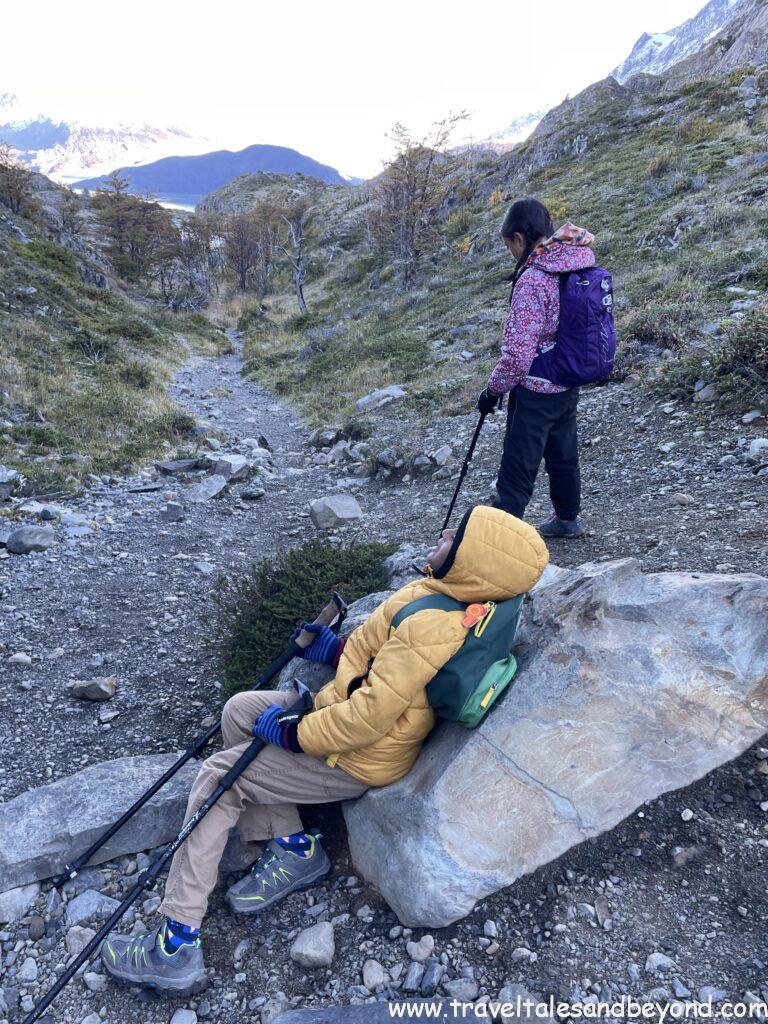
Then the hours accumulated. By the back half of the longer days — particularly the French Valley’s 12 miles — the question started appearing. “How much further?” Once. Then again. Then once more. Not whining — just a 9-year-old doing an honest calculation of how much he had left in his legs.
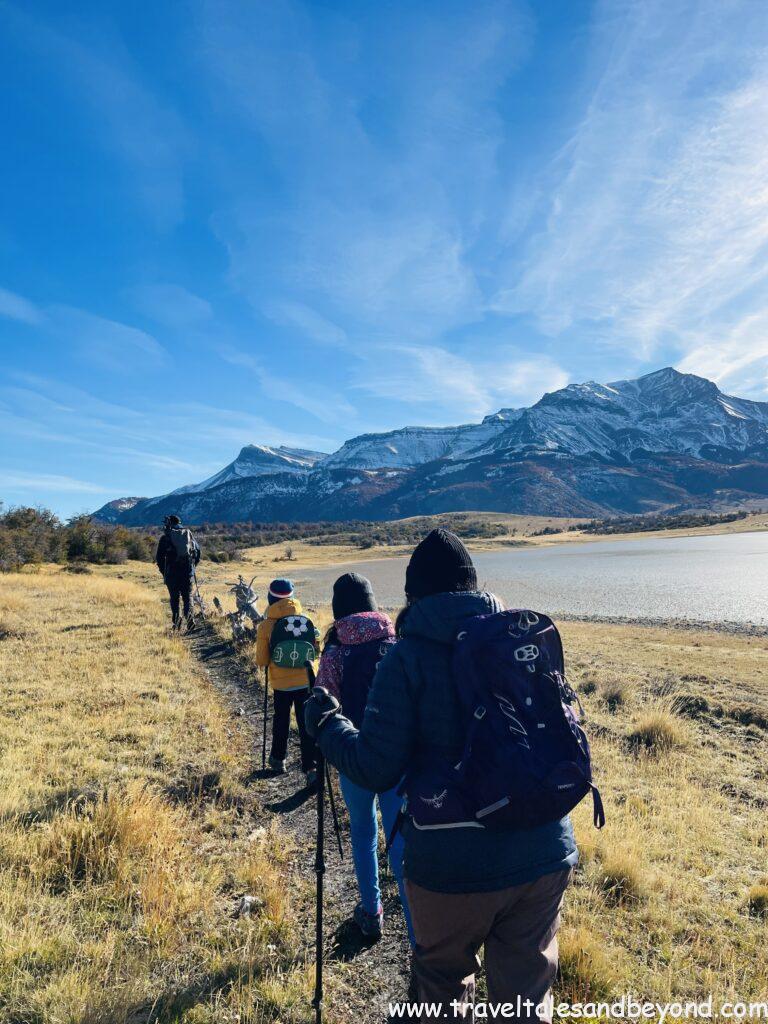
And here’s what made the difference every single time: his friend. The other family’s child — the same age, same energy, same mixture of enthusiasm and occasional exhaustion. When one flagged the other pulled him forward. When both flagged at once the guides stepped in with distraction, encouragement, and perfectly timed snack breaks. But mostly it was the friendship. Two kids pushing each other through the hard parts in a way no parent or guide can manufacture.
By the end of each long day he was tired in the way that only genuine physical effort produces — the kind of tired that comes with quiet pride. He never once said he wanted to stop. He just wanted to know how far away the finish was.
That’s the honest picture. Enthusiastic, capable, genuinely tested, and ultimately unstoppable — with a little help from his friend.
What this means for your child: Pacific Northwest hiking on easy to moderate trails is a reasonable way to gauge whether your child is ready for Patagonia. If they handle 5-6 mile moderate hikes without complaint and still have energy at the end, they’re a candidate. If they struggle at mile 3, Patagonia’s full-day hikes will be a very hard day. Be honest with yourself about this before you book.
The Hikes He Did — And How He Really Did
French Valley Hike (12 miles / 20km) — Full Completion
This was the first big test and the one we were most nervous about. Twelve miles is a long day for anyone. For a 9-year-old on his first serious hiking trip, it was the unknown.
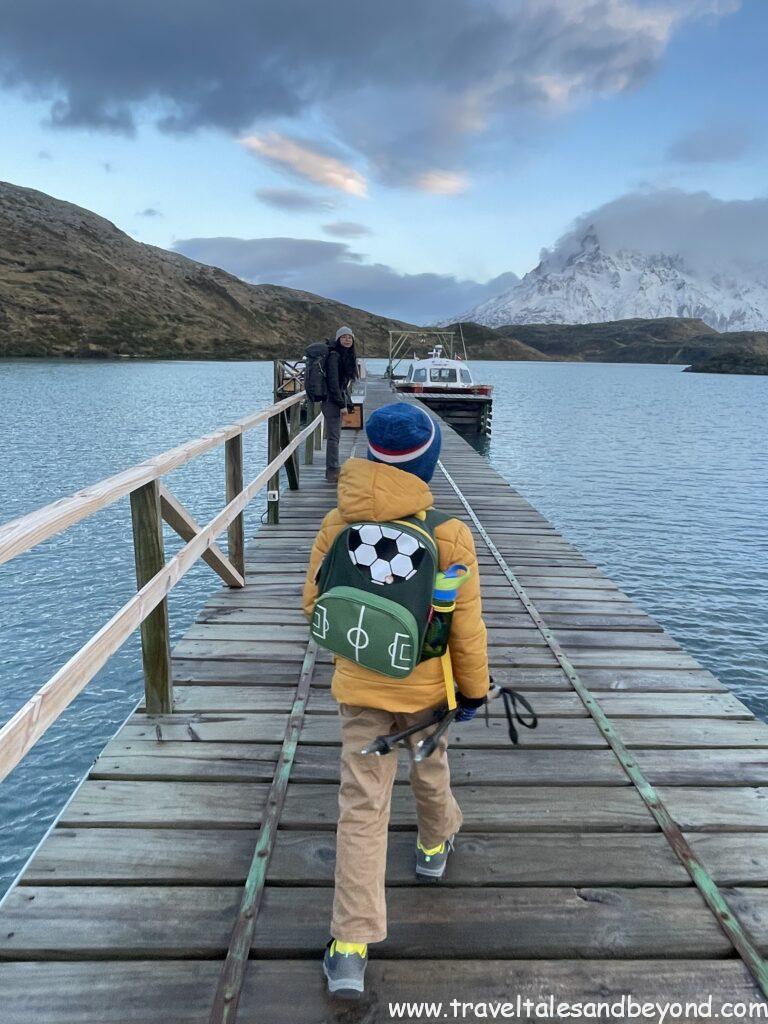
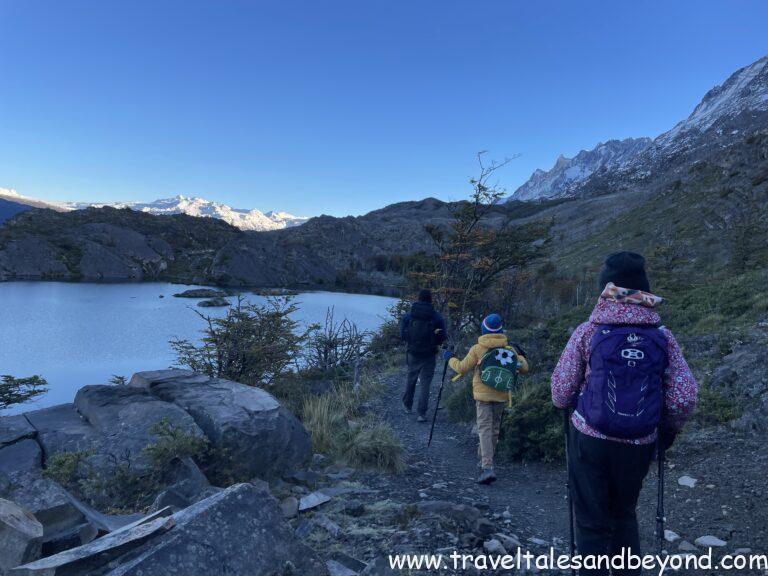
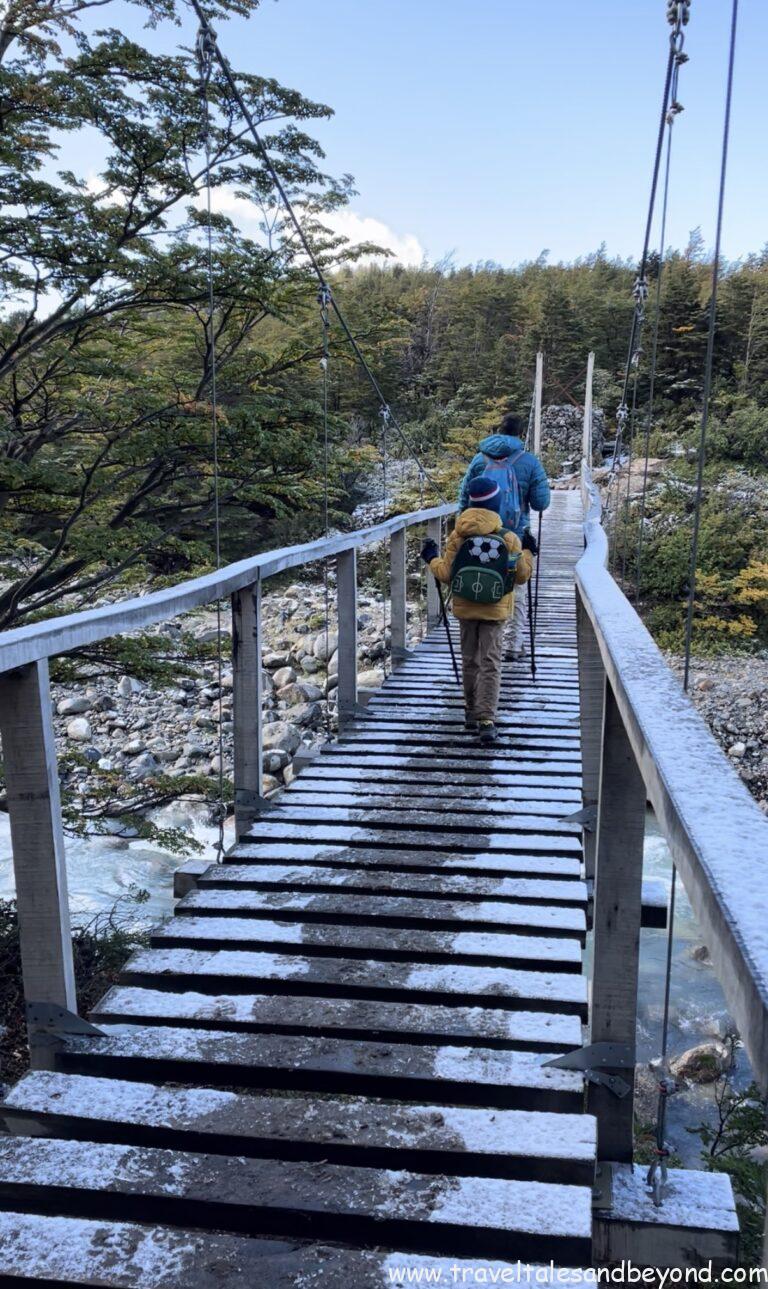
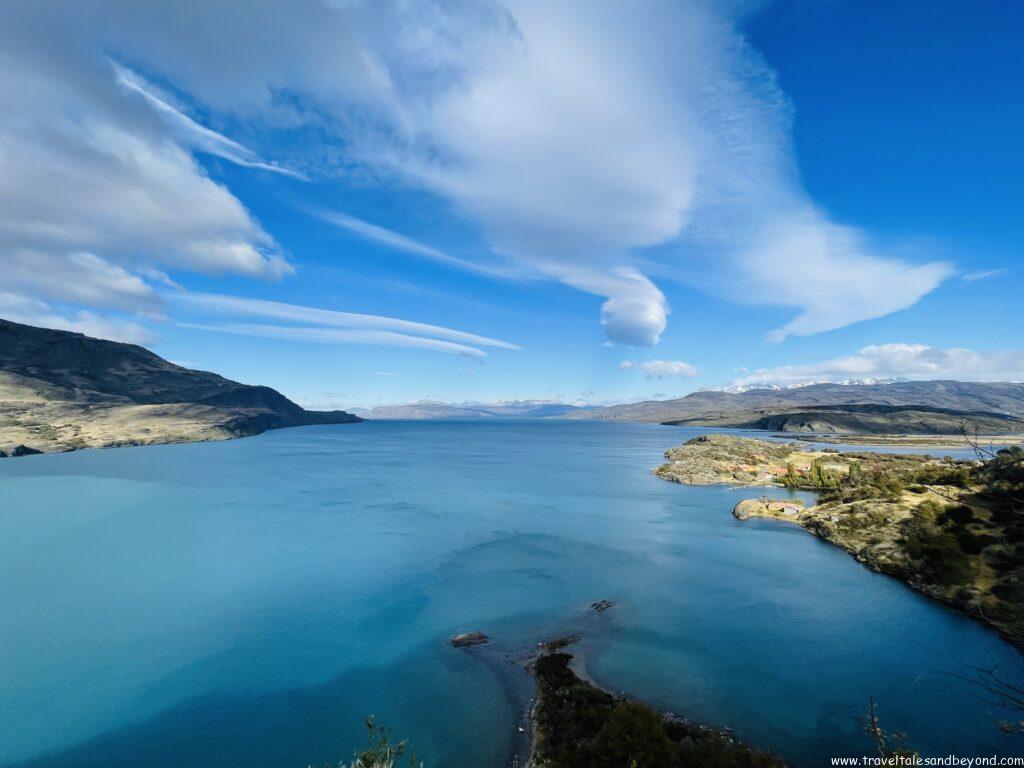
We met our guide Mona in the hotel lobby at 7:30am, hot lunch already packed in thermal boxes by the kitchen. A 20-minute boat ride from the hotel took us across the lake to the trailhead — the turquoise water of Lake Pehoé glittering in the early morning light, Paine Grande looming ahead. Even before the hiking started, the scenery was doing its job.
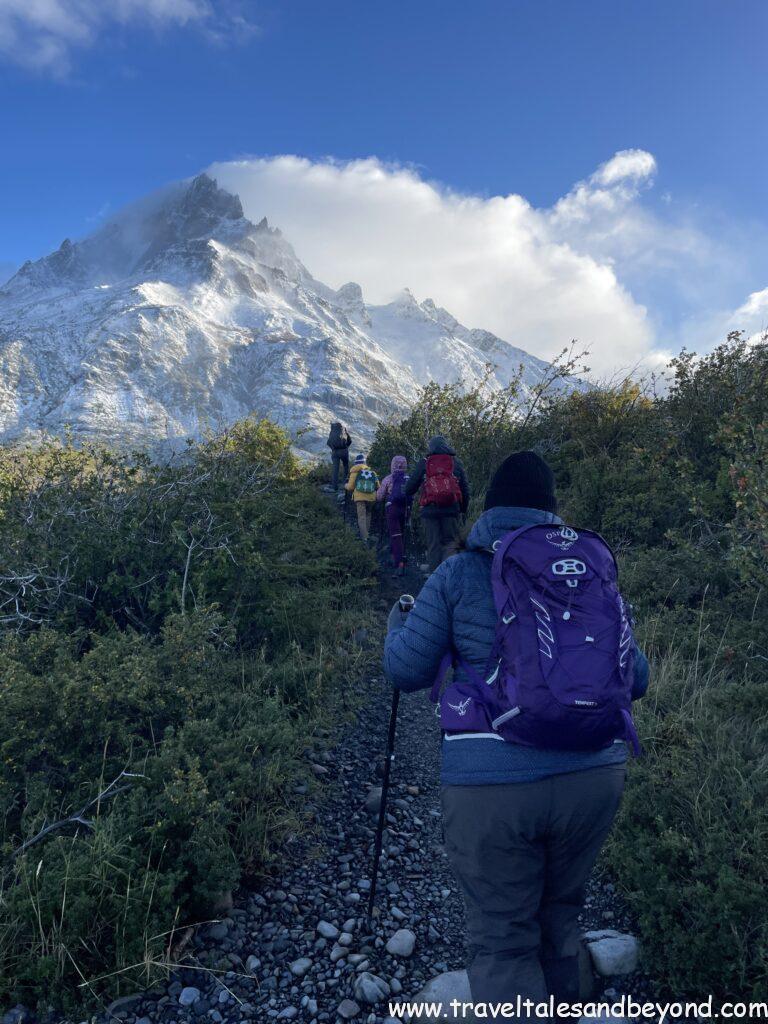
What kept our son engaged across 12 miles wasn’t any single dramatic view — it was the sheer variety of what the trail threw at him. Peaceful forest sections where the trail felt almost gentle. Rocky scrambles that required hands and feet. Wide open valley sections where the wind hit you full in the face and the scale of the landscape suddenly became real. For a child with a short attention span for anything that stays the same too long, the French Valley is perfectly designed. Something always changed before boredom could set in.
By the upper sections of the valley the landscape opened up completely — jagged peaks on both sides, hanging glaciers visible above the treeline, the valley floor dropping away below. At the mirador at the top he went quiet. Not tired-quiet — awestruck-quiet. The kind of silence that happens when a 9-year-old runs out of words for what he’s looking at.
Then the “how much further” questions started on the way back down.
By the time we reached the boat back to the hotel it was 6:30pm — a full ten-hour day. He was genuinely exhausted. He was also genuinely proud. That combination, for a child on his first serious hike, is exactly what you want.
For parents: The French Valley is the right first hike for kids in Torres del Paine. Not because it’s easy — it isn’t — but because the variety keeps children engaged across the distance. Pack more snacks than you think you need and accept that the last two hours will be slower than the first two.
Base of the Towers Day — The Smart Split
This is the day we’re most glad we handled the way we did — and the most useful thing we can tell other families.
The Base of the Towers hike is 14 miles with 900 meters of elevation gain. It’s the iconic Torres del Paine image — the three granite spires reflected in a turquoise lake at their base. It’s also the most physically demanding hike in the W Trek, with a brutal final ascent on loose scree.
After two days of serious hiking our son had earned an honest assessment. We made the call: my husband would do the full Base of the Towers hike. Our son and I would take the Los Bosques trail instead — a half-day hike through forest — followed by a Gaucho barbecue at an old barn.
This was not a disappointment. It was the right decision.
On the Los Bosques trail we found fresh puma footprints. For a 9-year-old, evidence that a mountain lion had recently walked the same path is significantly more exciting than most things in life. The barbecue at the barn — traditional Gaucho food, live music, dancing — turned into one of the highlights of the entire trip.
Meanwhile my husband completed the Base of the Towers in full and came back with photos that genuinely took our breath away.
The lesson: Having the flexibility to split your group is not a compromise. It’s smart trip management. The right operator makes this possible — a rigid group tour does not.
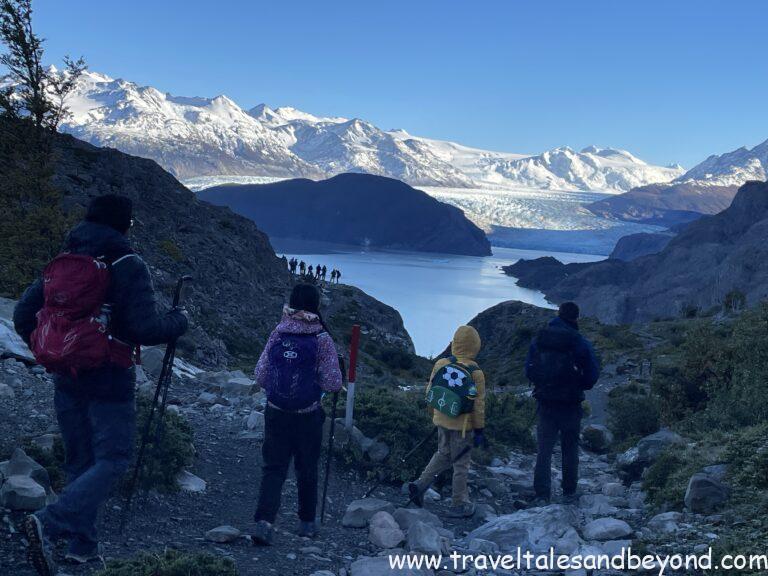
Glacier Grey Hike (7 miles one way) — Full Completion With Deadline Pressure
If the French Valley was the endurance test, Glacier Grey was the adventure.
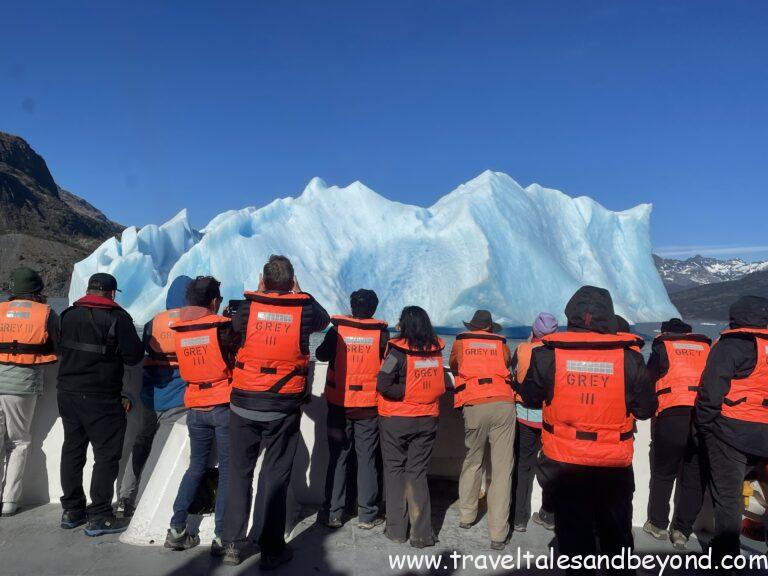
The hike itself is 7 miles one way — shorter than the French Valley but with a complication that added real stakes: a catamaran departure at 1pm that couldn’t be missed. Hike far enough by 1pm and you get a two-hour boat ride with up-close views of the glacier and floating icebergs. Miss the boat and you hike all the way back.
We explained this to our son before we started. It was, in retrospect, exactly the right motivational tool for a sporty 9-year-old. Suddenly this wasn’t just a hike — it was a race against a deadline.
He didn’t ask “how much further” once.
We made the catamaran with 15 minutes to spare. The two hours on the water — Glacier Grey rising above us, blue-white icebergs floating past at arm’s reach — was unlike anything we’d seen on the entire trip. For the adults it was awe-inspiring. For the kids it was, frankly, the coolest thing that had ever happened to them.
For parents: The catamaran deadline is genuinely useful for keeping kids motivated on this hike. Don’t hide it from them — use it. And make sure the timing is clear with your guide before you start
What Made It Work — Practically
This is the section we wish we’d found before we went. Not the inspirational stuff — the practical details that actually made a multi-day hiking trip with a 9-year-old in one of the world’s most remote national parks genuinely manageable.
The Guides Were Exceptional — And the Private Experience Made All the Difference
We had five different guides across eight days — Mona, Papo, Jon, Ginger, and our Knowmad Adventures guide who handled the city logistics. Every single one of them was exceptional with our son.
Because we were two families — a group of six — Hotel Explora assigned us a dedicated guide for our group on every hike. That meant every day in Torres del Paine was effectively a private guided experience. No keeping up with other travellers moving at a different pace. No waiting for a larger group at trail junctions. No compromising rest stops because twenty other people were ready to move on.
The guide set the pace entirely around our kids and our group’s energy. On the French Valley hike, when the “how much further” questions started in the final two hours, it was guide Mona who handled it best — not with false reassurance but with honest landmarks. “See that ridge? We rest there. Then two more sections after that.” Specific, truthful, manageable. A child can work with that in a way they can’t work with “not far now.”
That kind of individualized attention is only possible in a private or small-group setting. If you are traveling as a family with children, ask your operator explicitly whether your group will have a dedicated guide or join a shared group hike. The answer matters more than almost any other logistical detail.
You cannot replicate this experience with a self-guided trip. The guides are not a luxury — they are the infrastructure that makes this trip work for families.
His Friend Made the Difference on the Hard Days
Traveling with another family whose child is the same age as yours changes everything on a long hiking day. When our son’s energy dipped his friend pulled him forward. When his friend flagged our son returned the favour. The competition, the conversation, the shared experience of something genuinely hard — none of that is replicable with a parent walking beside them no matter how encouraging you are.
If you are considering Patagonia with a child under 11, our strongest practical advice is this: find another family with a child the same age and go together. It is not the same trip without it.
Snacks — More Than You Think, Better Than You’d Expect
Hotel Explora packed a hot lunch in a thermal box for every full-day hike. At altitude, in Patagonian wind, after four or five hours of serious hiking, a proper hot meal on the trail is genuinely transformative. Not just for children — for adults too. But for a 9-year-old it’s the difference between a child who finishes the afternoon strong and one who runs out of fuel entirely.
Beyond the hot lunch, snacks between breakfast and midday are non-negotiable. We carried granola bars, dried fruit, and nuts in our daypacks and distributed them at every rest stop without waiting to be asked. Don’t wait for your child to say they’re hungry — by the time they say it they’re already running low. Feed them before the wall hits.
The Flexibility to Choose Each Day’s Activity
Hotel Explora operates on a daily activity selection model — each evening guests choose from a menu of half-day and full-day options for the following day. For families this is invaluable.
It meant that after the French Valley’s exhausting 12 miles we could choose a scenic drive and shorter hike the next day to recover. It meant on the Base of Towers day we could split our group. It meant every day’s decision was made with knowledge of how our son had handled the previous day rather than being locked into a fixed itinerary decided months before.
Rigid group tours don’t offer this. It’s one of the most important questions to ask any operator before you book: can we adjust the daily activity based on how the group is feeling?
Early Dinners and Early Bedtimes — Non-Negotiable
Full-day hikes starting at 7:30am after big physical days require proper recovery. We enforced early dinners and early bedtimes without exception throughout the Torres del Paine section of the trip.
Break the rhythm once with a late night and you’ll feel it for two days. With children, probably three.
What Was Hard — The Honest Part
Every family travel post has a version of this section that reads like a disclaimer — a few token challenges quickly followed by reassurance that everything was wonderful really. This isn’t that.
The Distance Is Real — Don’t Underestimate It
Twelve miles sounds manageable on paper. On a Patagonian trail, starting at 7:30am and finishing at 6:30pm with wind, elevation change, and varied terrain, it is a full day of physical effort for an adult. For a 9-year-old it is a significant achievement — but only if you go in with honest expectations about what the last two hours will look like.
Our son’s version of struggle was not dramatic. He didn’t cry, didn’t refuse to walk, didn’t have a meltdown. He got quiet and asked “how much further” a few times. That was it.
The honest advice: don’t tell your child how long the hike is at the start of the day. Break it into sections with your guide. Let each landmark be the goal rather than the total distance. A 9-year-old who knows he has four miles left will struggle differently than one who knows he has one more ridge to the rest stop.
The Weather Is Relentless and Unpredictable
The French Valley gave us sunshine, rain, and snow — all in the same day. In the moment, when the wind changes and the temperature drops 15 degrees in twenty minutes at altitude, it requires immediate action — layers on, hoods up, pace adjusted.
We layered our son up proactively at every rest stop rather than waiting for him to feel cold — by the time a child says they’re cold they’ve been cold for twenty minutes.
The Patagonian wind specifically is in a category of its own. For a child with less body mass than an adult it’s more impactful. A good windproof outer layer is not optional.
7:30am Starts After Big Physical Days Are Hard
The accumulation of early starts after physically demanding days is something you feel by Day 4 or 5 in a way you don’t anticipate on Day 1. For children who need consistent sleep to function well, the rhythm of early dinners and early bedtimes isn’t optional — it’s the only way to sustain the schedule across five days.
Patagonia Is Remote — Adjust Your Expectations Accordingly
Torres del Paine is not a theme park with a hiking backdrop. It is a genuinely remote, genuinely wild national park where the weather makes decisions, not you. Flights get delayed. Trails get muddy. Plans change based on conditions.
We’d encourage every family to have an honest conversation with their children before the trip about what “things might change” actually means in practice. A child who understands this in advance handles it infinitely better than one who feels ambushed by it.
The One Thing We’d Do Differently
We wouldn’t change the trip. But if we went again we’d build in one fully rest day — not a scenic drive, not a short hike, just a morning at the hotel with the hot tub and the mountains. By Day 5 everyone’s body was asking for it. Schedule it more deliberately than we did.
Pack a Backup Pair of Kids’ Hiking Shoes — This Is Not Optional
Mid-trip our son’s hiking boot tore. Not a minor scuff — the sole started separating from the upper, mid-hike, in Torres del Paine National Park.
The hotel staff were wonderful — they glued the shoe back together and it held well enough to finish the trip. But we were lucky. Here is what you need to know before you pack:
There are no shoe shops inside Torres del Paine National Park. None. The hotel gift shop carried some footwear for adults — nothing for children. If your child’s hiking shoes fail and the hotel can’t fix them, you have a serious problem with no easy solution.
Pack a backup pair of kids’ hiking shoes or at minimum a sturdy pair of trail runners that could serve as a replacement. They don’t take much space and the cost of needing them and not having them — mid-hike, in a remote national park — is significant. This is the kind of thing that sounds obvious in retrospect and occurs to nobody before they leave home.
We’re telling you now so you don’t find out the same way we did.
His Personal Highlight — It Wasn’t the Hiking
Ask our son what his favourite part of Torres del Paine was and he won’t mention the French Valley mirador. He won’t mention the icebergs from the catamaran. He won’t mention the puma footprints on the Los Bosques trail, though those came close.
He’ll tell you about the horses.
Horseback Riding with the Gauchos
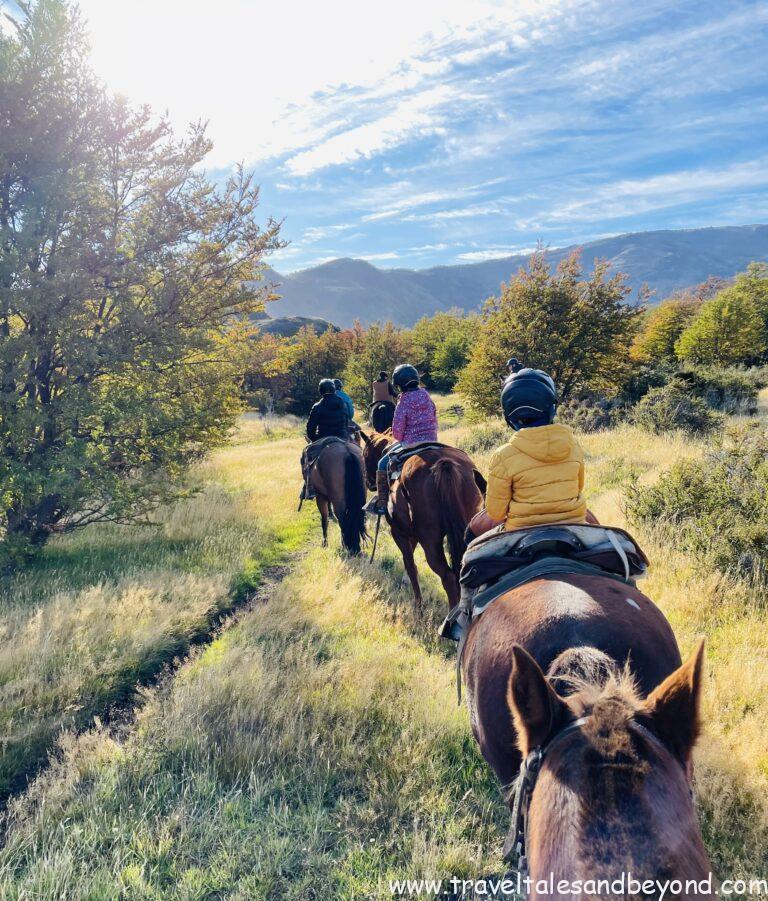
On our last morning in Torres del Paine, before our afternoon flight back to Santiago, Hotel Explora arranged horseback riding with the Gauchos — the Chilean cowboys who have worked this land for generations. The hotel drove us to the stables, the Gauchos fitted us with gear and gave us a brief introduction, and then we were on horseback moving through one of the most spectacular landscapes on the planet.
Horses follow each other naturally on the trail — the Gauchos and our guide Ginger kept the group together on the designated paths — which meant even a first-time rider felt secure and capable from the first few minutes. For our son, who had never ridden a horse seriously before, the combination of the animal, the landscape, and the Gaucho culture was completely captivating.
An hour on horseback in Patagonia. Simple, unhurried, unlike anything else in the trip.
He talked about it for the entire flight home.
What This Tells You About Traveling with Kids
We planned this trip around three major W Trek hikes. We researched elevation gains and trail distances and catamaran departure times. The hiking was the point. The hiking was the whole conversation for months before we left.
And his favourite memory was one hour on a horse.
Children experience travel on a completely different frequency from adults. The things that move them most are rarely the things you planned most carefully. The puma footprints on a trail we chose as the easier option. The Gaucho who showed him how to hold the reins. The friend beside him on every trail who made the hard days feel like an adventure rather than an ordeal.
Build in the horseback riding. Do the barbecue at the old barn. Let the Gauchos show your child something that has nothing to do with granite towers or glacier lakes. Those are the stories they’ll tell.
The Gaucho Barbecue — Worth Its Own Mention
On Day 5 while my husband tackled the Base of the Towers, our son and I finished the Los Bosques trail at an old barn that Hotel Explora uses for a traditional Gaucho barbecue lunch. Fire-grilled meat, traditional Chilean sides, live music — a genuine local cultural experience in a weathered barn in the middle of Patagonia. Not a tourist show. The real thing.
For our son it was a window into a way of life completely unlike anything he’d seen before — the Gauchos, the horses, the fire, the landscape outside the barn door. He was completely absorbed.
If your operator offers this experience — take it. It is a highlight in its own right, not a consolation prize for the day you don’t do the big hike.
The Operator Question — Why It Matters More Than Anything
Our Honest Position
We are not sponsored by either company. Nobody asked us to write this. We’re telling you about Knowmad Adventures and Hotel Explora because without them this trip would have been a fundamentally different — and significantly harder — experience for our family.
What Knowmad Adventures Did
Knowmad Adventures handled everything outside of Hotel Explora — Santiago logistics, Valparaíso day trip, airport transfers, domestic flights to Puerto Natales, and the overall trip architecture.
What that meant in practice: we arrived in Santiago and were met by our guide. Every transfer across the entire trip happened without us having to think about it. For a family traveling with a child across multiple cities and a remote national park in a country where Spanish is the primary language, this kind of seamless logistics management is not a small thing.
What to ask any operator before booking:
- Do you have experience specifically with families and children?
- Can we adjust daily activities based on how the group is feeling?
- What happens if a child can’t complete a planned hike — is there a backup option?
- Are guides assigned to our family specifically or shared across a large group?
What Hotel Explora Did
Hotel Explora is all-inclusive — accommodation, all daily activities, all guiding, all meals including packed trail lunches. For five nights inside Torres del Paine National Park it handled every logistical detail of the hiking portion of our trip.
Here is what that specifically meant for traveling with a child:
Daily activity flexibility. Each evening we chose the next day’s activities from a menu of options. No fixed itinerary. Every decision made with knowledge of how our son had handled the previous day.
Named, consistent guides — and for us, a private experience. We had Mona, Papo, Jon, and Ginger across five days. Because we were two families — a group of six people — Hotel Explora assigned us a dedicated guide for our group. That made every hike a private guided experience. No keeping up with other travellers at a different pace. No waiting for a larger group to catch up. No compromising on rest stops or snack breaks because the group dynamic required it. The guide set the pace entirely around our two kids and our group’s energy levels that day. For families with children this is a significant advantage — and worth specifically asking about when you book. A group of six with a private guide is a completely different experience from joining a shared group hike.
Hot meals on every trail. The thermal lunch boxes on full-day hikes were not a minor detail. A hot meal at altitude after five hours of hiking in Patagonian wind is the single most effective child-energy intervention we’ve ever experienced.
Dietary restrictions handled without friction. I mentioned mine once at check-in. The chef accommodated them at every single meal for five days without being asked again.
Location inside the park. Being inside Torres del Paine means trailheads are minutes away. For a child who has already had a long hiking day, not facing a two-hour transfer back to accommodation outside the park is a genuine quality of life difference.
The Cost Reality
Hotel Explora is expensive — approximately $5,800 per adult and $1,050 per child for five nights all-inclusive. Total trip cost for our family of three including Knowmad Adventures was approximately $14,500 excluding international flights.
For a family attempting this level of hiking in this level of remoteness with a child, the all-inclusive model isn’t a luxury — it’s infrastructure. If the budget is the constraint, the honest advice is to wait until you can do it properly rather than attempt it with inadequate support.
The One Question That Matters Most
Before you book any operator for Patagonia with kids, ask them this:
“Tell me about a family with a child under 10 that you’ve taken to Torres del Paine. What did you do differently for them and how did it go?”
A good operator will have a specific story. A great operator will have several.
What Age Is Right for Patagonia with Kids?
Age is only one part of the answer. Here’s our honest framework.
Under 7: Full W Trek hikes are not realistic for most children this age. Scenic drives, shorter nature walks, and the Gaucho horseback riding are accessible and spectacular — but if hiking the W Trek is the goal, wait.
7 to 9: Possible — but only with significant caveats. The child needs to be physically active, genuinely enthusiastic, and temperamentally flexible. An all-inclusive operator with daily activity flexibility is essential. Our strongest advice: bring another family with a child the same age.
10 to 12: The sweet spot. Old enough to handle full-day hikes with genuine stamina. Old enough to understand what they’re seeing. Young enough that the sense of wonder is still completely intact. If you have a child in this age range who loves being outdoors, stop hesitating and start planning.
13 and above: The conversation shifts from “can they handle it” to “do they want to come.” Teenagers who are genuinely interested will have an extraordinary experience. Teenagers brought along reluctantly will make everyone’s trip harder.
The Better Questions to Ask
Age is the wrong filter. Ask these instead:
Is your child physically active by choice — not just tolerant of activity? There’s a difference between a child who will reluctantly participate and one who genuinely seeks adventure. Patagonia rewards the second type.
How does your child handle discomfort? Cold, wind, tired legs, changed plans, early mornings. These are guaranteed. A child who reframes discomfort as adventure will thrive. One who can’t will struggle regardless of age.
How does your child respond to new adults in authority? The guides are central to making this trip work. A child who engages naturally with Mona’s pacing strategy or Ginger’s horse instructions gets so much more from the experience.
Do you have another family with a same-age child to bring? We keep coming back to this because it made such a tangible difference. If the answer is yes, almost everything else becomes more manageable.
Our Honest Age Recommendation
The minimum realistic age for the full W Trek experience with the right operator and the right child is 8. Below that, adjust the hiking ambitions significantly.
Our son was 9, sporty, adaptable, had done moderate Pacific Northwest hikes, and had a same-age friend beside him every step of the way. All of those factors together made it work. Remove any two of them and the trip would have looked different.
Be honest with yourself about your child. That honesty — more than any age guideline — is what will determine whether this trip is the experience of a lifetime or a very long, very windy, very expensive hard day.
Our Honest Verdict
Patagonia with kids is one of the best decisions we’ve ever made as a family. It is also one that required more careful thought, better planning, and more honest self-assessment than almost any trip we’ve taken.
It Is Doable — But Not For Every Child or Every Family
Our son completed two of the three main W Trek legs on his first serious hiking trip — French Valley (12 miles) and Glacier Grey (7 miles one way). On Base of the Towers day we split the group, which turned out to be one of the best decisions of the trip. He rode horses with Gauchos on his last morning. He found puma footprints on a trail we chose as the easier option. He asked “how much further” on the French Valley and kept walking anyway. He came home already asking where we’re hiking next.
That outcome didn’t happen by accident. It happened because of who he is, because of the friend beside him every day, because of guides who knew exactly how to handle a 9-year-old at mile ten of a twelve-mile trail, because we made the smart call to split the group on Base of the Towers day, and because we chose an operator whose infrastructure made the ambitious days possible without ever feeling unsupported.
Remove any of those elements and the story might have been different.
The Five Things That Made It Work
1. Choose the right operator — it’s the single most important decision. Not the most scenic lodge, not the cheapest option. The operator whose guides are exceptional with children, whose daily schedule is flexible, and whose meals on the trail are hot and substantial. And specifically ask whether your group will have a dedicated guide — for families with children a private guided experience changes everything.
2. Bring another family with a same-age child. Two kids together in Torres del Paine is a fundamentally different experience from one child surrounded by adults. Find your people and go together. A group of six also means you’re more likely to get a dedicated private guide.
3. Be honest about your child before you book. Physically active by choice. Flexible when plans change. Responsive to new adults. Able to reframe discomfort as adventure. These traits determine success in Patagonia more than age or fitness level alone.
4. Build in the non-hiking experiences. The Gaucho horseback riding. The barbecue at the old barn. The scenic drive on the slower day. These aren’t consolation prizes — they are the experiences your child will talk about most when they get home. Plan them deliberately.
5. Keep the rhythm — early dinners, early bedtimes, no exceptions. Five days of serious hiking starting at 7:30am requires consistent recovery. The discipline is boring. The results are not.
6. Pack a backup pair of kids’ hiking shoes. Our son’s boot tore mid-trip. The hotel glued it. There are no shoe shops inside Torres del Paine and the gift shop only carries adult sizes. A backup pair of kids’ trail shoes takes minimal space and could save your trip.
Would We Do It Again?
Without hesitation.
We’d book the same operator. We’d bring the same family. We’d do the French Valley first again, split the group on Base of the Towers day again — and feel just as good about that decision — and race the catamaran on Glacier Grey again.
The one thing we’d add is a full rest day mid-trip. Not a shorter hike — a genuine rest. Hot tub, mountains, nothing scheduled. Our bodies asked for it by Day 5. Next time we’ll listen earlier.
The Last Thing
There is a moment on the French Valley hike when the trail climbs above the treeline and the valley opens up completely in front of you. Jagged peaks on both sides, hanging glaciers above, the turquoise lake far below, Patagonian wind in your face.
Our son went quiet.
Not tired-quiet. Not bored-quiet. The particular silence of a child who has run out of words for what he’s looking at — standing at the top of something genuinely hard that he got to entirely by himself, seeing something that most people never see in their lifetime.
That moment cost us fourteen thousand dollars and eight days of planning and five early mornings and several rounds of “how much further.”
It was worth every single part of it.
For the complete day-by-day itinerary, cost breakdown, and everything you need to plan this trip, read our full 1 Week in Patagonia guide →
Pin this post for your Patagonia family travel planning!
More family adventure travel: Tanzania Safari with Kids | Australia 14-Day Itinerary| Costa Rica – A 10 day trip to the Central American paradise
If you liked reading this post here are few others
- Spain – Barcelona, Valencia, Seville, Madrid
- Tanzania – A 7-day trip to African safari
- Chile – A week long trip to breathtaking Patagonia
- Prague – A 2 day escape to Bohemian beauty
- Gibraltar – A day trip from Spain
- Fiji – A four-day stopover
- Turkey – A 10 day trip to Istanbul and Cappadocia region
- Germany – Berlin, Dresden, Nuremberg
- Portugal – A week long trip to Lisbon, Porto, Nazare, Duorro valley
- Belgium – Brussels, Bruges, Ghent, Dinant
Shaminee is a U.S.-based mom and family travel blogger who designs detailed itineraries for her own family and turns them into practical guides for others. Her goal is to make family travel simpler, more organized, and more enjoyable.
Read more →
Discover more from Travel Tales And Beyond
Subscribe to get the latest posts sent to your email.